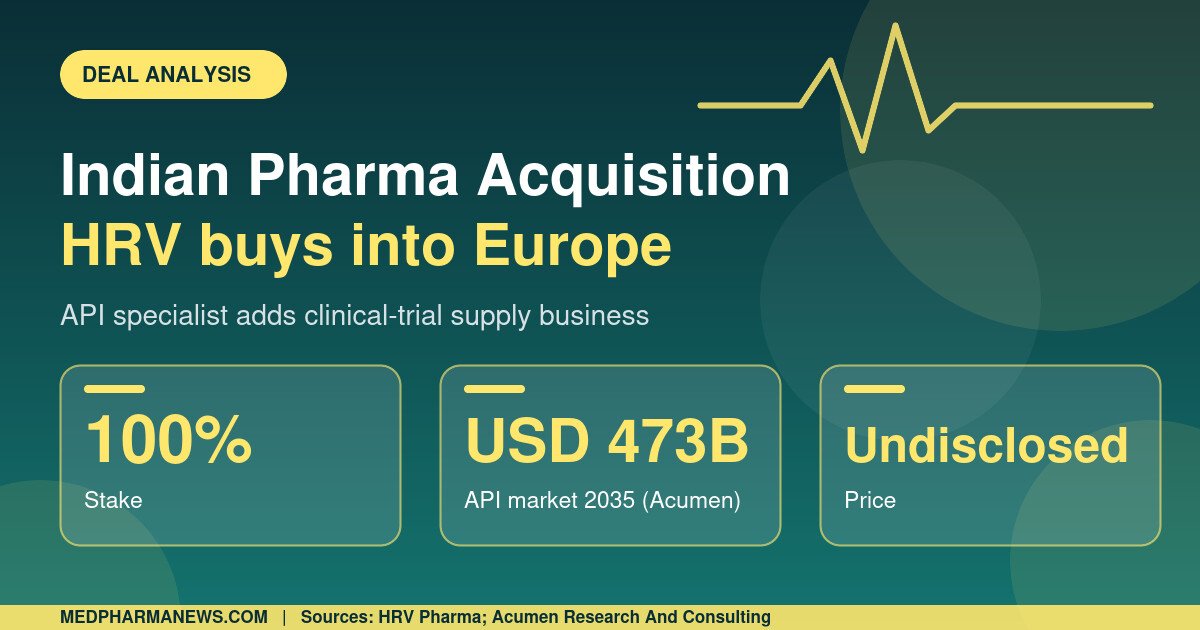
An Indian pharma acquisition announced on 3 November 2026 shows an ingredient specialist reaching into services: Hyderabad-based HRV Pharma has signed definitive agreements to buy 100% of Phatebo GmbH, a German company that sources comparator, investigational and ancillary medicines for clinical trials. The price, financing and closing date have not been disclosed. The company’s chief executive, Hari Kiran Chereddi, called it HRV’s first finished formulations business. This business analysis looks at the strategic rationale, the numbers that are known and the risks, and it is not investment advice.
Key takeaways on the Indian pharma acquisition
- Target: Phatebo GmbH, Hilzingen, Germany, with revenue of about ₹350 crore in 2025.
- Seller: ZeroStack Corp.; stake: 100%; price and closing date: not disclosed.
- Buyer: HRV Pharma, API-focused, asset-light, with customers in 55 countries and 50-plus partner plants.
- Management: Martin Lisker and the team continue; the Phatebo name and customer agreements are kept.
- Nuance: Phatebo distributes medicines for trials and does not manufacture them.
The strategic logic
HRV’s model is asset-light and intellectual-property-led, meaning it relies on partner manufacturers rather than owning plants. Phatebo is also an asset-light, service-style business: it sources and distributes medicines under a wholesale authorisation and good distribution practice. The fit is therefore consistent with HRV’s preference for capital-light models, and it gives the company a European base and exposure to the clinical-trial sponsor market. It also moves HRV from selling ingredients to handling finished medicines, though not to making them.
Why services niches attract ingredient companies
Ingredient supply is a competitive, price-sensitive business in which customers can switch suppliers on cost. A regulated services niche such as trial supply offers a different profile: customers pay for reliability, compliance and speed, switching costs can be higher because sponsors do not want to change vendors mid-trial, and revenue is linked to the volume of clinical research and not to commodity pricing. These are general features of such businesses and not disclosed facts about Phatebo, whose margins and customer terms were not published. They do, however, explain why a company like HRV might see strategic value in the niche.
What the numbers say
| Item | Detail |
|---|---|
| Phatebo 2025 revenue | About ₹350 crore |
| HRV offices | India, US, Netherlands, Dubai, Mexico, Turkey |
| HRV partner plants | More than 50 with US FDA or EU-GMP approvals |
| HRV customer countries | 55 |
| Price | Not disclosed |
| Closing date | Not disclosed |
Without a price, no valuation multiple can be calculated. We therefore do not estimate one. The only financial figure is Phatebo’s revenue, about ₹350 crore, and the company did not disclose HRV’s own revenue in the material we reviewed, so the relative size of the two cannot be assessed.
Questions to ask when the price is undisclosed
- How is the deal funded, from cash, debt or new equity?
- What conditions, such as regulatory clearances, must be met before closing?
- What are Phatebo’s margins and how concentrated is its customer base?
- Is any part of the price contingent on future performance?
- Does HRV intend to build formulation manufacturing, or stay in distribution?
Risks (our framing)
- Compliance: distribution licences and quality standards must be maintained through the transition.
- Integration: combining an Indian ingredient company with a German service business, across time zones and regulatory systems.
- Customer concentration: trial-supply revenue can depend on a few large sponsors and contract research organisations.
- Trade and logistics: movement of medicines across borders is exposed to customs, currency and transport disruption.
- Strategy clarity: the deal does not by itself create formulation manufacturing capability.
Scenarios (illustrations, not forecasts)
If integration goes smoothly, HRV could cross-sell its ingredients and partner-made products to Phatebo’s customers, although the announcement does not say that this is the plan. If Phatebo’s customers are cautious about the change in ownership, retention could be tested during the transition, which is why continuity of management matters. A third possibility is that the deal is a first step toward a broader formulations strategy; the company has not said so, and we do not assume it.
Timeline
- 2015: HRV Pharma and Phatebo founded.
- 2025: Phatebo revenue of about ₹350 crore.
- 3 November 2026: definitive agreements announced.
- Later: closing and integration.
Market context
According to Acumen Research And Consulting, the global active pharmaceutical ingredient market was USD 255.47 billion in 2025 and is projected to reach USD 473.20 billion by 2035, a compound annual growth rate of 6.3% for 2026 to 2035, with North America above 39%, Asia-Pacific about 25% and growing at 8.5%, and Europe about 22%. Merchant APIs held 58% and generic APIs 34% in 2025. By our calculation the endpoints imply about 6.4%. The report header says the forecast runs to 2036 while the title says 2035. It describes HRV’s core ingredient market and not clinical-trial supply.
Our analysis
In our assessment, the acquisition is a diversification move that fits HRV’s asset-light style. Its value will depend on the price paid, Phatebo’s margins and customer retention, none of which is public. The market for ingredients is growing at a steady rate, but the report does not measure the trial-supply niche. We make no forecast of earnings or share price.
What is not disclosed
- Price and financing.
- Closing conditions and date.
- Phatebo’s profit and customer concentration.
- HRV’s own revenue and strategic plan for the unit.
Risks and caveats
- Deal signed, not closed.
- Figures are company-reported.
- Market data are indicative.
- This article is not investment advice.
What to watch next
- Closing.
- Financial disclosure.
- Customer retention.
- Further acquisitions or partnerships.
General background
Related coverage: Laurus Labs’ CDMO-driven results. The European framework is described by the European Medicines Agency and BfArM. More in the pharmaceuticals section.
Questions readers are asking about the Indian pharma acquisition
What is HRV buying?
100% of Phatebo GmbH, a German clinical-trial medicine supply company.
How much is it paying?
Not disclosed.
Does HRV now make finished medicines?
No. Phatebo sources and distributes medicines and does not manufacture them.
FAQ
What does asset-light mean?
Relying on partners rather than owning plants.
What is a comparator?
An existing medicine used as a standard in trials.
What is GDP?
Good distribution practice.
How we reported this: details come from the HRV Pharma announcement of 3 November 2026 as reported in trade and business press; market figures are attributed to Acumen Research And Consulting; calculations marked as ours are our own. Last updated 5 November 2026. This is news reporting and not investment advice.