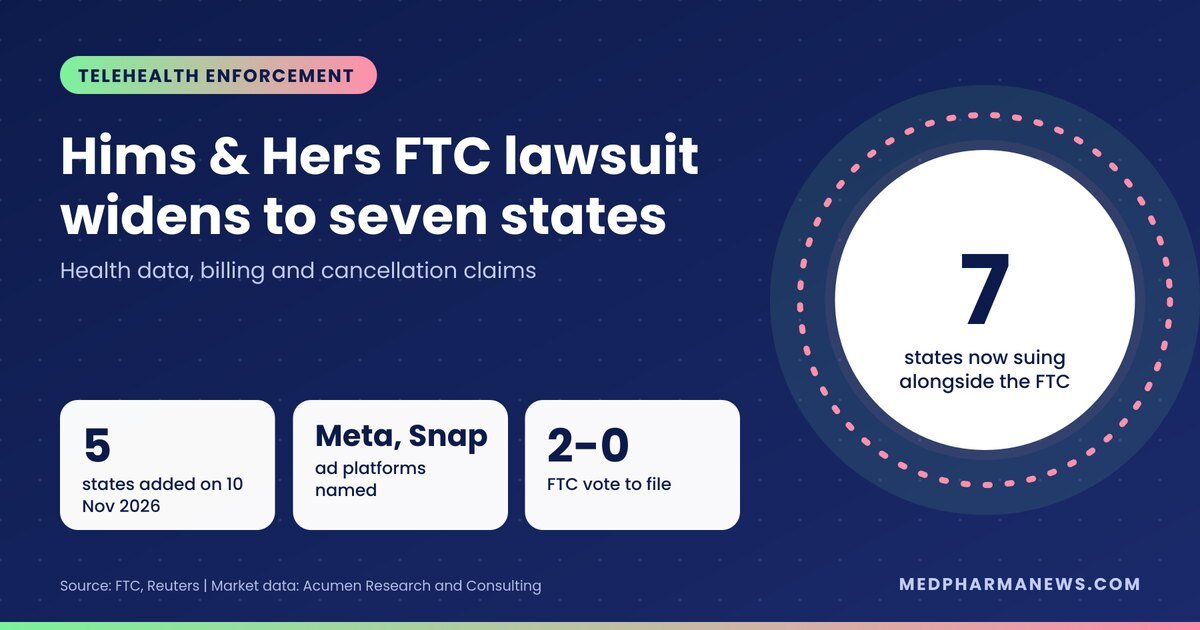
The Hims & Hers FTC lawsuit got bigger on 10 November 2026, when Arizona, Florida, Nebraska, Ohio and Wisconsin joined the Federal Trade Commission’s case accusing the telehealth company of sharing customers’ sensitive health information with advertising platforms such as Meta and Snap, charging for prescriptions before patients saw a clinician, and making subscriptions hard to cancel. The amended complaint, filed in the US District Court for the Northern District of California, means seven states plus the FTC are now suing. Hims & Hers says it will fight the claims.
For investors and for the wider direct-to-consumer health sector, the expansion turns a single federal case into a multistate enforcement action with added state-law exposure. Here is what the complaint alleges, what it does not yet show, and why other telehealth brands should be paying attention.
Key takeaways on the Hims & Hers FTC lawsuit
- Five states joined on 10 November, adding to Utah and California (through Los Angeles County Counsel), which joined the original July filing.
- The FTC voted 2-0 to file the amended complaint, case number 3:26-cv-07871 in the Northern District of California.
- Claims rest on the FTC Act, the Restore Online Shoppers’ Confidence Act (ROSCA) and seven states’ consumer protection laws.
- The core allegations cover health data sent to ad platforms, charges triggered by intake forms, and a buried cancel button.
- Hims & Hers calls the new filings follow-on claims built on the same flawed allegations and says it will defend itself.
- These are allegations; no court has ruled on them.
Case timeline at a glance
| Date | Event | Plaintiffs |
|---|---|---|
| 29 Jul 2026 | Original complaint filed | FTC, Utah, California (via LA County Counsel) |
| 31 Aug 2026 | Complaint version listed on FTC case page | Same |
| 10 Nov 2026 | First amended complaint filed | FTC plus Arizona, Florida, Nebraska, Ohio, Wisconsin, Utah, California |
The three sets of allegations, explained
1. Health data shared with ad platforms
The FTC says Hims promised to protect patient privacy but passed information about consumers’ medical conditions to third parties including Meta and Snap. According to the agency’s July announcement, this happened two ways: by uploading lists of certain customers to advertising platforms, and through tracking tools on its website that automatically sent visitor actions, known as events, to those companies. For a business whose products cover weight loss, erectile dysfunction, hair loss and mental health, the inference that someone visited or bought from a given page can itself reveal a diagnosis.
2. Charged before a clinician weighed in
Hims marketed the idea that customers could connect with a provider to find a treatment “right for them” and would not be charged until medication was prescribed. The FTC alleges most customers never had a real consultation; submitting the intake form led to near-immediate charges and enrolment in a recurring plan, without a chance to review the treatment first.
3. A cancel button that was hard to find
Before 2023, the complaint says, most customers could cancel only by phone, email or chat. After an online option arrived, it allegedly appeared only after users chose an option to add or remove items from an order and worked through several more steps. Refill dates were also not clearly disclosed, which the FTC says made it hard to stop the next charge in time. ROSCA is the federal law that covers this kind of negative-option billing.
Why five more states raise the stakes
State attorneys general bring their own consumer protection statutes, which can carry separate civil penalties and remedies on top of what the FTC can seek. Each additional state also adds its own investigators and settlement demands, which tends to make any eventual resolution larger and more prescriptive. The amended filing seeks a permanent injunction, monetary and civil penalty judgments and declaratory relief, according to its title on the FTC docket; the exact amounts are not stated in the public summaries.
The timing is awkward for the company. Reuters reported that a day earlier Hims cut its full-year core profit forecast, citing costs tied to a shift toward branded weight-loss drugs and international expansion. The legal action adds another overhang as the company launches new categories such as compounded peptides and branded GLP-1 access.
What it signals for telehealth and subscription health brands
This case sits at the intersection of two enforcement priorities: health data flowing to ad-tech, and subscriptions that are easy to join but hard to leave. Any direct-to-consumer brand that runs pixel-based advertising on condition-specific pages, or that bills on intake rather than on a prescriber’s decision, has reason to audit its flows now. We looked at the economics of that model in our analysis of prescription subscription plans and at how rivals are moving clinical work in-house in our piece on Ro’s Robin AI health agent.
- Data: Remove or tightly configure third-party trackers on pages that reveal a condition or treatment.
- Billing: Charge after clinical review, and show the price, refill date and recurring nature before checkout.
- Cancellation: Make online cancellation as simple as sign-up.
Market context
The scrutiny follows rapid growth. Acumen Research and Consulting estimated the global telehealth market at USD 84.1 billion in 2022 and projects USD 716.5 billion by 2032, a compound annual growth rate of 24.2%, with North America the largest region and services the biggest component. As more care is bought online, regulators are treating marketing data and checkout design as patient-protection issues rather than only advertising questions.
What is still unknown
- The specific data fields shared with each platform have not been detailed in the FTC’s public statements.
- The penalty amounts sought and the number of affected customers have not been disclosed publicly.
- No trial date or ruling on any motion has been announced.
Further industry analysis is available in our Industry Insights section.
FAQ
Why is the FTC suing Hims & Hers?
The FTC alleges Hims shared sensitive health information with advertisers despite privacy promises, charged customers before any clinician review, and made subscriptions hard to cancel. Hims denies wrongdoing.
Which states joined the Hims & Hers lawsuit?
Arizona, Florida, Nebraska, Ohio and Wisconsin joined on 10 November 2026. Utah and California, through Los Angeles County Counsel, were part of the original July complaint.
Can Hims & Hers customers get a refund?
Not yet. The complaint seeks monetary relief, but refunds would only follow a settlement or court order. Customers can contact the company directly about billing disputes in the meantime.
Is Hims & Hers still operating?
Yes. The lawsuit does not stop the company from operating, and it continues to sell treatments and launch new products while the case proceeds.
Sources: FTC press release, 10 Nov 2026; FTC case page; FTC press release, 29 Jul 2026; Reuters. Market data: Acumen Research and Consulting. Allegations have not been proven in court. Not legal or investment advice. Last updated 12 November 2026.