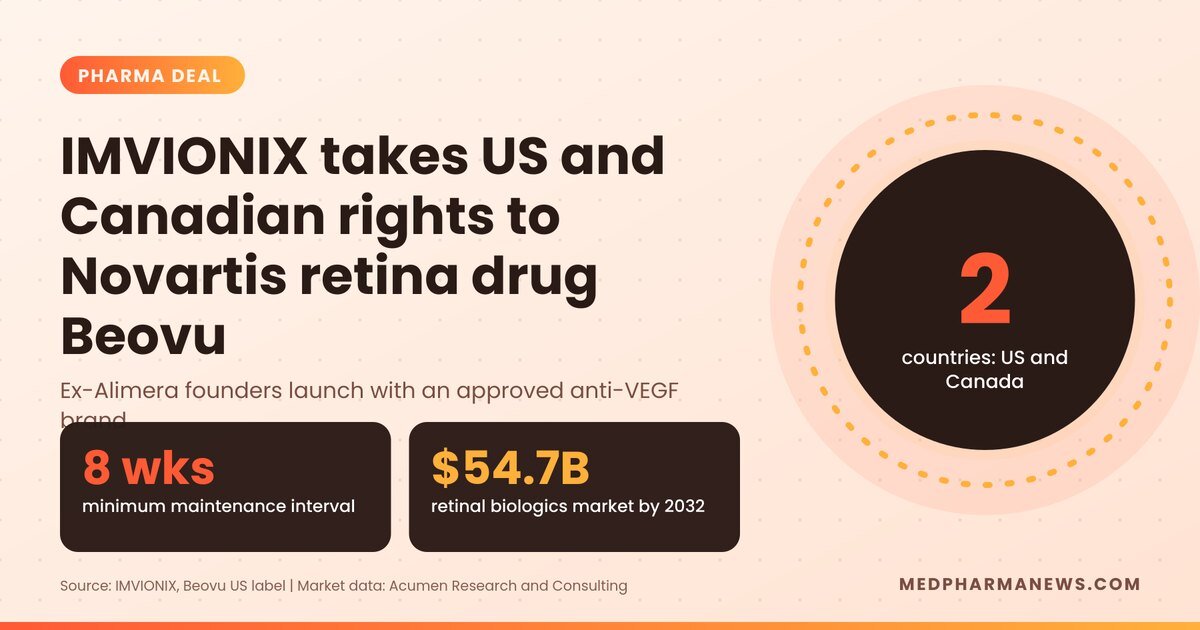
The IMVIONIX Beovu acquisition, announced on November 10, 2026, moves Novartis’s retinal injection Beovu (brolucizumab-dbll) to a newly launched, privately held ophthalmology company in Georgia. IMVIONIX takes exclusive US and Canadian commercial rights and becomes the marketing authorization holder in both countries. Financial terms were not disclosed. For Novartis it is another step away from a once-promising brand; for IMVIONIX, founded in 2025 by former Alimera Sciences executives, Beovu is the first product and the company’s official debut.
Key takeaways on the IMVIONIX Beovu acquisition
- IMVIONIX acquired exclusive US and Canadian rights to Beovu from Novartis; the price was not disclosed.
- Beovu is approved for wet age-related macular degeneration (nAMD, US 2019) and diabetic macular edema (DME, US 2022).
- The founders are former Alimera Sciences leaders, backed by Caligan Partners with Velan Capital as a collaborator.
- Beovu’s label carries warnings for retinal vasculitis and retinal vascular occlusion, and maintenance doses must be at least 8 weeks apart.
- No transition date, pricing or sales targets were announced.
Who IMVIONIX is
IMVIONIX is based in Peachtree Corners, Georgia. Founder and chief executive Rick Eiswirth previously ran Alimera Sciences, the retina company behind the Iluvien steroid implant, alongside co-founders Jason Werner, Todd Wood and Elliot Maltz. The team cites about 60 years of combined ophthalmology experience. Caligan Partners, an activist-leaning healthcare investor, and its investors funded the Beovu deal. In the company announcement, Eiswirth said IMVIONIX is “well capitalized to execute on our mission” and plans to add further retina therapies.
The model is familiar in specialty pharma: a focused sales force buys a mature, approved product that a large company no longer prioritises and re-markets it to a narrow prescriber base, here retina specialists. The bet is that concentrated attention can stabilise or grow a brand that a global portfolio left behind.
Beovu’s clinical profile at a glance
Brolucizumab is a humanized single-chain antibody fragment that blocks VEGF-A. Its small size allows a high molar dose (6 mg in 0.05 mL), which underpinned its pitch for longer intervals between injections. In head-to-head trials it matched aflibercept 2 mg on vision gains.
| Trial | Condition | BCVA gain, Beovu | BCVA gain, aflibercept | Difference (95% CI) |
|---|---|---|---|---|
| HAWK (Week 48) | nAMD | +6.6 letters | +6.8 letters | -0.2 (-2.1 to 1.8) |
| HARRIER (Week 48) | nAMD | +6.9 letters | +7.6 letters | -0.7 (-2.4 to 1.0) |
| KESTREL (Week 52) | DME | +9.2 letters | +10.5 letters | -1.3 (-2.9 to 0.3) |
| KITE (Week 52) | DME | +10.6 letters | +9.4 letters | +1.2 (-0.6 to 3.1) |
Per the US label, nAMD dosing starts with three monthly injections, then every 8 to 12 weeks. DME starts with five injections six weeks apart, then every 8 to 12 weeks.
The safety history that shaped the brand
Beovu’s commercial trajectory changed after reports of retinal vasculitis and retinal vascular occlusion, immune-mediated events that typically occur alongside intraocular inflammation and can follow the first injection. The label now tells physicians to stop treatment in patients who develop them. The MERLIN study added a second constraint: patients given maintenance doses every 4 weeks had more inflammation and occlusion than those dosed every 8 or 12 weeks, so the label states that maintenance doses should not be given less than 8 weeks apart. Those limits, combined with strong competition, are the context any new owner inherits.
Market context
The opportunity is still large. Acumen Research and Consulting values the global retinal biologics market at USD 21.6 billion in 2022 and projects USD 54.7 billion by 2032, a 9.9% CAGR, with VEGF-A antagonists holding the largest share and North America the leading region. By our calculation that is roughly 2.5 times growth over the decade. Acumen also cites National Institutes of Health estimates of about 200 million people with AMD worldwide, projected to reach 300 million by 2040.
A small share of a market that size can sustain a focused company. The challenge is that the anti-VEGF field is crowded with established brands, longer-acting options and incoming biosimilars, so IMVIONIX will need to define where Beovu fits for retina specialists. Read our related coverage of ophthalmic drug delivery systems and Novartis’s Q3 2026 results.
What to watch next
- Transition timing: when IMVIONIX takes over distribution, labeling and pharmacovigilance from Novartis.
- Pricing and contracting: whether the new owner competes on price or payer access.
- Pipeline additions: the company says it will seek more retina products.
- Rest of world: the deal covers only the US and Canada; Novartis did not say what happens elsewhere.
FAQ
Did Novartis sell Beovu?
Novartis transferred exclusive US and Canadian commercial rights to IMVIONIX, which becomes the marketing authorization holder there. Beovu remains a Novartis trademark used under license.
Will patients notice a change in Beovu treatment?
The drug, dose and label are unchanged. Patients with questions about supply or support programs should speak with their retina specialist.
What is Beovu approved for?
Wet age-related macular degeneration and diabetic macular edema, given as an injection into the eye.
Who owns IMVIONIX?
It is privately held, founded by former Alimera Sciences executives with backing from Caligan Partners and in collaboration with Velan Capital.
More: Pharmaceuticals news
Sources: IMVIONIX announcement via PR Newswire (November 10, 2026); Beovu US prescribing information. Market data: Acumen Research and Consulting, Retinal Biologics Market report. Not medical or investment advice. Last updated: November 12, 2026.