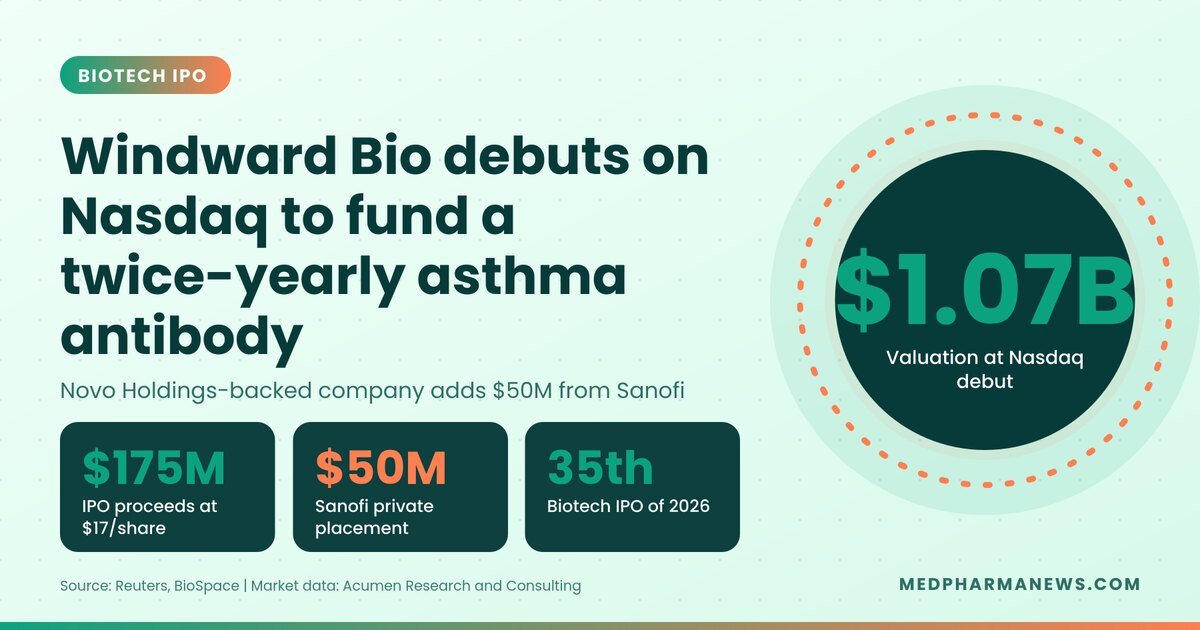
The Windward Bio IPO priced on 12 November 2026 at $17 a share, raising about $175 million, and the Basel-based biotech opened at $18.35 on Nasdaq the next day, giving it a market value of roughly $1.07 billion. Backed by Novo Holdings, with Sanofi buying a further $50 million of stock privately, Windward is betting its future on WIN378, an anti-TSLP antibody it wants to dose just twice a year in asthma and COPD.
Key takeaways on the Windward Bio IPO
- Windward sold about 10.3 million shares at $17, the middle of its $16-18 range, for gross proceeds of about $175 million.
- Sanofi is taking a $50 million private placement of shares and pre-funded warrants, lifting expected total proceeds to about $225 million.
- Shares opened at $18.35, a first-trade gain of about 7.9% by our calculation, valuing the company near $1.07 billion.
- The money funds WIN378, an anti-TSLP monoclonal antibody in Phase 2/3 for asthma and Phase 2 for COPD, designed for twice-yearly dosing.
- BioSpace counts Windward as the 35th biotech IPO of 2026, against only eight in all of 2025.
Deal terms at a glance
| Item | Detail |
|---|---|
| Offer price | $17 per share (range $16-18) |
| Shares sold | About 10.3 million |
| Gross IPO proceeds | About $175 million |
| Sanofi private placement | $50 million (shares and pre-funded warrants) |
| Total expected capital raised | About $225 million |
| Underwriters’ option | Up to 1.5 million additional shares for 30 days |
| First trade | $18.35 on Nasdaq, 13 November 2026 |
| Implied market value | About $1.07 billion |
| Key backers | Novo Holdings; Sanofi (strategic and venture arm) |
Why investors are paying for a TSLP antibody
TSLP (thymic stromal lymphopoietin) is a signalling protein released by the lining of the airways when it is irritated by allergens, viruses or pollution. It sits at the top of the inflammatory cascade, upstream of the IL-4, IL-5 and IL-13 pathways that most current asthma biologics block one at a time. Hitting TSLP can therefore calm both allergic and non-allergic forms of airway inflammation, which is why the target has drawn so much attention.
The concept is proven. AstraZeneca and Amgen’s Tezspire (tezepelumab) is already approved as an anti-TSLP add-on treatment for severe asthma, injected every four weeks. Windward’s pitch is not a new mechanism but a more convenient one: an engineered antibody that lasts long enough for two injections a year. In respiratory biologics, where patients often drop off monthly or fortnightly injections, dosing frequency can decide who wins prescriptions.
Where WIN378 stands in development
According to BioSpace, WIN378 is in an ongoing Phase 2/3 study in asthma and a Phase 2 study in COPD, and Windward plans to start a confirmatory asthma trial in the first half of 2027. The company has said the IPO money is meant to carry WIN378 through those three trials, including regulatory and manufacturing preparation. Pivotal results are therefore unlikely before 2028 at the earliest. Investors are buying a mid-stage asset, not a near-term launch.
Leadership is a big part of the story. Chief executive Luca Santarelli previously ran VectivBio, sold for $1.2 billion, and Therachon, sold for $810 million. Novo Holdings is an early backer, and Sanofi’s venture arm took part in Windward’s $165 million Series B crossover round in May before the parent company committed to the IPO placement.
What Sanofi’s $50 million signals
A large pharma buying into an IPO is not an acquisition, and it gives Sanofi no announced rights to WIN378. Still, the move is worth noting. Sanofi markets Dupixent, the best-selling respiratory and dermatology biologic, and has been building a pipeline of next-generation immunology drugs. Owning a stake in a long-acting TSLP antibody keeps it close to a potential future competitor or partner. Readers should treat any talk of a future deal as speculation until a company says otherwise.
The 2026 biotech IPO window
Windward’s debut came during a weak week for listings overall, with technology stocks under pressure and interest rates expected to stay high. Biotech has been the exception. BioSpace’s count of 35 biotech debuts this year compares with eight in 2025, and 2026 proceeds have already passed annual totals for 2022 through 2025. Parabilis Medicines’ $670 million IPO this summer was the largest biotech debut on record. Jeff Zell of IPO Boutique told Reuters that “in IPO lulls, we see that the biotech sector is sometimes not truly affected by the broader market.” The revival has been linked to policy shifts in Washington and sweeping changes at the FDA.
Market context: asthma and COPD drugs
The addressable market is large. Acumen Research and Consulting values the global asthma and COPD drug market at USD 36.7 billion in 2022 and expects USD 60.3 billion by 2032, a 5.2% compound annual growth rate, with North America holding more than 36% of revenue in 2022 and Asia-Pacific growing fastest. The report was last updated in February 2023, so the numbers are indicative. Biologics are only a slice of that total, but they are the fastest-moving slice, and COPD is the newest frontier after recent approvals of targeted antibodies. Respiratory is also where big companies are restructuring their commercial teams, as AstraZeneca’s recent US sales job cuts show.
Risks and open questions
- Clinical risk: twice-yearly dosing must still match the efficacy of monthly competitors, and no WIN378 efficacy data have been published in this offering coverage.
- Competition: Tezspire is entrenched, and other long-acting respiratory antibodies, including twice-yearly options aimed at IL-5, compete for the same severe asthma patients.
- Timelines: a confirmatory asthma trial starting in 2027 means the company will likely need more capital before any filing.
- Aftermarket performance: an opening pop says little about the six- and 12-month record, where many 2026 IPOs have been volatile.
FAQ
What was Windward Bio’s IPO price?
Windward Bio priced its Nasdaq IPO at $17 per share on 12 November 2026 and began trading on 13 November, opening at $18.35, about 7.9% above the offer price.
What drug is Windward Bio developing?
Its lead drug is WIN378, an anti-TSLP monoclonal antibody being tested in asthma (Phase 2/3) and COPD (Phase 2), designed to be injected twice a year.
Who owns Windward Bio?
Novo Holdings is a major backer, and Sanofi is buying $50 million of shares and pre-funded warrants in a private placement alongside the IPO.
How does WIN378 compare with Tezspire?
Both block TSLP. Tezspire is approved and given every four weeks; WIN378 is investigational and aims for two doses a year. No head-to-head data exist.
Sources: Reuters report on the Windward Bio Nasdaq debut (13 November 2026); BioSpace; Windward Bio SEC registration filings. Market data: Acumen Research and Consulting. This article is for information only and is not investment or medical advice. More in Industry Insights. Last updated 14 November 2026.