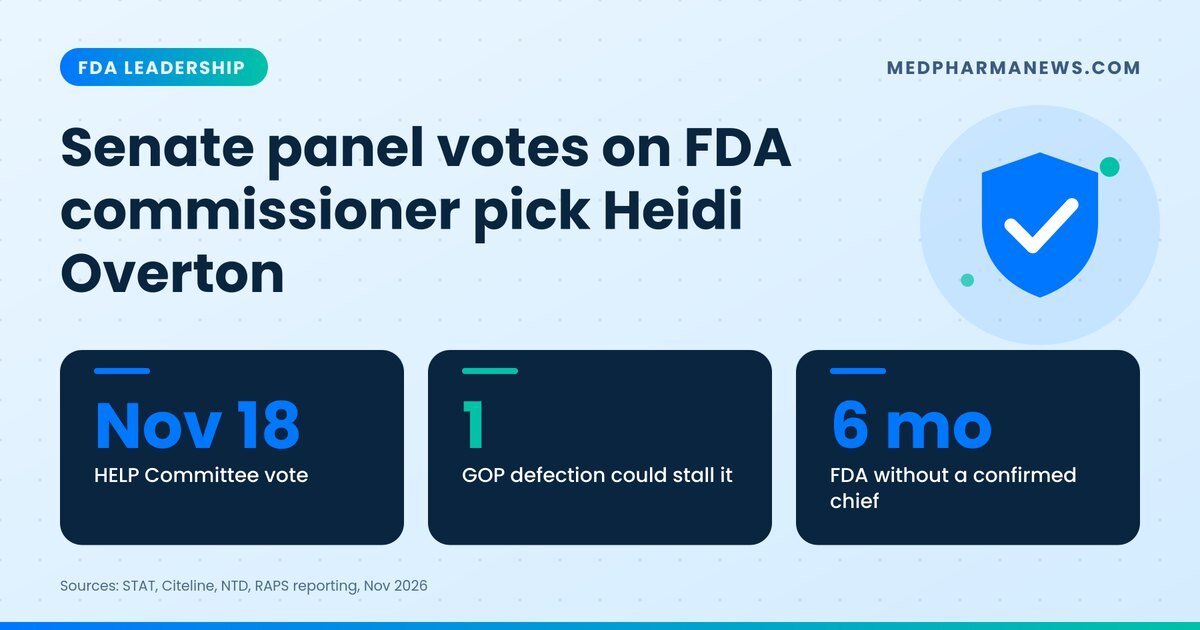
The Heidi Overton FDA vote is set for 18 November 2026, when the Senate Health, Education, Labor and Pensions (HELP) Committee decides whether to send President Trump’s pick for FDA commissioner to the full Senate. With Republicans holding a one-seat edge on the panel and committee chair Bill Cassidy still publicly undecided, a single Republican defection could stall the nomination, according to STAT and other reports.
For drugmakers, the stakes are practical. The FDA has had no Senate-confirmed leader since Marty Makary resigned in May, its acting commissioner is expected to leave at year end, and Democrats take control of the Senate in January. If Overton is not confirmed before then, the agency could head into 2027 with another interim chief.
Key takeaways on the Heidi Overton FDA vote
- HELP Committee vote: Wednesday, 18 November 2026, alongside the nomination of James O’Neill to lead the National Science Foundation.
- Committee math: Republicans hold a one-vote majority, so one GOP no vote would block a favorable report if every Democrat votes against.
- Chair Bill Cassidy, a physician, has said he is undecided, citing a lack of trust over what he called broken promises and irresponsible decisions in the administration.
- Susan Collins and Lisa Murkowski have also raised concerns, while anti-abortion groups are pressing for action on mifepristone before any vote.
- Timing is tight: Republicans control the Senate only until January 2027.
Who is Heidi Overton?
Overton is a surgeon by training who serves as deputy assistant to the president for domestic policy at the White House. Before that she worked at the America First Policy Institute, a conservative think tank, where she wrote policy papers including work opposing gender-affirming care for minors. Trump announced her nomination in August, and she testified before the HELP Committee in September.
Her record pulls in two directions, which explains the unusual coalition of doubters. Earlier public comments questioned telehealth prescribing of medication abortion and backed the option of separate measles, mumps and rubella shots, a position public-health experts say lacks scientific support. At her hearing, however, she reportedly told senators that vaccines on the US market are safe and effective, described the combined MMR vaccine as the best tool against measles outbreaks, and declined to prejudge FDA’s ongoing mifepristone safety review.
Where the votes stand
| Senator or group | Reported position | Main concern |
|---|---|---|
| Bill Cassidy (R-La.), HELP chair | Undecided | Trust in the administration on vaccines; he lost his primary and leaves the Senate in January |
| Susan Collins (R-Maine) | Concerns raised | Reproductive health and agency independence |
| Lisa Murkowski (R-Alaska) | Concerns raised | Reproductive health |
| Josh Hawley (R-Mo.) | Not stated | Wants tighter restrictions on abortion pills |
| Patty Murray (D-Wash.) | Will vote no | Vaccine and reproductive policy |
| Outside groups | Planned Parenthood opposes; Americans United for Life supports; SBA Pro-Life America wants a delay | Mifepristone in-person dispensing rules |
Not every HELP Republican has to oppose her for the nomination to stall. A tied committee vote would mean no favorable recommendation, which makes floor action harder in the few weeks left before the Senate changes hands. Whether Cassidy, now a lame-duck chair, uses that leverage is the single biggest variable.
Why the pharma industry is watching closely
Leadership instability has already shown up in policy. Reuters reported on 12 November that FDA has quietly shelved the Commissioner’s National Priority Voucher pilot launched under Makary, leaving companies that held or sought vouchers uncertain about review timelines. We covered the fallout in FDA National Priority Voucher Pilot Shelved: What Happens to 22 Drugs.
A confirmed commissioner would also lead negotiations for the next round of user fee agreements: the current Prescription Drug User Fee Act authority expires at the end of September 2027, and talks with industry run through 2026 and early 2027. A string of high-profile decisions is also due, including Capricor’s deramiocel decision on 22 November. Reviewers keep working regardless of who sits in the commissioner’s office, but policy direction on accelerated approval, rare disease flexibility and vaccine framework changes needs a leader with Senate backing.
Three scenarios after 18 November
- Committee advances her: Republican leaders would need floor time in December, competing with other nominees and year-end spending bills. Confirmation by simple majority is possible before January.
- Committee deadlocks or rejects: The nomination likely dies with this Congress. Acting Commissioner Kyle Diamantas is expected to depart at year end, and reports say Sara Brenner could return as acting commissioner.
- Vote is postponed: Anti-abortion groups have asked for a delay until mifepristone in-person dispensing is restored. A delay pushes the decision into a Democratic Senate, where confirmation odds fall sharply.
What is still unclear
Several key facts are not yet public: how Cassidy will vote, whether the White House would renominate Overton in January if she stalls, and what FDA’s mifepristone review will conclude. Reporting on senators’ positions comes from statements and media accounts rather than a formal whip count, so positions can shift before Wednesday’s markup.
More policy analysis is in our Industry Insights section.
FAQ
When is the Senate vote on Heidi Overton for FDA commissioner?
The Senate HELP Committee is scheduled to vote on 18 November 2026. If she clears committee, a full Senate vote would follow, likely in December.
Who is running the FDA now?
Kyle Diamantas is acting commissioner. He is expected to leave at the end of 2026, and the agency has had no Senate-confirmed head since Marty Makary resigned in May.
Why is Bill Cassidy undecided on Overton?
Cassidy has cited a lack of trust stemming from what he called broken promises and irresponsible decisions within the administration, particularly around childhood vaccine policy.
What happens if Overton is not confirmed before January?
Her nomination would likely lapse when the new Congress begins, and Democrats would control the Senate. The White House could renominate her or choose someone else, while an acting commissioner continues to run the agency.
Sources: Senate HELP Committee schedule as reported by STAT (11 November 2026), Citeline HBW Insight, NTD/Epoch Times, LifeNews, RAPS and Connecticut Public/NPR. Positions are as reported and may change. This article is not medical or investment advice. Last updated 14 November 2026.