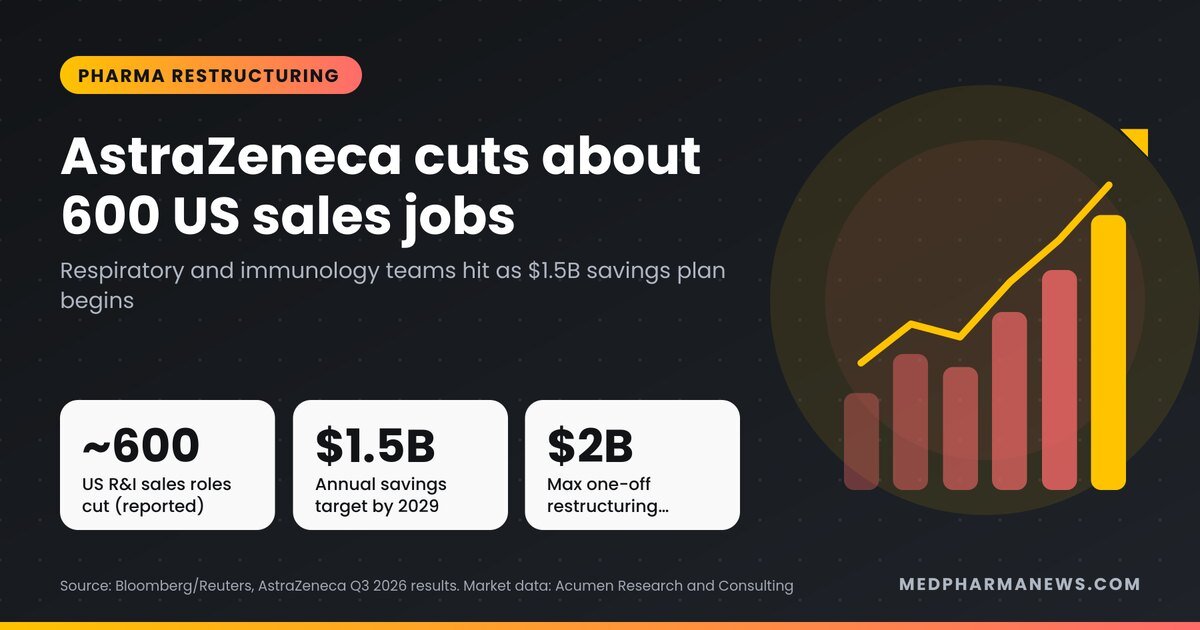
AstraZeneca job cuts have reached its US sales force: the company is eliminating about 600 commercial roles supporting its respiratory and immunology medicines, according to a Bloomberg News report on 13 November 2026 that Reuters carried the same day. The reductions are the first visible piece of the three-year, roughly $1.5 billion-a-year savings programme AstraZeneca unveiled with its third-quarter results on 30 October. AstraZeneca declined to comment on the report, and some affected employees are expected to move into other roles inside the company.
Key takeaways on AstraZeneca job cuts
- About 600 US sales jobs in the respiratory and immunology (R&I) commercial teams are being cut, per Bloomberg sources.
- The move belongs to a cost programme running through 2029 that targets about $1.5 billion in annual savings, with up to $2 billion in one-off restructuring charges.
- Savings are meant to be reinvested mainly in a pipeline of more than 180 projects and about 20 planned launches.
- AstraZeneca’s finance chief said in October the company does not expect overall headcount to shrink; cuts in some areas are paired with hiring in others.
- R&I brought in about $2.5 billion in the third quarter, roughly a sixth of group revenue, according to Reuters.
What was reported, and what was not
The report came from people familiar with the matter rather than from an AstraZeneca announcement, so several details remain unconfirmed. Bloomberg did not identify which brands’ field teams are affected, which regions or territories are involved, or when separations take effect. No state WARN notices tied to the cuts had surfaced publicly at the time of writing. Readers should treat the 600 figure as a credible press report, not a company disclosure.
What is on the record is the framework. On 30 October, AstraZeneca said it would pursue roughly $1.5 billion in annualised savings over three years, booking up to $2 billion in restructuring charges along the way. Reuters calculated that the savings target equals about 4% of the company’s 2025 operating expenses of $34.36 billion. At the time, management gave few specifics on where the money would come from.
The numbers behind the restructuring
| Metric | Figure | Source |
|---|---|---|
| Reported US sales job cuts (R&I) | About 600 | Bloomberg via Reuters, 13 Nov 2026 |
| Annualised savings target | About $1.5 billion | Q3 2026 results, 30 Oct |
| One-off restructuring charges | Up to $2 billion | Q3 2026 results |
| Programme timeline | Three years, through 2029 | Q3 2026 results |
| Q3 2026 revenue | $16.21 billion (+7% at CER) | Reuters |
| Q3 oncology revenue | $7.77 billion (+17%) | Reuters |
| Q3 R&I revenue | About $2.5 billion | Reuters |
| Global workforce | About 100,000 | ITV News |
| Cuts as share of workforce | About 0.6% | By our calculation |
Why the sales force, and why respiratory and immunology
Field sales is one of the few large, flexible cost lines in a drugmaker’s US business, and it tends to be resized when a portfolio’s growth mix changes. AstraZeneca’s centre of gravity has moved decisively toward cancer: oncology revenue rose 17% to $7.77 billion in the third quarter, led by Imfinzi at about $2 billion and Enhertu at $969 million. This week the company also won a new US approval for Imfinzi with Padcev in muscle-invasive bladder cancer (our coverage of the Imfinzi Padcev approval), the kind of launch that soaks up commercial investment.
Respiratory and immunology, by contrast, is a mature franchise in which inhaled brands such as Symbicort face generic and pricing pressure, while newer biologics such as Fasenra, Tezspire and Saphnelo are prescribed largely by specialists. Specialist-focused selling generally needs fewer, more targeted representatives than broad primary-care detailing. That is analysis, not a company explanation: AstraZeneca has not said why R&I was chosen. Pricing scrutiny also weighs on the inhaler business globally; in India, for example, Symbicort pricing has been litigated (see our report on the NPPA Symbicort case).
Does this mean AstraZeneca is shrinking?
Not on the company’s own account. Chief financial officer Aradhana Sarin told reporters in October that AstraZeneca was “not expecting to shrink the headcount,” describing hiring in some areas alongside reductions or reorganisation in others. CEO Pascal Soriot used the same results day to reaffirm the goal of $80 billion in annual revenue by 2030, built partly on about 20 new medicine launches. The 2026 outlook was held.
The cost plan is therefore best read as reallocation. Operating expenses rose 7% to $27.56 billion in the first nine months of 2026, and management expects costs to rise again in the fourth quarter. Trimming mature-brand selling helps fund late-stage trials and launch teams without letting expenses outrun revenue. Setbacks this year with camizestrant and Wainua make the pipeline’s 2027 readouts, which analysts see as supporting more than $20 billion in combined peak sales, even more central to that plan.
Market context: the respiratory drug arena
The business AstraZeneca is reshaping sits in a large, slower-growing category. Acumen Research and Consulting estimates the global asthma and COPD drug market at $36.7 billion in 2022, projected to reach $60.3 billion by 2032 at a 5.2% compound annual growth rate. Acumen’s report notes North America held more than 36% of that market in 2022 and identifies Symbicort among the leading brands. Those growth rates trail what large pharma sees in oncology, which helps explain why companies tilt sales spending toward cancer. The Acumen figures were last updated in February 2023 and should be treated as indicative.
What it means for patients, prescribers and staff
- Patients: Sales force changes do not affect drug supply or prescriptions. Nothing in the report suggests any AstraZeneca respiratory or immunology product is being withdrawn.
- Prescribers: Some practices may see fewer representative visits or a change in their contact, with more engagement moving to medical science liaisons or digital channels.
- Employees: Some affected staff are expected to be redeployed, per Bloomberg’s sources. Severance terms have not been reported.
- Investors: The cuts are consistent with the savings target already guided; the bigger swing factors remain 2027 pipeline data and US pricing policy.
What to watch next
Watch for state WARN filings that would confirm locations and timing, any further commercial reorganisations outside the US, and how much of the up-to-$2 billion restructuring charge AstraZeneca books in its full-year 2026 results. Industry-wide, layoff trackers show biopharma job cuts trending down for 2026 overall, so a large-cap reshuffle like this one is notable mainly as a signal of where AstraZeneca sees its growth. More industry analysis is in our Industry Insights section.
FAQ
How many jobs is AstraZeneca cutting in the US?
About 600 sales roles in its US respiratory and immunology commercial teams, according to Bloomberg News sources reported on 13 November 2026. AstraZeneca has not confirmed the figure.
Why is AstraZeneca laying off sales staff?
The cuts are reported to be part of a three-year programme announced on 30 October 2026 to save about $1.5 billion a year and reinvest mainly in its drug pipeline.
Will AstraZeneca’s total workforce shrink?
The company’s CFO said in October it does not expect overall headcount to fall, as reductions in some areas are offset by hiring elsewhere.
Are AstraZeneca asthma or COPD drugs affected?
No product withdrawal or supply change has been reported. The reported changes concern sales staffing, not medicine availability.
Sources: Bloomberg News report as carried by Reuters/Investing.com (13 Nov 2026); AstraZeneca Q3 2026 results coverage by Reuters and ITV News (30 Oct 2026); Reuters report. Market data: Acumen Research and Consulting. Not investment advice. Last updated 14 November 2026.