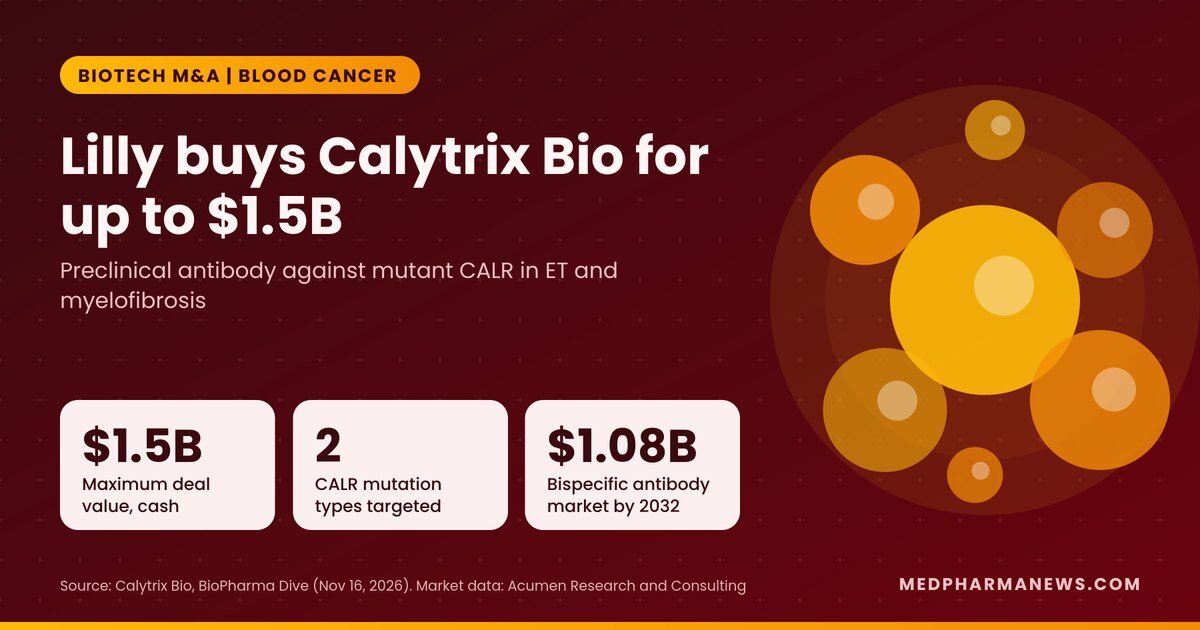
The Lilly Calytrix acquisition, announced on November 16, 2026, will see Eli Lilly pay up to $1.5 billion in cash for Calytrix Bio, a privately held Massachusetts startup with a preclinical antibody aimed at the mutation behind many cases of essential thrombocythemia (ET) and myelofibrosis (MF). The price combines an undisclosed upfront payment with milestones tied to clinical and regulatory events, and it marks Lilly’s 14th or 15th disclosed company purchase of 2026, depending on how the tally is kept.
Key takeaways on the Lilly Calytrix acquisition
- Headline value: up to $1.5 billion in cash; the upfront share was not disclosed.
- Asset: an unnamed biparatopic antibody designed to hit both Type 1 and Type 2 mutant calreticulin (mCALR), still in preclinical development.
- Seller: a company formed in 2025 by J.P. Morgan Life Sciences Private Capital, backed by Westlake BioPartners and Avoro Ventures.
- Strategy: Lilly is deliberately buying early, higher-risk science; BioPharma Dive counts more than $30 billion spent on acquisitions this year.
- Competition: Incyte’s mutant-CALR antibody INCA033989 is already in the clinic with Breakthrough Therapy designation.
The deal at a glance
| Item | Detail |
|---|---|
| Buyer | Eli Lilly and Company |
| Target | Calytrix Bio, Wellesley Hills, Massachusetts (private) |
| Maximum value | Up to $1.5 billion in cash (upfront plus milestones) |
| Lead program | Biparatopic antibody against Type 1 and Type 2 mutant CALR |
| Stage | Preclinical |
| Target diseases | Essential thrombocythemia and myelofibrosis |
| Calytrix advisers | Centerview Partners (financial), Goodwin Procter (legal) |
| Lilly legal counsel | Paul, Weiss, Rifkind, Wharton & Garrison |
Why mutant calreticulin is an attractive target
ET and MF are myeloproliferative neoplasms, chronic blood cancers in which the bone marrow overproduces cells. ET drives up platelet counts and clotting risk; MF scars the marrow, enlarges the spleen and causes anemia and exhausting symptoms. After JAK2, mutations in the CALR gene are the next most common driver, found in roughly a fifth to a third of ET and MF patients in published studies.
The mutated calreticulin protein shows up on the surface of the malignant cells, while healthy cells carry the normal version. That gives drug developers something rare in blood cancer: a cancer-only handle on the cell surface. Calytrix’s antibody is biparatopic, meaning it binds two separate sites on the same protein, an approach intended to tighten binding and cover both major mutation classes. Today’s standard treatments, including JAK inhibitors such as Incyte’s Jakafi, largely manage symptoms and blood counts rather than removing the mutant clone.
Calytrix chief executive Brad Prosek said the company was built on the belief that patients with MPNs “deserve therapies that do more than manage symptoms.” Whether its antibody can do that is untested in people.
The Incyte benchmark Lilly has to beat
The clearest reason to watch this space is Incyte’s INCA033989, an antibody against mutant CALR that is well ahead of Calytrix. At the European Hematology Association congress in June 2026, Incyte reported that 70% of ET patients reached a complete hematologic response across dose levels and 87% reached a complete or partial response, with a median of about two weeks to a durable complete response. In MF, 39% achieved at least a 35% spleen volume reduction as monotherapy, and 89% showed falling mutant CALR levels. The FDA granted Breakthrough Therapy designation in November 2025 for certain Type 1 CALR-mutated ET patients, and Incyte planned a phase 3 ET trial by mid-2026.
Those early results validate the target, which lowers scientific risk for Lilly, but they also mean Calytrix will arrive years behind. Lilly is effectively betting that a pan-mutant, biparatopic design can offer broader coverage, including Type 2 mutations, or a better profile for long-term use. It is a familiar pattern in the sector; contrast the setback described in our coverage of Geron’s discontinued IMpactMF trial, which shows how hard myelofibrosis endpoints can be.
Lilly’s risk-on buying spree
Calytrix is small next to Lilly’s bigger 2026 moves, such as the roughly $2.9 billion Merida Biosciences deal in August, but it fits a stated strategy. Jacob Van Naarden, who leads Lilly’s oncology unit and corporate business development, told BioSpace that “risk is really our friend here,” arguing that early bets create value that late-stage purchases cannot. Funded by obesity-drug cash flow, Lilly has been buying privately held startups at a pace no rival matches; GSK, Gilead and Novartis each made three company acquisitions this year, according to BioPharma Dive.
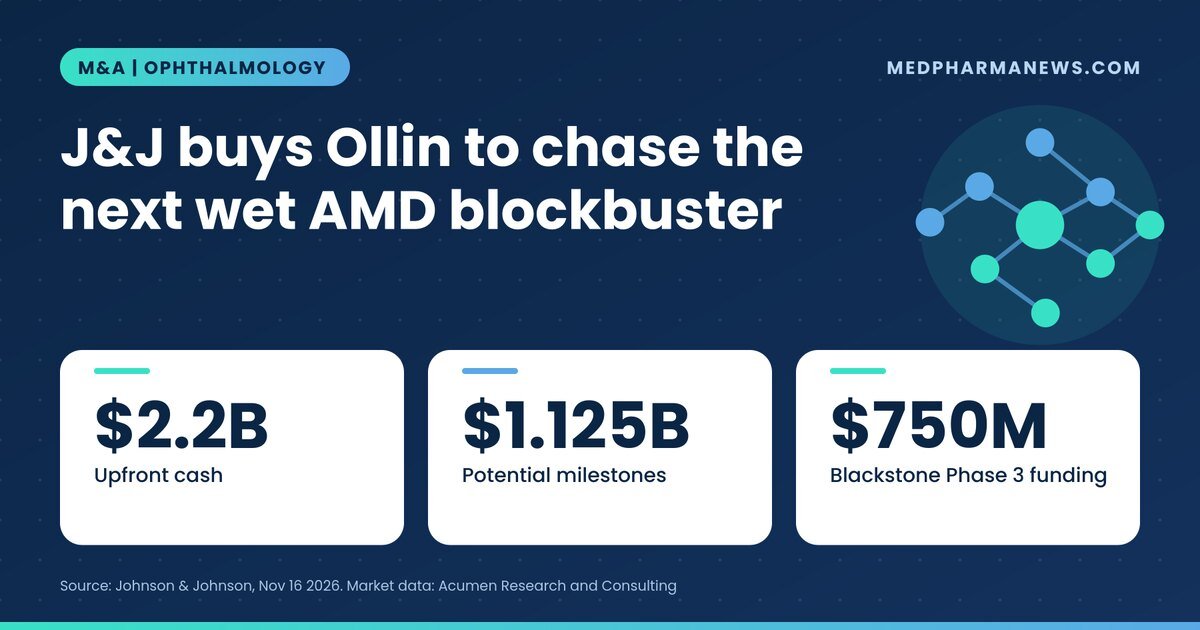
For venture investors, the deal is a quick exit: J.P. Morgan’s life sciences arm formed Calytrix only last year. By our calculation, even if most of the $1.5 billion is milestone-based, the structure lets Lilly pay heavily only if the antibody clears clinical hurdles, the same logic that shaped J&J’s Ollin acquisition the same day.
Market context
Biparatopic antibodies are usually grouped with bispecific formats, since both engage two binding sites. According to Acumen Research and Consulting, the global bispecific antibodies market was valued at USD 554 million in 2022 and is projected to reach USD 1,084 million by 2032, growing at a 7.1% compound annual rate from 2023 to 2032, with North America the leading region and Asia-Pacific the fastest growing.
What is still unknown
- How much Lilly pays upfront versus in milestones.
- When the antibody will enter human trials and which disease goes first.
- Expected closing date and any regulatory conditions.
- Whether Lilly will combine it with JAK inhibitors or position it as a stand-alone, disease-modifying therapy.
FAQ
How much is Lilly paying for Calytrix Bio?
Up to $1.5 billion in cash, including an upfront payment and later milestone payments. The split was not disclosed.
What does Calytrix Bio make?
A preclinical biparatopic antibody designed to target cells carrying Type 1 or Type 2 mutant calreticulin, the driver of many essential thrombocythemia and myelofibrosis cases.
Is there an approved mutant CALR drug?
No. Incyte’s INCA033989 is the most advanced candidate, with Breakthrough Therapy designation and phase 3 plans in ET, but it is not approved.
How many companies has Lilly acquired in 2026?
Calytrix is Lilly’s 14th disclosed transaction by BioSpace’s count and 15th company acquisition by BioPharma Dive’s, with more than $30 billion committed this year.
Sources: Calytrix Bio announcement; BioPharma Dive; BioSpace; Incyte EHA 2026 release. Market data: Acumen Research and Consulting. More in Industry Insights. Not medical or investment advice. Last updated November 17, 2026.