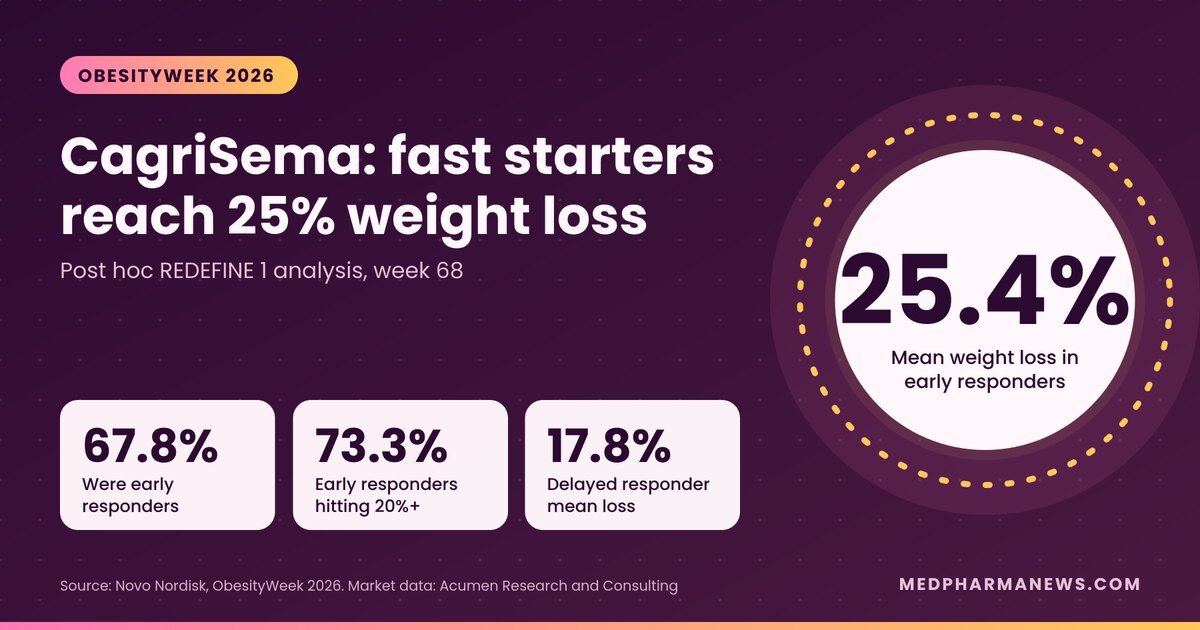
New CagriSema weight loss data presented at ObesityWeek 2026 in Washington, DC on 15 November show that people who lost at least 5% of their body weight in the first eight weeks went on to lose an average of 25.4% by week 68, compared with 17.8% for slower starters. Novo Nordisk’s post hoc analysis of the Phase 3 REDEFINE 1 trial found that 67.8% of CagriSema users were early responders, and nearly three in four of them reached 20% weight loss or more. The FDA is expected to decide on CagriSema in the fourth quarter of 2026.
The headline number is eye-catching, but the more useful message for patients and prescribers is about timing: how quickly someone responds in the first two months appears to predict where they end up. Below we unpack what the analysis showed, where its limits lie and why it matters commercially as Novo prepares for a US decision.
Key takeaways on CagriSema weight loss
- Early responders (at least 5% loss by week 8) averaged 25.4% weight loss at week 68; delayed responders averaged 17.8%.
- About two-thirds of CagriSema users (67.8%, n=1,367) were early responders; 649 were delayed responders.
- 73.3% of early responders reached 20% or greater weight loss, versus 37.2% of delayed responders.
- Even slower starters mostly did well: only 3.6% of delayed responders lost less than 5% by week 68.
- A second analysis linked CagriSema to meaningful gains in physical and psychosocial function from as early as week 8.
- These are post hoc, hypothesis-generating results; CagriSema is not yet approved, with an FDA decision expected in Q4 2026.
What the REDEFINE 1 early-response analysis found
REDEFINE 1 was a 68-week, double-blind trial in 3,417 adults with obesity, or overweight plus at least one related condition, who did not have type 2 diabetes. It compared once-weekly CagriSema 2.4 mg/2.4 mg, a fixed combination of the amylin analogue cagrilintide and the GLP-1 drug semaglutide, with each component alone and with placebo. The main results were published in the New England Journal of Medicine in 2025.
The new analysis split CagriSema users by how much weight they had lost at week 8. Early responders had already lost 7.8% on average at that point, compared with 3.4% for delayed responders. The gap then widened over the following 60 weeks.
| Weight loss at week 68 | Early responders | Delayed responders |
|---|---|---|
| Mean weight loss | 25.4% | 17.8% |
| 20% or more | 73.3% | 37.2% |
| 15% to under 20% | 16.1% | 23.8% |
| 10% to under 15% | 7.9% | 21.3% |
| 5% to under 10% | 2.5% | 14.0% |
| Under 5% | 0.3% | 3.6% |
By our calculation, early responders were about twice as likely to reach the 20% threshold as delayed responders (73.3% versus 37.2%), and the difference in mean loss was 7.6 percentage points. Women were more likely than men to fall into the early group, at 71.8% versus 59.5%.
Why early response matters in practice
Doctors prescribing obesity medicines often struggle to tell, a few weeks in, whether a patient is on track. W. Timothy Garvey, an author of the analysis, noted that it “can be hard to know early on how an individual patient will respond.” An eight-week check gives clinicians a simple marker for setting expectations and planning follow-up.
The data should not be read as a reason to stop treatment in slower starters. More than a third of delayed responders still reached 20% loss, and 61% reached at least 15%, by our calculation from the table above. Novo itself stresses that the findings are hypothesis-generating and are not a basis for changing clinical decisions.
Function and quality of life
A second post hoc analysis used the IWQOL-Lite-CT questionnaire, which measures how weight affects daily physical and social life. Assuming everyone stayed on treatment, 73.1% of CagriSema users (n=2,108) reported a meaningful improvement in physical function at week 68, compared with 49.1% on placebo (n=705), a 24.1-point difference. On the total score the figures were 69.1% and 40.4%. The advantage over placebo for physical function was significant at every visit from week 8 onward.
Side effects and caveats
Gastrointestinal effects were common in REDEFINE 1: 79.6% of CagriSema users reported them versus 39.9% on placebo, including nausea (55% vs 12.6%), constipation (30.7% vs 11.6%) and vomiting (26.1% vs 4.1%). Most were mild to moderate and transient, and 5.9% stopped treatment because of side effects versus 3.5% on placebo. The responder split was defined after the trial, uses observed data, and has not yet been peer reviewed as a full paper, so it can show association but not cause.
The commercial stakes for Novo Nordisk
Novo filed CagriSema with the FDA in December 2025, and a decision is due before year-end. The drug is Novo’s main answer to Eli Lilly’s next wave of obesity medicines, which were also on show at the same meeting, as covered in our report on Lilly’s ObesityWeek 2026 data. CagriSema’s REDEFINE 1 headline result disappointed some investors when it was first reported who had hoped for more, so data that help doctors identify strong responders may become part of Novo’s launch message. A lower-dose study, REDEFINE 9, reported around 21% average weight loss. For more on Novo’s pipeline, see our coverage of its etavopivat filing, and browse the Pharmaceuticals section.
Market context
Acumen Research and Consulting estimated the global anti-obesity drugs market at USD 2.1 billion in 2022 and projected USD 8.2 billion by 2032, a 14.6% compound annual growth rate, with prescription drugs holding the largest share and Asia-Pacific growing fastest. That report was last updated in September 2023, before the most recent surge in GLP-1 prescribing, so its figures are dated and best treated as indicative.
Frequently asked questions
How much weight do people lose on CagriSema?
In this REDEFINE 1 analysis, early responders lost 25.4% on average at 68 weeks and delayed responders 17.8%. Averages across all trial participants differ depending on the statistical method used.
Is CagriSema approved by the FDA?
Not yet. Novo submitted it in December 2025 and expects an FDA decision in the fourth quarter of 2026.
What is an early responder to CagriSema?
Someone who lost at least 5% of their starting body weight by week 8. About 68% of CagriSema users in REDEFINE 1 met that bar.
What is CagriSema made of?
It combines cagrilintide, a long-acting amylin analogue, with semaglutide, the GLP-1 drug in Wegovy, in one weekly injection at 2.4 mg of each.
Sources: Novo Nordisk release, 15 November 2026; Garvey et al., N Engl J Med 2025;393:635-647. Market data: Acumen Research and Consulting. Not medical or investment advice. Last updated 15 November 2026.