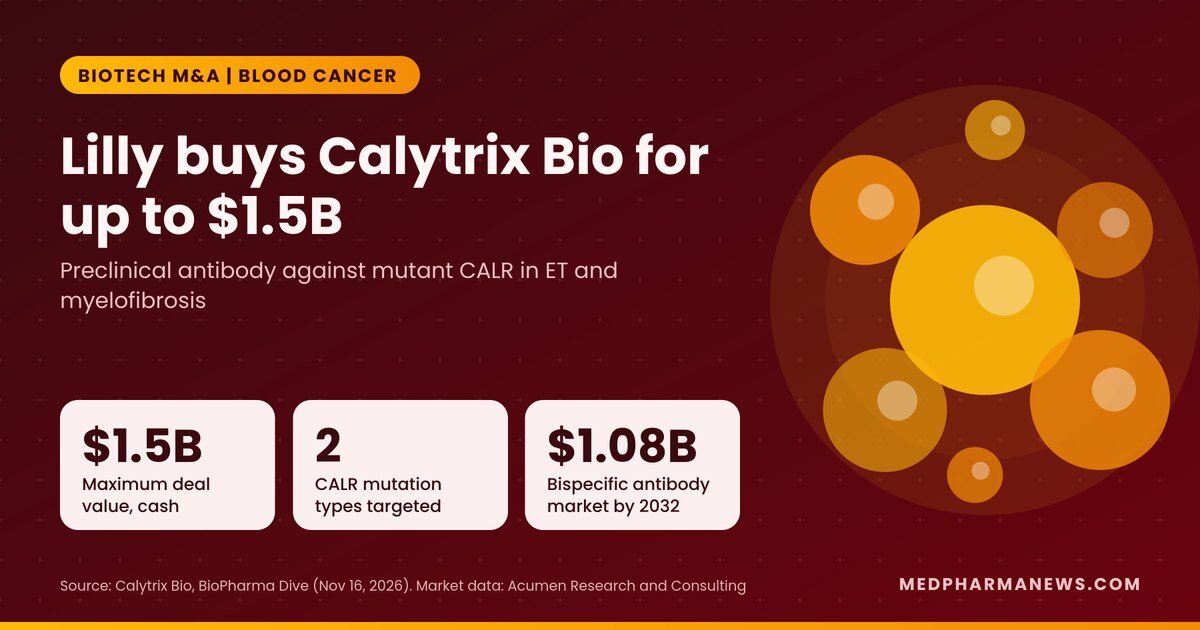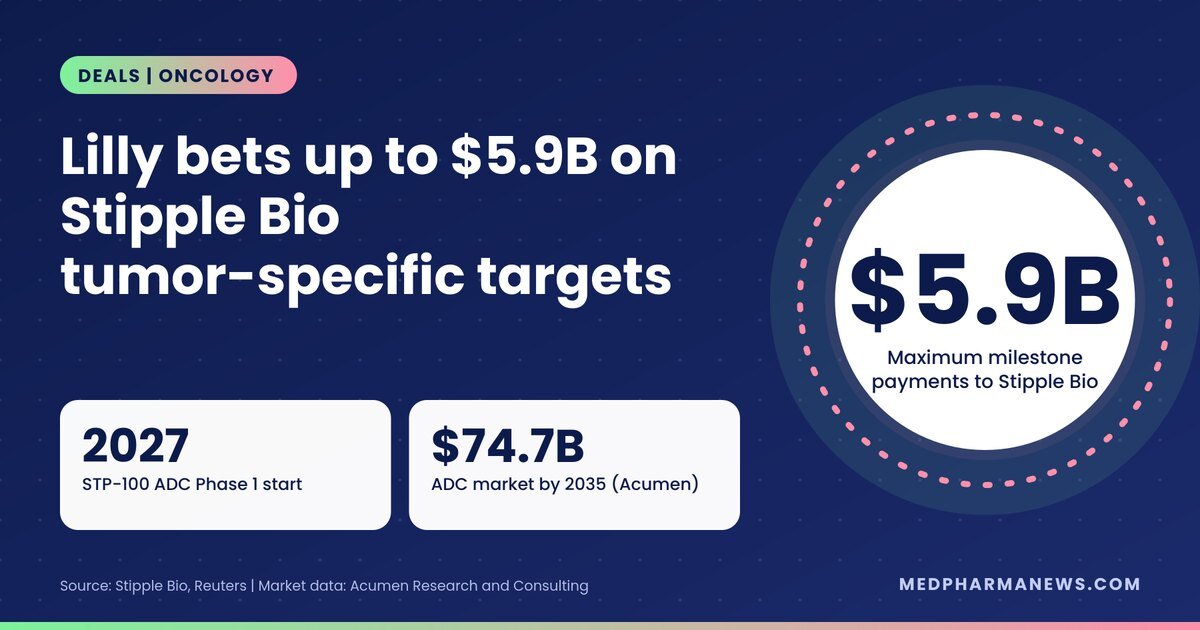
The Lilly Stipple Bio deal, announced on 16 November 2026, gives Eli Lilly exclusive worldwide rights to cancer drugs built on Stipple Bio’s tumor-targeting discovery platform, with the Cambridge, Massachusetts start-up eligible for up to $5.9 billion in milestone payments. Stipple also receives an undisclosed upfront payment, an equity investment from Lilly and tiered royalties on any products that reach the market. It came the same day Lilly agreed to buy Calytrix Bio for up to $1.5 billion, another oncology bet.
Key takeaways on the Lilly Stipple Bio deal
- Headline value: up to $5.9 billion in research, development and commercial milestones, plus royalties.
- Upfront cash and the size of Lilly’s equity stake were not disclosed.
- The pact is multi-target and multi-modality; Lilly will pair Stipple’s binders with its own oncology technologies.
- Stipple’s own lead asset, the antibody-drug conjugate STP-100, is slated to enter a Phase 1 solid tumor study, including pancreatic cancer, in early 2027.
- The deal extends Lilly’s push to build an oncology business beyond Verzenio and Jaypirca as obesity revenue funds diversification.
Deal terms at a glance
| Term | What was disclosed |
|---|---|
| Announced | 16 November 2026 |
| Structure | Research collaboration and license agreement |
| Upfront payment | Yes, amount not disclosed |
| Equity | Lilly investment in Stipple, size not disclosed |
| Milestones | Up to $5.9 billion in aggregate |
| Royalties | Tiered, on net sales |
| Rights | Exclusive worldwide development and commercialization rights for Lilly |
| Number of targets | Multiple; not specified |
Investors should treat the $5.9 billion figure with the usual caution for biobucks deals. Most of the value is contingent on programs that have not yet been named, let alone tested in people. The real near-term economics sit in the undisclosed upfront and equity components, which neither company has quantified.
What Stipple’s Pointillist platform is trying to solve
The persistent weakness of targeted cancer drugs is on-target, off-tumor toxicity: many surface proteins used as targets also appear at lower levels on healthy tissue, so potent payloads end up damaging normal cells. That problem limits dosing and has sunk otherwise promising antibody-drug conjugates (ADCs) and T-cell engagers.
Stipple’s Pointillist Platform is designed to find binders against cell-surface epitopes that are specific to tumors, the small molecular footprints that distinguish a cancer cell from the healthy tissue around it, rather than whole proteins shared by both. If the approach works, it could widen the therapeutic window for powerful modalities. Stipple chief executive Jeff Landau said Lilly brings “tremendous expertise in oncology drug discovery and development.” The company, named to the 2026 Endpoints 11 list of promising private biotechs, has not published clinical data yet.
Why Lilly is spending on oncology now
Lilly’s cash flow from tirzepatide and its newer obesity medicines has turned it into one of the most active buyers in biotech this year. The Stipple pact sits alongside the Calytrix acquisition targeting mutant CALR blood cancers, announced the same day, and a broader effort to build out targeted therapies, ADCs and immuno-oncology. Both deals share a theme: aiming at markers that exist only on cancer cells, an approach that could produce safer drugs if the biology holds up.
The structure also fits a pattern among large pharma buyers: rather than paying billions upfront for a single late-stage asset, Lilly is buying optionality on a discovery engine and keeping most of the risk-weighted cost for later, when programs prove themselves.
Market context: the ADC opportunity
Stipple’s own lead, STP-100, is an ADC, and the modality is one of the most obvious homes for tumor-specific binders. According to Acumen Research and Consulting, the global antibody-drug conjugate market was worth USD 16.4 billion in 2025 and is projected to reach USD 74.7 billion by 2035, growing at a 16.3% CAGR. Acumen’s analysis, updated on 11 November 2026, highlights several dynamics relevant to the Lilly bet:
| ADC market metric (Acumen) | Value |
|---|---|
| Market size, 2025 | USD 16.4 billion |
| Projected size, 2035 | USD 74.7 billion |
| Forecast CAGR, 2026 to 2035 | 16.3% |
| Enhertu share of ADC sales, 2025 | 30.4% |
| HER2-directed share, 2025 | 43.5% |
| “Others” incl. pipeline ADCs, share in 2035 | 42.0% (from 16.4% in 2025) |
The last line matters most for Lilly. Acumen expects newer and pipeline ADCs to take a far larger slice of the market by 2035, while also noting that developers must show clear advantages over approved ADCs to win share. Better tumor selectivity is exactly the kind of differentiation that could matter. Acumen also flags lung cancer as the fastest-growing ADC indication, at about 31% a year.
Risks and open questions
- No human data: STP-100 has not yet entered the clinic, and the Lilly programs are at the research stage.
- Undisclosed economics: without the upfront figure, it is hard to judge how much Lilly is committing now.
- Target validation: tumor-specific epitopes can be scarce or heterogeneous across patients, which could limit how many programs advance.
- Competition: dozens of ADC developers, many in China, are chasing similar selectivity gains. For a recent example of that race, see our analysis of the claudin 18.2 ADC contest.
FAQ
How much is Lilly paying Stipple Bio?
Stipple can earn up to $5.9 billion in milestones plus royalties. Lilly is also making an upfront payment and an equity investment, but neither amount has been disclosed.
What does Stipple Bio do?
Stipple is a private Cambridge, Massachusetts biotech whose Pointillist Platform finds binders to tumor-specific cell-surface epitopes, aiming to hit cancer cells while sparing healthy tissue.
Is Lilly acquiring Stipple Bio?
No. It is a research collaboration and license agreement with an equity investment, not an acquisition. Stipple remains independent and keeps developing its own ADC, STP-100.
When will Stipple’s first drug enter trials?
Stipple plans to start a Phase 1 trial of STP-100 in solid tumors, including pancreatic cancer, in early 2027.
More analysis is available in our industry insights section.
Sources: Stipple Bio announcement (16 Nov 2026); Reuters. Market data: Acumen Research and Consulting. This article is for information only and is not investment advice. Last updated 17 November 2026.