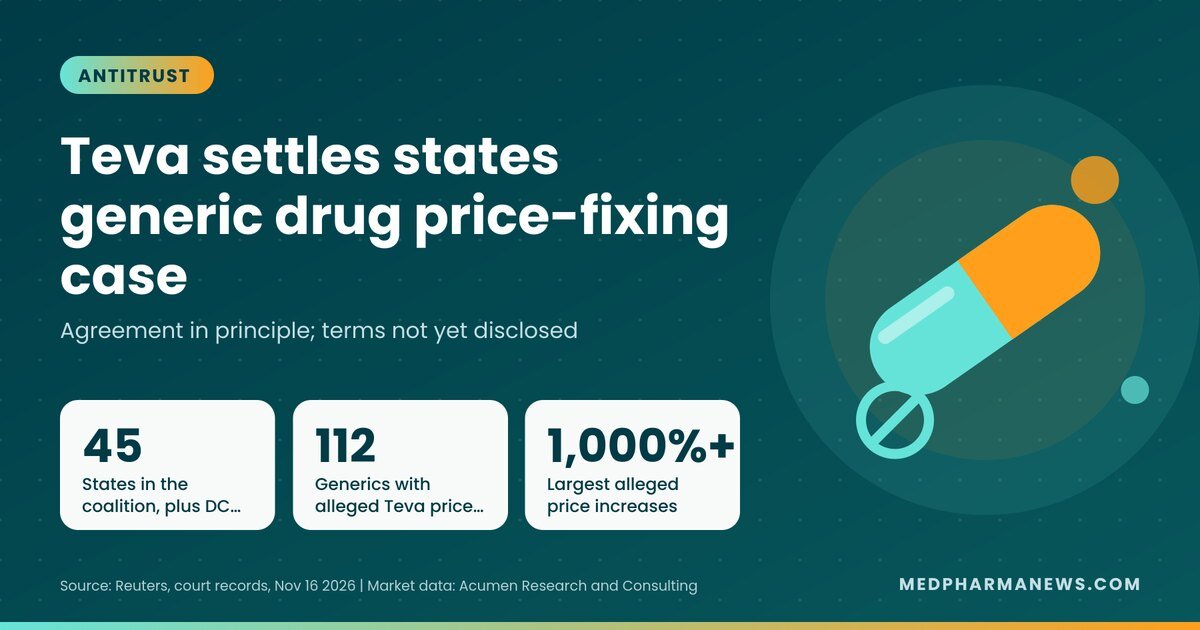
The Teva price-fixing settlement with US states, reached as an agreement in principle and disclosed in court on November 16, 2026, removes Teva Pharmaceutical Industries from the center of one of the largest antitrust cases ever brought over generic medicines. Chief Judge Michael Shea of the federal court in Hartford, Connecticut, paused the case after Teva and a coalition of 45 states, Washington, DC and two US territories told the court they had a deal, Reuters reported. The financial terms have not been made public.
Key takeaways on the Teva price-fixing settlement
- Teva and 45 states, DC and two territories reached an agreement in principle; the Hartford court stayed the case on November 16, 2026.
- The states, led by Connecticut Attorney General William Tong’s office, allege a conspiracy that began in 2012 and drove sharp generic price increases in 2013 and 2014.
- Teva is accused of raising prices on about 112 generic drugs and colluding with rivals on at least 86 of them, sometimes by more than 1,000%.
- No dollar amount, admission of liability or conduct terms have been disclosed. Teva did not immediately comment.
- The case named dozens of other defendants, and Judge Shea oversees two further state generic-drug antitrust suits, so the wider litigation is not over.
What the states say happened
The core allegation is that generic makers agreed to divide customers so that each company kept its so-called fair share of a given drug’s market, and then used that stability to raise prices instead of competing them down. In the states’ words, the defendants embarked in 2012 on one of the most damaging price-fixing conspiracies in US history. Generic medicines are supposed to get cheaper as more manufacturers enter; the complaint argues the opposite happened for dozens of products during 2013 and 2014.
These are allegations. The settlement, as reported, does not include a public finding that Teva broke state antitrust law, and the company has historically disputed the states’ claims in this case.
How the generic price-fixing saga unfolded
| Period | Event |
|---|---|
| 2012 | Alleged start of the conspiracy, according to the states |
| 2013 to 2014 | Price spikes on dozens of generics; Teva alleged to have raised about 112 |
| 2019 | States file the complaint that makes Teva its central defendant |
| August 2023 | Teva enters a federal deferred prosecution agreement: US$225 million criminal penalty, divestiture of its generic pravastatin and about US$50 million in donated medicines |
| November 16, 2026 | Agreement in principle with 45 states, DC and two territories; case stayed |
The 2023 federal resolution, reported at the time by CNBC, is a useful reference point. Teva’s US$225 million penalty is being paid in instalments of US$22.5 million a year from 2024 to 2027, with US$135 million due in 2028. Glenmark paid US$30 million for its role in the pravastatin scheme. That deal resolved federal criminal exposure; the states’ civil claims for damages and penalties ran separately, which is why this week’s settlement matters.
What the missing terms will tell us
Until the agreement is finalised and filed, three questions are open. First, the payment: investors and other defendants will read the figure as a benchmark for what the remaining claims are worth. Second, conduct remedies: state antitrust settlements sometimes include compliance monitoring, pricing transparency or cooperation obligations, and cooperation by Teva could strengthen the states’ hand against other defendants. Third, how any money is used: state settlements can fund restitution, consumer programmes or general treasuries, and that allocation is usually set out only in final documents.
Why it matters beyond Teva
Generics fill the large majority of US prescriptions, so collusion in this market reaches patients, employers and public programmes such as Medicaid. The case has also shaped the industry: years of price erosion, legal costs and federal scrutiny pushed several large generic makers to cut portfolios or shift toward branded and biosimilar products. Teva itself has leaned harder on brands and biosimilars, including the US commercialisation deal covered in our Teva and Samsung Bioepis analysis. For other drug-pricing fights, see our coverage of the GLOBE model lawsuit and more in Industry Insights.
Market context
The scale of the generic market explains why the stakes are high. Acumen Research and Consulting projects the global generic drugs market to reach around US$627.6 billion by 2027, growing at a CAGR of about 11.1% from 2020 to 2027, with North America the largest region and Teva among the leading players. The same report cites estimates that generics saved the US health system about US$1.67 trillion over a decade. The report was last updated in 2021, so treat the figures as indicative.
What to watch next
- A filed settlement agreement or announcement from the Connecticut attorney general’s office with the amount and terms.
- Any disclosure from Teva in its next regulatory filings on the size of the charge.
- Movement by other defendants toward settlement, and the schedule for the two related state cases before Judge Shea.
Frequently asked questions
What is the Teva price-fixing lawsuit about?
US states allege that Teva and dozens of other generic drugmakers coordinated to share customers and raise prices on many generic medicines starting in 2012, with the steepest increases in 2013 and 2014.
How much is Teva paying the states?
The amount has not been disclosed. The parties reached an agreement in principle, and terms are expected once the settlement is finalised.
Is this the same as Teva’s 2023 DOJ settlement?
No. In 2023 Teva resolved federal criminal charges with a US$225 million deferred prosecution agreement. The state case is a separate civil antitrust action seeking damages and penalties.
Can consumers get money from the Teva settlement?
It is too early to say. Whether any funds go to individual consumers depends on the final terms. Watch your state attorney general’s website for official claim information and be wary of unofficial claim offers.
Sources: Reuters reporting (November 16, 2026); CNBC on the 2023 DOJ deferred prosecution agreement. Market data: Acumen Research and Consulting, Generic Drugs Market report. This article is for information only and is not legal or investment advice. Last updated November 17, 2026.