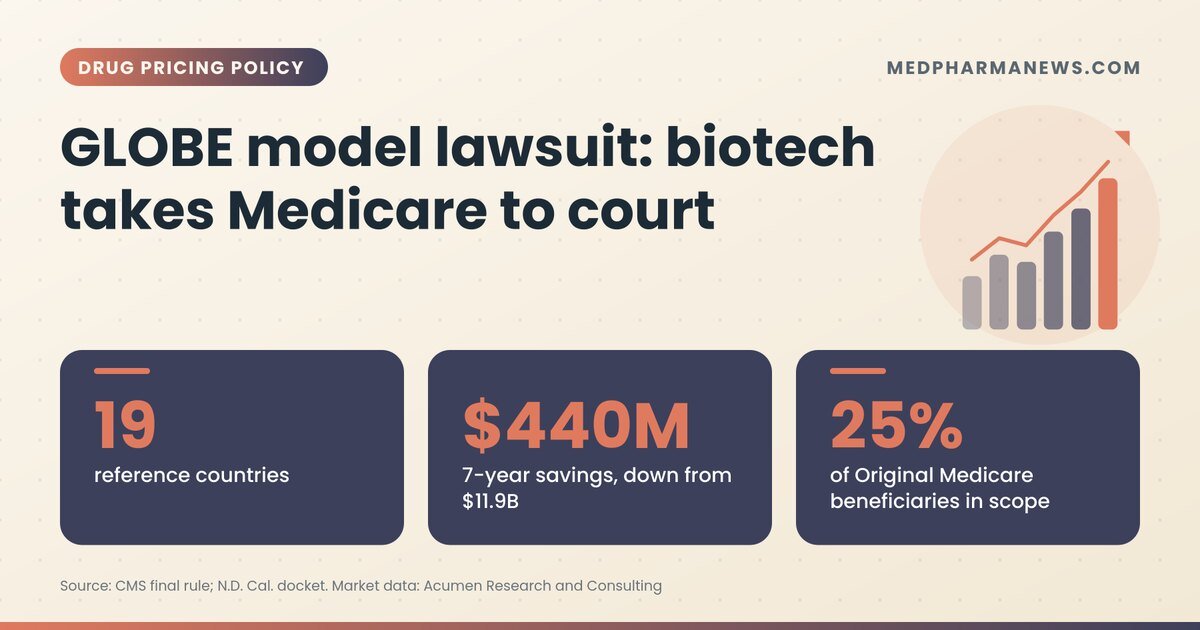
A second GLOBE model lawsuit is now pending against Medicare’s plan to tie Part B drug rebates to prices in 19 wealthy countries. On November 6, 2026, the Biotechnology Innovation Organization (BIO), Biocom California and the California Life Sciences Association sued the Department of Health and Human Services and CMS in the US District Court for the Northern District of California, arguing that the Innovation Center has no legal power to impose the model. PhRMA filed its own challenge in Washington, D.C., in October. GLOBE is due to start on January 1, 2027.
Key takeaways on the GLOBE model lawsuit
- Case: Biotechnology Innovation Organization et al. v. Kennedy et al., No. 3:26-cv-13372 (N.D. Cal.), assigned to Judge Patrick C. Pitts.
- Claims: lack of statutory authority under the Administrative Procedure Act, plus Appropriations Clause, nondelegation and separation-of-powers arguments.
- GLOBE uses the lowest or a volume-weighted international price as a benchmark for Part B rebates on high-spend, single-source drugs.
- The final rule shrank sharply: projected savings fell from $11.9 billion to $440 million over seven years, and as few as four manufacturers may be affected.
- Neither lawsuit has paused the model, and no court has ruled.
GLOBE in one paragraph
The Global Benchmark for Efficient Drug Pricing model, finalized by CMS on September 30, 2026, is a mandatory most-favored-nation experiment inside Medicare Part B, the benefit that pays for drugs given in doctors’ offices and hospital clinics. Instead of measuring price increases against a domestic baseline, it computes Part B inflation rebates against an international benchmark adjusted for purchasing power. It runs in randomly selected areas covering about 25% of Original Medicare beneficiaries, with lower coinsurance for patients there from April 1, 2027 to March 31, 2032. Full details sit on the CMS GLOBE model page.
Proposed versus final: how much bite is left
| Feature | December 2025 proposal | September 2026 final rule |
|---|---|---|
| Projected Medicare savings | $11.9 billion | $440 million over 7 years |
| Manufacturers affected | 19 | As few as 4 (after waivers) |
| Orphan-only drugs | Included | Excluded |
| Cell and gene therapies | Included | Excluded |
| Plasma-derived products | Included | Excluded |
| Oncology and breakthrough drugs | Included | Still included |
| Reference countries | 19 | 19 (GDP-PPP adjusted) |
By our calculation, the final rule cuts projected savings by about 96% from the proposal. Much of that comes from a side door: companies that signed Medicaid discount agreements under the separate GENEROUS model can be waived from GLOBE. More than 20 drugmakers have done so, and one independent tally found that 32 of 36 otherwise-qualifying medicines belong to those companies, leaving roughly four drugs from three firms in scope.
Why sue over a model this small?
The dollars at stake in GLOBE’s first version are modest for an industry of this size. The precedent is not. The plaintiffs argue that the Innovation Center’s authority to test payment models is limited to defined populations with care problems, and that a mandatory, nationwide-in-effect pricing rule is policy that only Congress can enact. If GLOBE survives, the same legal route could carry a broader version later, or the companion Part D model, GUARD, which remains under White House review.
The choice of venue is also telling. Filing in Northern California, home to a large share of BIO’s smaller members, lets the groups argue harm to companies with one or two products that cannot absorb lost Part B revenue the way large pharma can. The groups say they collectively represent more than a third of US biotech companies.
The government’s position
CMS Administrator Dr. Mehmet Oz has argued that Part B patients and taxpayers have paid far more than people in peer countries, and CMS says Americans pay more than four times as much for brand-name drugs. The agency disputes the claim that GLOBE will chill innovation, pointing to the exclusions it added for rare-disease, cell and gene therapies. For patients, the practical stake is coinsurance: Part B usually charges 20%, which can run to thousands of dollars for cancer infusions and eye injections. Our explainer on why the US healthcare system is expensive sets out the wider cost drivers.
Market context
International reference pricing matters because the US is the profit center of a very large market. Acumen Research and Consulting sizes the global pharmaceutical market at USD 1.5 trillion in 2022, rising to USD 2.8 trillion by 2032 at a 6.4% annual growth rate, with North America the dominant region. Even a narrow Medicare pilot is watched closely because it tests whether US prices can be pegged to that global baseline. Pricing pressure is also pushing companies toward biosimilar partnerships, as seen in the Teva and Samsung Bioepis US deal.
Timeline and what to watch
- Now: briefing under way in the BIO case; PhRMA’s D.C. case is listed as related litigation.
- Any preliminary injunction motion: the clearest early signal of whether GLOBE starts on time.
- January 1, 2027: model launch and collection of voluntary international net price data.
- April 1, 2027: reduced coinsurance begins in selected areas.
- March 31, 2034: end of rebate invoicing and reconciliation.
- GUARD: whether the Part D counterpart is finalized, which would widen the fight.
FAQ
What is the Medicare GLOBE model?
A CMS Innovation Center model that sets Part B drug rebates using prices in 19 reference countries, for single-source drugs with more than $100 million in annual Part B spending.
Who is suing to stop GLOBE?
PhRMA sued in October 2026 in Washington, D.C. BIO, Biocom California and the California Life Sciences Association sued on November 6, 2026, in the Northern District of California.
Will GLOBE lower my Medicare drug costs?
Only if you have Original Medicare in a selected area and receive a covered drug, starting April 2027. Nothing changes for patients today.
Are gene therapies and rare-disease drugs included?
No. The final rule excludes orphan-only drugs, cell and gene therapies and plasma-derived products.
Sources: CMS GLOBE final rule (September 30, 2026); court docket via Georgetown Health Care Litigation Tracker; law-firm and trade press summaries of the rule. Market data: Acumen Research and Consulting. More in Industry Insights. Not legal, medical or investment advice. Last updated: November 12, 2026.