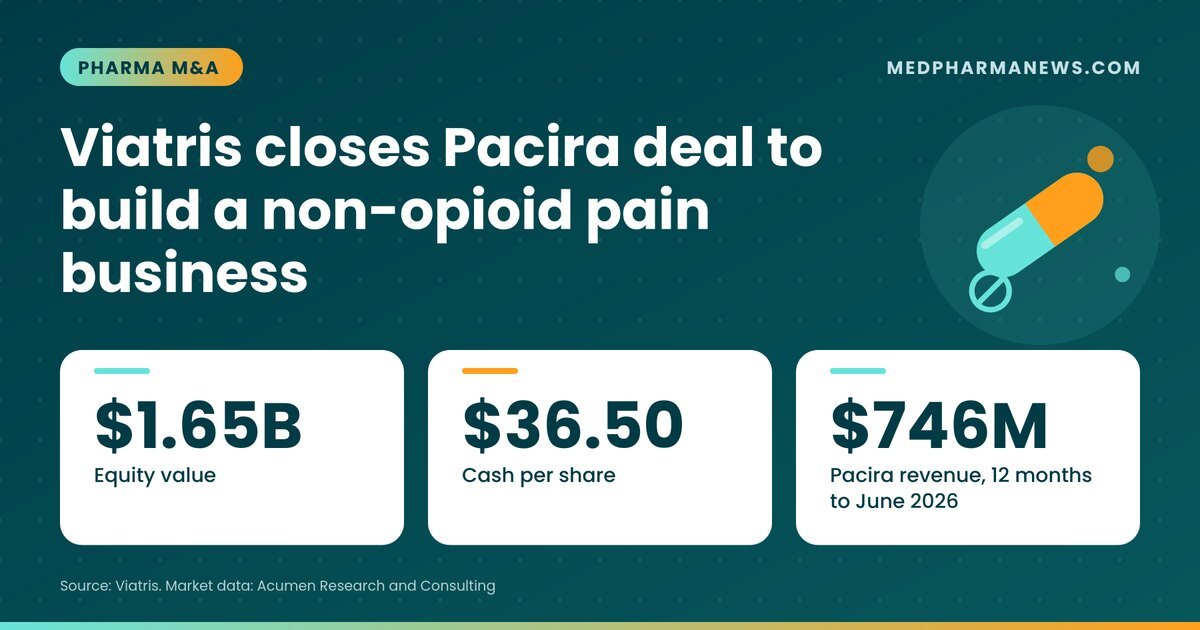
The Viatris Pacira acquisition is done. On 17 November 2026, Viatris said it had closed its $1.65 billion all-cash purchase of Pacira BioSciences at $36.50 a share, turning the maker of the non-opioid post-surgical pain drug Exparel into a wholly owned subsidiary and removing Pacira from the Nasdaq. The deal, first announced on 8 October, closed weeks ahead of the end-of-year target and gives Viatris, best known for generics and off-patent brands, its largest step yet into branded US specialty medicines.
Key takeaways on the Viatris Pacira acquisition
- Price: $36.50 per share in cash, an aggregate equity value of about $1.65 billion.
- About 32.9 million shares, roughly 66.5% of Pacira’s stock, were tendered; the rest were cashed out in a second-step merger without a shareholder vote.
- Assets: Exparel (liposomal bupivacaine) for post-surgical pain and Zilretta (extended-release triamcinolone) for knee osteoarthritis pain.
- Viatris expects Pacira to add $90 million to $100 million in revenue between 17 November and 31 December 2026.
- Funding came mainly from cash on hand plus short-term borrowing, and Viatris says the deal is immediately accretive.
Why Viatris wanted Pacira
Viatris was formed in 2020 from Mylan and Pfizer’s Upjohn unit, and much of its revenue comes from mature brands and generics facing steady price erosion. Management has spent the past two years trying to rebuild around what it calls innovative medicines. Pacira fits that plan in three ways.
First, it brings a US hospital and surgery-centre sales force, market access team and medical affairs group that Viatris largely lacked. Chief executive Scott A. Smith called those capabilities highly complementary. Second, Exparel and Zilretta are both patent-protected and already reimbursed, so revenue arrives on day one. Third, Viatris says the products are synergistic with its fast-acting meloxicam opportunity, an acute pain programme that would be sold into the same surgical call points.
The opioid backdrop matters too. Hospitals and payers have spent a decade trying to cut opioid prescribing after surgery, and long-acting local anaesthetics are one of the main tools for doing so. Owning marketed products plus a related acute-pain programme lets Viatris present itself as a non-opioid pain company rather than a collection of individual brands.
The deal by the numbers
| Metric | Figure |
|---|---|
| Offer price per share | $36.50 cash |
| Aggregate equity value | About $1.65 billion |
| Shares tendered | About 32.9 million (66.46%) |
| Pacira revenue, 12 months to 30 June 2026 | About $746 million |
| Pacira adjusted EBITDA, same period | About $177 million |
| Expected revenue to Viatris, 17 Nov to 31 Dec 2026 | $90 million to $100 million |
| Announced / closed | 8 Oct 2026 / 17 Nov 2026 |
By our calculation, the purchase price equals roughly 2.2 times Pacira’s trailing revenue and about 9.3 times its trailing adjusted EBITDA on an equity-value basis (enterprise value, which adds debt and subtracts cash, was not disclosed in the closing release). The $90 million to $100 million guided for the 45-day stub period annualises to roughly $730 million to $810 million, in line with Pacira’s recent run rate, which suggests Viatris is not assuming a near-term sales jump.
What Exparel and Zilretta do
Exparel packs the local anaesthetic bupivacaine into multivesicular liposomes that release the drug slowly at the surgical site. It is approved for local infiltration in patients aged six and older and for specific nerve blocks in adults, and is used to reduce pain in the first days after operations such as joint replacement and soft-tissue surgery. Zilretta is a single extended-release steroid injection into the knee for osteoarthritis pain, designed to keep the drug in the joint longer than a standard steroid shot.
Neither is a blockbuster on its own, but together they give Viatris a recurring, hospital-based revenue line that is less exposed to retail pharmacy pricing pressure than its legacy portfolio.
Risks Viatris now owns
The biggest long-term question is exclusivity. Both products are described as patent-protected, but Viatris has not published expiry dates, and its own announcement talked about using its intellectual property and lifecycle-management experience to sustain sales after competitors arrive. That phrasing signals that generic or alternative long-acting bupivacaine products are part of the planning horizon. Pricing pressure from hospital group purchasing organisations and the outcome of the meloxicam programme are the other swing factors.
Integration is a more immediate test. Viatris has spent recent years selling businesses rather than buying them, and running a specialty surgical sales force is different from managing a generics portfolio.
For other recent pharma dealmaking, see our coverage of the Gedeon Richter Mayne Pharma deal and Pfizer’s Starna CAR-T agreement, or browse our Pharmaceuticals section.
Market context
According to Acumen Research and Consulting, the global pain management therapeutics market was worth USD 75.3 billion in 2022 and is projected to reach USD 120.9 billion by 2032, a 4.4% compound annual growth rate. NSAIDs held the largest drug-class share, anaesthetics form a distinct segment, North America leads and Asia-Pacific is expected to grow fastest. The report was last updated in March 2023, so the figures are best read as indicative of scale rather than current.
What to watch next
- Viatris’s first full-year guidance including Pacira, likely with its fourth-quarter results early in 2027.
- Any disclosure of Exparel and Zilretta patent expiry dates or settlement terms.
- Progress of the fast-acting meloxicam programme and how Viatris bundles it with Exparel.
- Whether Viatris follows with further specialty acquisitions now that the integration has started.
FAQ
Did Viatris buy Pacira BioSciences?
Yes. Viatris completed the acquisition on 17 November 2026, paying $36.50 per share in cash. Pacira is now a wholly owned Viatris subsidiary and its shares have been delisted from Nasdaq.
How much did Viatris pay for Pacira?
The offer valued Pacira’s equity at about $1.65 billion. Viatris funded it mainly with cash, plus some short-term borrowing.
What happens to Exparel after the acquisition?
Exparel stays on the market and is now sold by Viatris through Pacira’s existing US commercial team. No change to its approved uses has been announced.
What happened to Pacira shares that were not tendered?
They were converted into the right to receive the same $36.50 per share in cash through a second-step merger that did not require a shareholder vote.
Sources: Viatris press release on completion (17 November 2026) and announcement and Form 8-K exhibit (8 October 2026). Market data: Acumen Research and Consulting. This article is for information only and is not investment or medical advice. Last updated 19 November 2026.