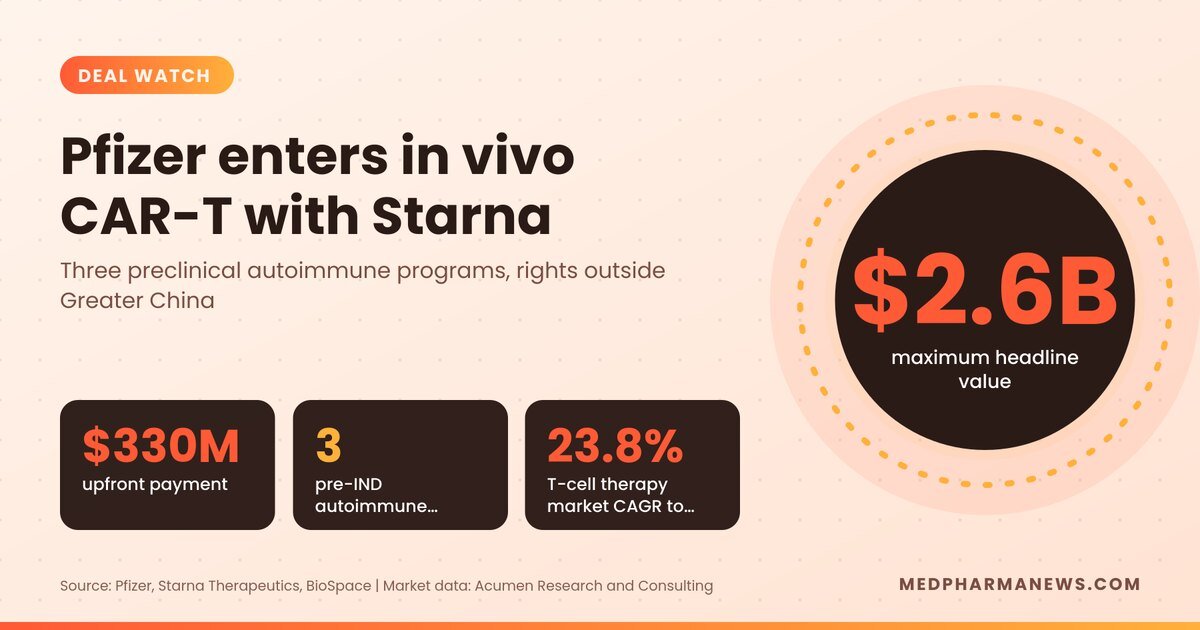
The Pfizer Starna deal, announced on November 18, 2026, gives Pfizer exclusive rights outside Greater China to three preclinical in vivo CAR-T programs for autoimmune disease from Suzhou-based Starna Therapeutics. Pfizer will pay $330 million upfront, with up to $2.3 billion more in milestones plus royalties, for a potential total of about $2.6 billion. It is Pfizer’s first move into in vivo CAR-T, a technology that aims to turn a patient’s own T cells into targeted cell killers inside the body instead of in a manufacturing plant.
The size of the upfront payment for programs that have not yet reached a US investigational new drug filing says a lot about where big pharma thinks autoimmune medicine is heading.
Key takeaways on the Pfizer Starna deal
- Money: $330 million upfront, up to $2.3 billion in development, regulatory and sales milestones, plus royalties on net sales.
- Assets: Three in vivo CAR-T programs for autoimmune diseases, all at the pre-IND stage. Targets and indications are undisclosed.
- Rights: Pfizer leads development and commercialization outside Greater China, with options to add China rights compound by compound.
- Platform: Starna pairs RNA payloads with targeted lipid nanoparticles (LNPs) to deliver CAR instructions directly to immune cells.
- Extras: Pfizer can use the technology in immunology and oncology and holds options on compounds from a separate research collaboration.
Deal terms at a glance
| Term | Detail |
|---|---|
| Upfront payment | $330 million |
| Milestones | Up to $2.3 billion |
| Maximum headline value | About $2.63 billion |
| Upfront as share of total | About 12.5% (by our calculation) |
| Programs | 3, autoimmune, pre-IND |
| Territory | Worldwide excluding Greater China (China options) |
| Royalties | Yes, on net sales |
An upfront of roughly one-eighth of headline value is high for preclinical assets, where early cash is often a much smaller slice. Pfizer also plans to make initial clinical drug supply at its own US facilities, according to deal coverage by BioSpace, a sign it wants manufacturing control from the outset.
Why in vivo CAR-T matters for autoimmune disease
Conventional CAR-T therapy is personalized: a patient’s T cells are collected, shipped to a facility, genetically engineered, grown and infused back, usually after chemotherapy to make room for them. In lupus and other antibody-driven diseases, CD19-directed CAR-T has produced striking drug-free remissions in small studies by resetting the B-cell compartment. But the cost, weeks of manufacturing and the toxicity of conditioning chemotherapy make that model hard to scale to millions of autoimmune patients.
In vivo approaches try to skip the factory. Starna’s version packages RNA encoding the chimeric antigen receptor inside a lipid nanoparticle designed to reach T cells, which then display the CAR temporarily. Because RNA does not integrate into the genome, the effect is expected to fade, which could be an advantage for autoimmune diseases where the goal is a deep B-cell reset rather than permanent surveillance. A Pfizer spokesperson told BioSpace that B-cell depletion therapies have been an area of interest and called the approach “a powerful way to pursue this next-generation approach in cell therapy.”
Who is Starna Therapeutics?
Starna was founded in 2021 by mRNA and LNP veterans and raised a $44 million Series B in October 2025, co-led by LYFE Capital, Lilly Asia Ventures and Hillhouse, according to PackGene’s report on that round. At the time, the company described early, unpublished investigator-initiated studies in China in a small number of lupus patients and one lymphoma patient, reporting complete loss of circulating B cells within 72 hours of a single low dose without chemotherapy pretreatment and mild cytokine release. Those findings have not been peer reviewed and should be treated as preliminary. Starna had said it planned versions including a dual CD19 and BCMA CAR and a circular RNA construct, though the deal does not say which programs Pfizer licensed.
How it compares with other in vivo CAR-T bets
Pfizer is a late arrival to a field that drew several large deals in 2025, as publicly reported at the time:
| Buyer | Target company | Reported headline value |
|---|---|---|
| AstraZeneca | EsoBiotec (acquisition) | Up to $1 billion |
| AbbVie | Capstan Therapeutics (acquisition) | Up to $2.1 billion |
| Gilead / Kite | Interius BioTherapeutics (acquisition) | $350 million |
| Bristol Myers Squibb | Orbital Therapeutics (acquisition) | $1.5 billion |
| Pfizer | Starna (license, 2026) | Up to about $2.6 billion |
Unlike those purchases, Pfizer has licensed programs rather than buying the company, which caps its exposure while China rights stay with Starna for now. The structure mirrors Pfizer’s wider pattern of sourcing assets from China, including its large Innovent pact and the Blackstone-funded obesity program we covered last week.
The risks Pfizer is taking on
- Safety in autoimmune CAR-T: BioSpace noted that Novartis and Bristol Myers Squibb have paused autoimmune CAR-T trials after safety events, including deaths. Regulators will scrutinize any B-cell-depleting cell therapy in non-cancer patients.
- Delivery is unproven at scale: Getting enough CAR expression in the right cells, and not elsewhere, is the central technical hurdle for every in vivo platform.
- No disclosed targets: Investors cannot yet judge how differentiated the three programs are.
- Geopolitics: US scrutiny of China-sourced biotech assets remains a policy wildcard for cross-border licensing.
Market context
Acumen Research and Consulting valued the global T-cell therapy market at USD 2.8 billion in 2022 and projects it will reach USD 23.3 billion by 2032, a compound annual growth rate of 23.8%, with CAR-T the leading therapy type by revenue. That forecast was last updated in October 2023 and is built largely on cancer use, so it is indicative only; a successful move into autoimmune disease would open a much larger patient pool than oncology alone. For a manufacturing angle on the same trend, see our report on cell and gene therapy manufacturing in India.
FAQ
How much is Pfizer paying Starna Therapeutics?
Pfizer is paying $330 million upfront and up to $2.3 billion in milestones, plus royalties, for a headline value of roughly $2.6 billion.
What is in vivo CAR-T?
It is an approach that delivers CAR genetic instructions directly into a patient’s T cells inside the body, here using RNA in lipid nanoparticles, instead of engineering cells in a lab and reinfusing them.
Which diseases will the Pfizer Starna programs target?
The companies have said only that the three programs target autoimmune diseases with unmet need; specific diseases and CAR targets were not disclosed.
When could these therapies reach patients?
All three programs are preclinical, so human trials would come first and any approval would be years away.
More coverage in our Industry Insights section.
Sources: Pfizer and Starna Therapeutics announcement (November 18, 2026) as reported by BioSpace and Pharmacally; PackGene report on Starna’s 2025 financing. Market data: Acumen Research and Consulting, T-Cell Therapy Market report (last updated October 2023). Not investment or medical advice. Last updated November 19, 2026.