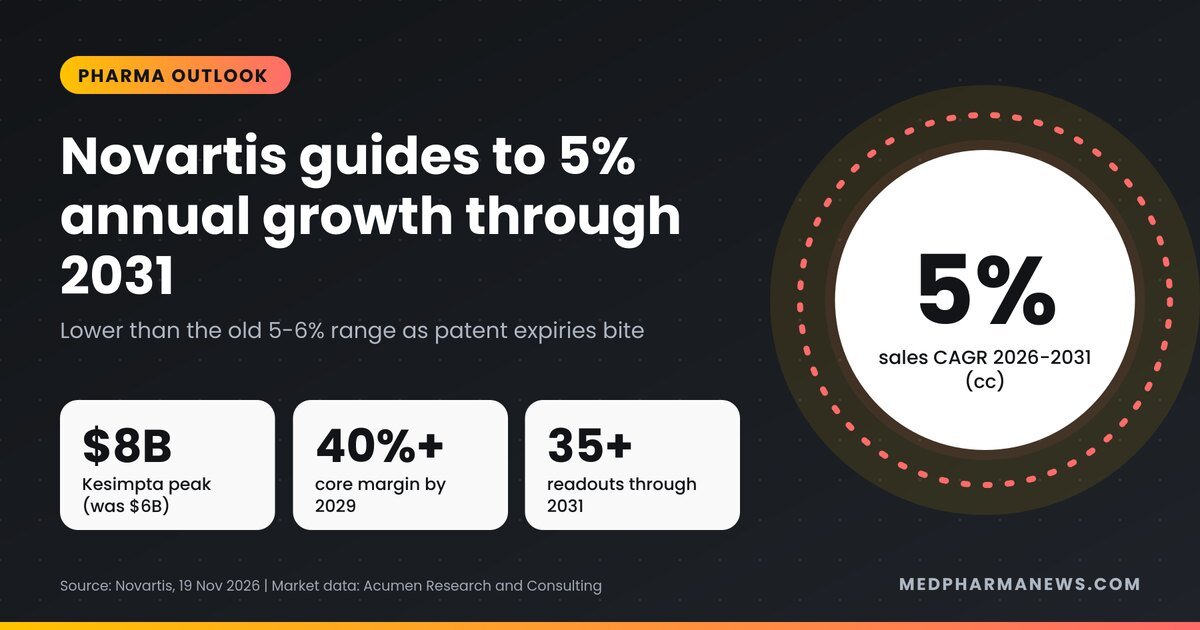
The new Novartis sales growth guidance, issued at the company’s investor event in London on 19 November 2026, projects net sales rising about 5% a year at constant currencies from 2026 through 2031, with core operating margin returning above 40% by 2029. Alongside the forecast, Novartis lifted peak sales estimates for three marketed drugs, Kesimpta, Scemblix and Leqvio, and said more than 35 potentially submission-enabling trial readouts are due by 2031. Reuters noted the target is a step down from the 5% to 6% annual growth Novartis had guided for 2025 to 2030.
Key takeaways on Novartis sales growth guidance
- Mid-term sales growth target: about 5% compound annual growth (constant currency), 2026 to 2031.
- Previous target: 5% to 6% a year for 2025 to 2030, so the top of the range has gone.
- Core operating income margin to return to 40% or more by 2029.
- Peak sales guidance raised: Kesimpta to $8bn (from $6bn), Scemblix and Leqvio to $5bn each (from $4bn).
- Rhapsido (remibrutinib) is guided at $8bn peak across chronic urticaria and multiple sclerosis.
- Nine in-market brands are now pegged at $3bn to $10bn peak sales each.
Why the target moved down
Novartis is in the middle of the heaviest patent cliff in its history. Chief executive Vas Narasimhan said the company expects to keep growing in 2026 “through the largest loss-of-exclusivity impact in our history”. The release does not put a dollar figure on that erosion. The best-known exposure is the heart failure drug Entresto, which began facing US generic competition in 2025.
The revised window also matters. Rolling the guidance forward to 2026 to 2031 means the base year now includes much of the generic erosion, and the target has to be delivered by newer brands rather than older blockbusters. A flat 5% instead of a 5% to 6% range signals that management sees less room for upside from that mix, at least on what it is prepared to commit to publicly.
Peak sales forecasts: old versus new
| Drug | Main use | Previous peak guidance | New peak guidance |
|---|---|---|---|
| Kesimpta (ofatumumab) | Relapsing multiple sclerosis | $6bn | $8bn |
| Scemblix (asciminib) | Chronic myeloid leukaemia | $4bn | $5bn |
| Leqvio (inclisiran) | LDL cholesterol lowering | $4bn | $5bn |
| Rhapsido (remibrutinib) | CSU, CIndU, relapsing MS | Raised earlier | $8bn |
By our calculation, the three upgrades add $4bn to Novartis’s combined peak sales expectations, and the four drugs in the table now carry $26bn of guided peak revenue between them. The nine brands Novartis places in the $3bn to $10bn bracket are Kisqali, Rhapsido, Cosentyx, Kesimpta, Pluvicto, Scemblix, Leqvio, the Zolgensma group (Zolgensma and Itvisma) and Fabhalta.
What 5% a year adds up to
Compounding 5% over the five years from 2026 to 2031 implies sales about 28% higher at the end of the period than at the start, by our calculation, at constant currency. At the old 6% upper bound the same span would have delivered roughly 34%. The difference looks small in a single year but amounts to several billion dollars of annual revenue by the early 2030s for a company of Novartis’s size.
The margin goal is arguably the more ambitious part. Getting core operating margin back above 40% by 2029 while absorbing generic erosion relies on newer, high-margin specialty drugs scaling quickly and on cost discipline in a period when US drug pricing policy is still shifting.
The pipeline Novartis is counting on
Novartis says it has more than 30 potential high-value assets across four core therapy areas and three technology platforms, with over 20 already in registration, Phase 3 or Phase 2, and 10 late-stage assets with multi-billion-dollar peak sales guidance. Assets it highlighted include:
- Cardiovascular and renal: abelacimab for stroke prevention in atrial fibrillation, QCZ484 for hypertension, farabursen for polycystic kidney disease.
- Immunology: ianalumab in lupus, GHZ339 in atopic dermatitis, GIA632 in vitiligo and lichen planus, Rhapsido in food allergy.
- Neuroscience: del-brax for FSHD, del-zota for exon 44 Duchenne, votoplam for Huntington’s disease.
- Oncology: pelabresib in myelofibrosis, the actinium-based radioligand AAA817 in prostate cancer, and a breast cancer portfolio.
Several of these came from recent deals, which is why the readout calendar is front-loaded with neuromuscular and cardiorenal data. The 35-plus readouts are the swing factor: hitting the 5% target probably needs a decent share of them to succeed, while positive surprises could push growth back toward the old range.
Market context
For comparison, Acumen Research and Consulting estimates the global pharmaceutical market at USD 1.5 trillion in 2022, projected to reach USD 2.8 trillion by 2032, a CAGR of 6.4%. Acumen names North America as the largest region and Asia-Pacific as the fastest growing. The periods and bases differ, so the comparison is indicative only, but it suggests Novartis is guiding to grow slightly slower than the overall market while it works through its patent expiries.
Risks and open questions
- Erosion pace: the company has not quantified the 2026 generic impact, making it hard to model how much new launches must offset.
- Competition: Kesimpta, Leqvio and Kisqali all face rival therapies, and peak forecasts assume continued share gains.
- Pipeline risk: late-stage failures, a regular feature of the industry this year, as seen with Merck’s nemtabrutinib exit, could dent the long-term story.
- Policy: US pricing reforms and tariffs remain moving targets for every large drugmaker.
More analysis of pharma strategy is in our Industry Insights section.
FAQ
What is Novartis’s sales growth guidance to 2031?
About 5% compound annual growth in net sales at constant currencies from 2026 to 2031, followed by sustained mid-single-digit growth over the longer term.
Did Novartis cut its growth forecast?
Effectively yes. The earlier target was 5% to 6% a year for 2025 to 2030; the new one is a single 5% figure over a later window.
Which Novartis drugs had peak sales raised?
Kesimpta (to $8bn), Scemblix (to $5bn) and Leqvio (to $5bn). Rhapsido is guided at $8bn.
When will Novartis margins recover?
The company targets a core operating income margin of 40% or more by 2029.
Sources: Novartis media release (19 Nov 2026); Reuters. Market data: Acumen Research and Consulting, Pharmaceutical Market report. Not investment advice. Last updated 19 November 2026.