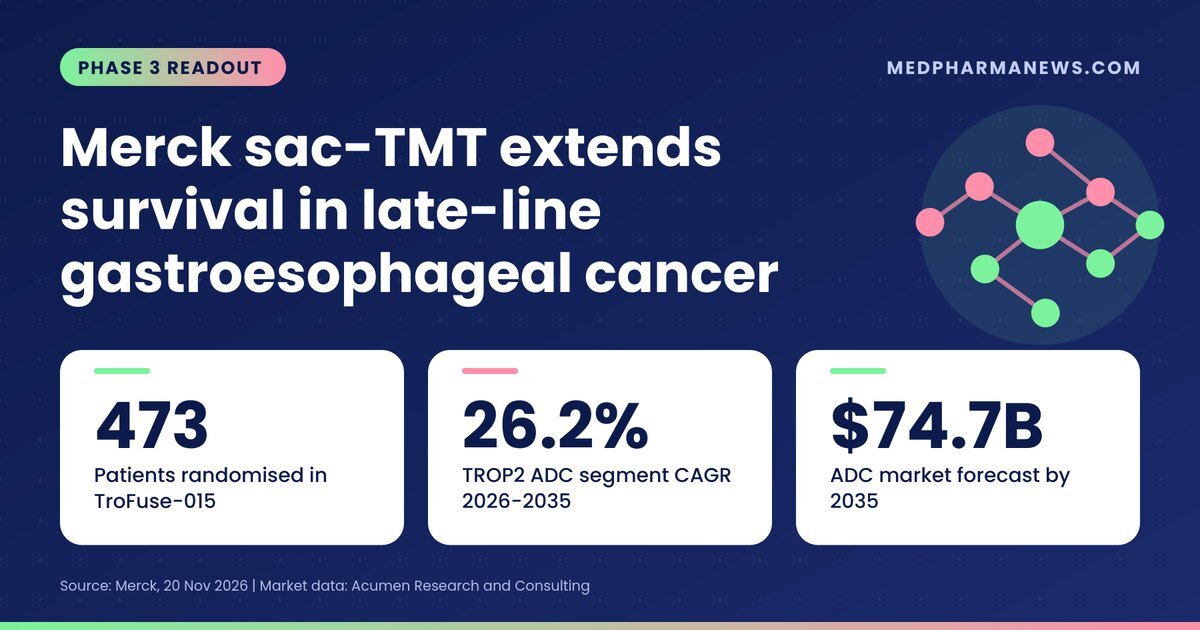
The Merck sac-TMT trial TroFuse-015 has met its primary goal: on 20 November 2026 Merck said sacituzumab tirumotecan (sac-TMT), its TROP2-directed antibody-drug conjugate licensed from China’s Kelun-Biotech, significantly extended overall survival versus physician’s choice of chemotherapy in 473 patients with advanced gastroesophageal adenocarcinoma who had already received at least two prior treatments. The trial missed its key secondary endpoint of progression-free survival, and Merck has not yet released the hazard ratio or median survival figures.
Key takeaways on the Merck sac-TMT trial
- TroFuse-015 is the second positive Phase 3 readout for sac-TMT, after TroFuse-005 in endometrial cancer.
- Benefit on overall survival was consistent across subgroups regardless of TROP2 expression, according to Merck.
- Progression-free survival by blinded central review did not reach significance; response rate favoured sac-TMT nominally but was not formally tested.
- No new safety signals were seen. Full data will go to a medical meeting and to regulators.
- Merck holds rights outside Greater China, and 18 global Phase 3 trials of the drug are under way.
The trial at a glance
| Item | Detail |
|---|---|
| Trial | TroFuse-015 (NCT06356311), global, randomised, open-label Phase 3 |
| Patients | 473 with unresectable or metastatic gastroesophageal adenocarcinoma after 2 or more prior lines |
| Experimental arm | sac-TMT 4 mg/kg on days 1, 15 and 29 of a 6-week cycle |
| Comparator | Physician’s choice: trifluridine-tipiracil, irinotecan, paclitaxel or docetaxel |
| Primary endpoint | Overall survival: met (final analysis) |
| Progression-free survival | Not statistically significant |
| Response rate | Numerically favoured sac-TMT; not formally tested |
| TROP2 testing | Not required; used as a stratification factor |
Why a PFS miss does not sink the readout
In third-line and later stomach and gastroesophageal junction cancer, patients typically live only months, and regulators weigh survival above every other measure. An overall survival win against active chemotherapy is the hardest bar to clear, and analysts at RBC Capital Markets called OS the gold standard in this setting, according to BioSpace. A split result like this one, with survival improving while scan-based progression does not, can happen when a drug’s benefit shows up after progression, when imaging intervals blur differences, or when control-arm patients cross to less effective later therapies. Until Merck publishes the curves, investors cannot tell which explanation applies or how large the survival gap is.
The other notable detail is that TROP2 expression was not needed for entry and the benefit held regardless of it. If confirmed in the full data, that would let sac-TMT be used without a biomarker test, a practical advantage over targeted rivals such as the Claudin 18.2 drugs, which require a positive tumour test. Merck’s oncology head Marjorie Green said: “There is a tremendous unmet need for therapies that can improve survival for these patients.”
How sac-TMT fits Merck’s post-Keytruda plan
Merck needs new growth drivers as Keytruda approaches loss of US exclusivity later this decade, and sac-TMT is one of its largest bets. The drug pairs a TROP2 antibody with a belotecan-derived topoisomerase I inhibitor payload. Its first Phase 3 win, TroFuse-005 in previously treated endometrial cancer, showed median overall survival of 19.0 versus 12.1 months (hazard ratio 0.68) at ESMO 2026, and the FDA has granted priority review there with a target action date of 15 June 2027.
Gastroesophageal cancer would be a second indication with a different competitive map. The late-line setting is already crowded with new entrants: we recently covered AstraZeneca’s Claudin 18.2 ADC sonesitatug vedotin and Takeda’s gastric cancer filing plans. Merck’s bet is that a biomarker-agnostic ADC can sit alongside or ahead of those options. The licensing structure also shows how Chinese biotech assets now anchor big-pharma pipelines: Kelun keeps Greater China, Merck the rest of the world.
Market context: TROP2 is the fastest-growing ADC target
According to Acumen Research and Consulting, the global antibody-drug conjugate market was valued at USD 16.4 billion in 2025 and is expected to reach USD 74.7 billion by 2035, a compound annual growth rate of 16.3%. Acumen expects TROP2-directed ADCs to be the fastest-growing target class, at a 26.2% CAGR from 2026 to 2035, while HER2 ADCs held 43.5% of the market in 2025. Topoisomerase I inhibitor payloads, the class sac-TMT uses, held 40.6% share in 2025 and are forecast to reach 55.3% by 2035.
| ADC market metric (Acumen) | Value |
|---|---|
| Market size, 2025 | USD 16.4 billion |
| Forecast, 2035 | USD 74.7 billion |
| CAGR 2026 to 2035 | 16.3% |
| TROP2 segment CAGR | 26.2% |
| Topo I payload share, 2025 to 2035 | 40.6% to 55.3% |
By our calculation, the Acumen forecast implies the ADC market grows about 4.6 times over the decade. Acumen also notes that new entrants must show clear advantages over approved ADCs to win share, which is why an overall survival result in a new tumour type matters more commercially than another response-rate study.
Open questions before filing
- Size of the benefit: the hazard ratio and median survival in each arm are the numbers that will decide uptake.
- Safety profile in this population, including rates of stomatitis, anaemia and neutropenia seen with this payload class.
- Regulatory path: Merck says it will discuss the data with authorities but has given no filing timeline.
- Which meeting: the company has not named the congress, though early 2027 gastrointestinal meetings are the obvious venue.
FAQ
What is sac-TMT?
Sacituzumab tirumotecan is an investigational antibody-drug conjugate that targets TROP2 on cancer cells and delivers a topoisomerase I inhibitor. It was developed by Kelun-Biotech and is partnered with Merck outside Greater China.
Did the TroFuse-015 trial succeed?
Yes on its primary endpoint, overall survival. It did not significantly improve progression-free survival.
Is sac-TMT approved for stomach cancer?
Not in the US or Europe. It remains investigational outside China; Merck has not yet filed for gastroesophageal cancer.
When could Merck get its first sac-TMT approval?
The FDA’s target date for previously treated endometrial cancer is 15 June 2027, which would be the first US decision.
Sources: Merck press release (20 November 2026), BioSpace, CancerNetwork, ClinicalTrials.gov NCT06356311. Market data: Acumen Research and Consulting, Antibody Drug Conjugate Market. More in Pharmaceuticals. Not medical or investment advice. Last updated 20 November 2026.