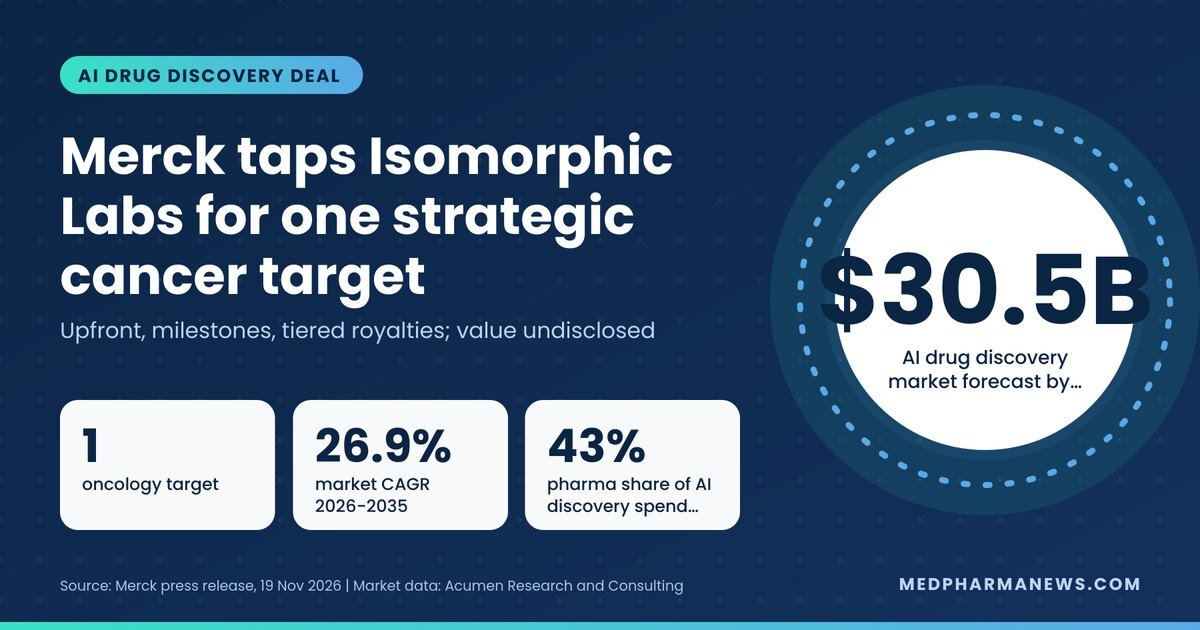
The Merck Isomorphic Labs collaboration, announced on 19 November 2026, pairs Merck & Co. (known as MSD outside the US and Canada) with the Alphabet-backed AI drug designer to find small-molecule drug candidates against a single, undisclosed cancer target. Isomorphic will design molecules in silico with its IsoDDE engine using some of Merck’s proprietary data, while Merck takes on preclinical and clinical development, manufacturing and sales. Isomorphic receives an upfront payment, milestones and tiered royalties, but neither company disclosed a dollar value. The deal lands days after Isomorphic closed a record USD 5 billion Series C.
Key takeaways on the Merck Isomorphic Labs collaboration
- Scope: one oncology target “of strategic importance” to Merck; small molecules only.
- Split of work: Isomorphic designs, Merck develops and commercialises.
- Economics: upfront, research to commercial milestones and tiered royalties; amounts not disclosed.
- Twist: Isomorphic can choose to co-fund development in exchange for higher royalties.
- Context: Merck joins a partner list that already included Eli Lilly and Novartis.
Deal terms at a glance
| Term | What was disclosed |
|---|---|
| Announced | 19 November 2026, Rahway, New Jersey |
| Modality | Small molecules |
| Therapeutic area | Oncology, one undisclosed target |
| Isomorphic role | Computational prediction and molecule design with IsoDDE |
| Merck role | Supplies select proprietary data; runs preclinical, clinical, manufacturing, commercial |
| Payments to Isomorphic | Upfront; research, development, regulatory and commercial milestones; tiered royalties |
| Optional upside | Co-funding option for elevated royalties |
| Total deal value | Not disclosed |
Why a single-target deal is the interesting part
Big pharma’s early AI partnerships often bundled several targets under a large headline number. This agreement is deliberately narrow. Merck is handing Isomorphic one oncology target it considers strategically important and sharing internal data to train against it. That structure suggests Merck has a specific problem in mind, quite possibly a target that conventional medicinal chemistry has struggled to drug, and wants to test whether a structure-prediction-led design engine can produce better starting molecules faster.
George Addona, who heads discovery, preclinical development and translational medicine at Merck Research Laboratories, framed the bet around tight coordination of “wet-lab and dry-lab functions”. In plain terms, the value will come from how quickly Isomorphic’s designs are synthesised and tested in Merck’s labs, and how fast those results feed back into the model.
The co-funding option shows where Isomorphic is heading
The most telling clause is Isomorphic’s right to co-fund development for richer royalties. A pure design-services company would not ask for it. A company sitting on fresh capital and wanting more of the value of the drugs it designs would. Isomorphic’s USD 5 billion Series C earlier this month gives it the cash to exercise such options across its partnerships, moving it closer to a drug developer than a software vendor, even though it still has no disclosed clinical-stage asset of its own.
For Merck, the structure caps early cash exposure while keeping full development control. That matters as the company prepares for Keytruda’s loss of exclusivity later this decade and looks to rebuild its oncology pipeline through deals, as other recent moves such as the end of its nemtabrutinib programme show.
How Isomorphic’s partner roster compares
Isomorphic was spun out of Google DeepMind in 2021 and is led by chief executive Sir Demis Hassabis, with Max Jaderberg as president. Its first two big pharma partners, Eli Lilly and Novartis, signed in early 2024 with headline values in the low billions combined, and Novartis later expanded its pact. Merck is the third large drugmaker to sign publicly and the first to pick a single named-strategic oncology target in its announcement. Unlike those earlier deals, Merck and Isomorphic have not put a ceiling figure on this one, which makes direct comparison impossible for now.
Market context: AI in drug discovery
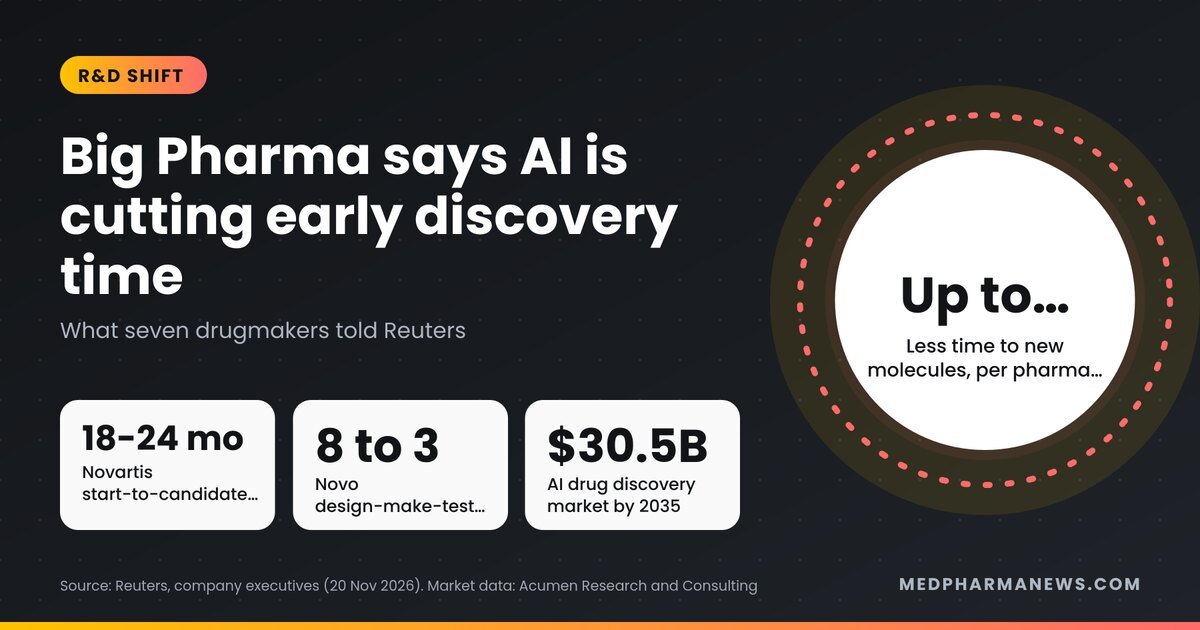
The deal fits a market growing at a fast clip. Acumen Research and Consulting values the AI in drug discovery market at USD 2.8 billion in 2025 and projects USD 30.49 billion by 2035, a CAGR of 26.9% over 2026 to 2035. Acumen estimates pharmaceutical companies were the largest end users in 2025 with a 43% share, ahead of biotech companies at 30%, and that cloud deployment accounted for 52% of the market. By our calculation, Acumen’s forecast implies the market will be roughly eleven times larger in 2035 than in 2025.
| Acumen metric | Value |
|---|---|
| Market size, 2025 | USD 2.8 billion |
| Forecast, 2035 | USD 30.49 billion |
| CAGR, 2026 to 2035 | 26.9% |
| Pharma end-user share, 2025 | 43% |
| Biotech end-user share, 2025 | 30% |
What to watch next
- Whether Merck or Isomorphic discloses the upfront or target in SEC filings or at investor events.
- The first development candidate nomination, which would trigger a milestone.
- Whether Isomorphic exercises its co-funding option, a signal of confidence in the molecule.
- Progress of any Isomorphic-designed molecule into human trials across its partnerships.
FAQ
What is the Merck and Isomorphic Labs deal worth?
Neither company disclosed the value. Isomorphic gets an upfront payment, milestones and tiered royalties.
What cancer target are Merck and Isomorphic working on?
The target has not been named. Merck describes it only as an oncology target of strategic importance.
What is IsoDDE?
IsoDDE is Isomorphic Labs’ drug design engine, which predicts molecular structures and interactions and proposes candidate molecules computationally.
Who owns Isomorphic Labs?
Isomorphic is an Alphabet company spun out of Google DeepMind, with outside investors joining in its recent funding rounds.
More deal analysis in Industry Insights.
Sources: Merck press release (19 Nov 2026); STAT News. Market data: Acumen Research and Consulting, AI in Drug Discovery Market report (updated September 2026). Not investment advice. Last updated 20 November 2026.