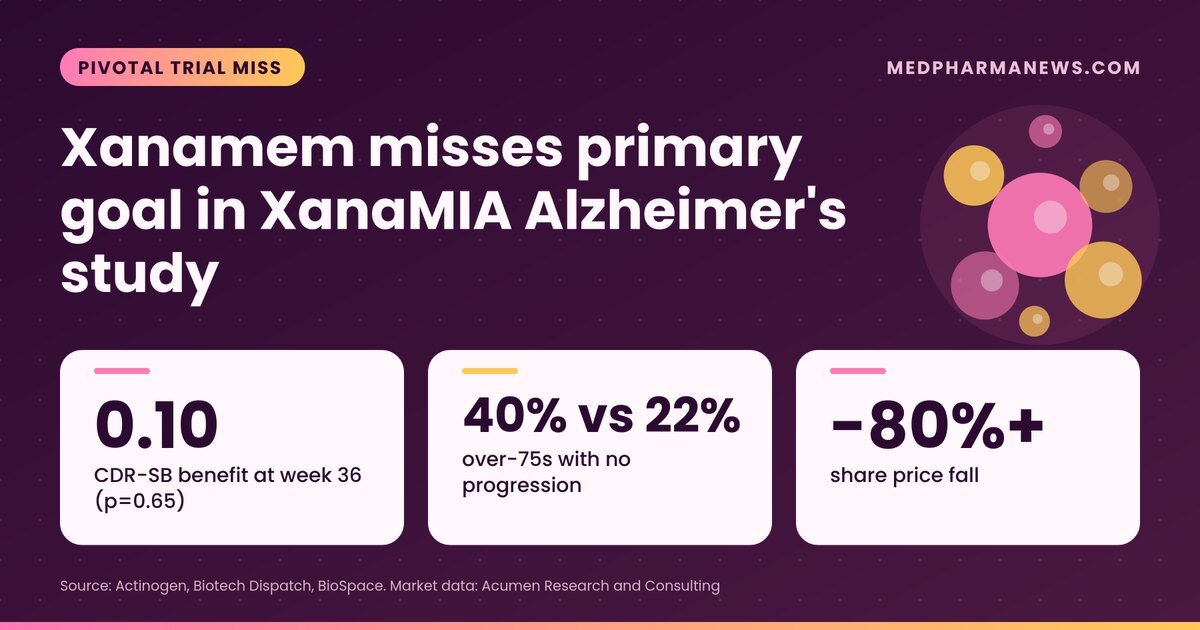
The pivotal Xanamem Alzheimer’s trial has missed its primary endpoint. Australian biotech Actinogen Medical said on 19 November 2026 that its once-daily oral drug Xanamem (emestedastat) did not significantly slow decline on the CDR-SB dementia scale after 36 weeks in the 247-patient XanaMIA study, and its shares fell by more than 80%. The company is now pinning its hopes on a signal in patients older than 75 and says it will take the data to partners and the US FDA.
Key takeaways on the Xanamem Alzheimer’s trial
- XanaMIA, a Phase 2b/3 trial of Xanamem 10 mg versus placebo, missed its primary goal: a 0.10-point CDR-SB difference at week 36 (p=0.65).
- A promising interim result from January (0.58 points at week 24 in 88 patients, p=0.03) did not hold up across the full study.
- In patients older than the median age of 75, 40% on Xanamem showed no CDR-SB progression versus 22% on placebo (p=0.02), a prespecified analysis.
- The mean benefit in that older group (0.39 points, which the company calls 30% slowing) was not statistically significant (p=0.22).
- No serious adverse events were attributed to the drug; Actinogen has suspended further Phase 3 spending and is seeking partners.
What XanaMIA tested
Xanamem takes a different route from the amyloid antibodies that dominate Alzheimer’s headlines. It is a small molecule that blocks 11β-HSD1, the enzyme that regenerates the stress hormone cortisol inside cells in the brain, liver and fat. The idea is that chronically high cortisol inside the brain contributes to cognitive decline, so lowering it locally could slow the disease without the brain swelling and infusion burden of antibody drugs.
XanaMIA enrolled 247 people with mild to moderate Alzheimer’s disease in Australia and the US. To enrich for active disease, patients needed raised levels of pTau181, a blood biomarker linked to Alzheimer’s pathology. They were randomized to 10 mg Xanamem or placebo once daily for 36 weeks, with CDR-SB, a standard 18-point measure of memory, judgment and daily function, as the primary endpoint.
The results side by side
| Analysis | Result | Statistically significant? |
|---|---|---|
| Full population, CDR-SB at week 36 (n=247) | 0.10-point benefit | No (p=0.65) |
| Interim futility analysis, week 24 (n=88) | 0.58-point benefit | Yes (p=0.03), not sustained |
| Over-75 subgroup, no CDR-SB progression | 40% vs 22% | Yes (p=0.02) |
| Over-75 subgroup, mean CDR-SB at week 36 | 0.39-point benefit (company: 30% slowing) | No (p=0.22) |
| Cognition and daily-living secondary endpoints | Small trends favouring Xanamem | Not reported as significant |
How much weight can the over-75 signal carry?
Actinogen frames the release as a trial that “demonstrates clinical benefit in older patients”, and it compares the 30% slowing in over-75s with the 27% reported for Eisai and Biogen’s Leqembi at 18 months and the 29% for Lilly’s Kisunla at 17.4 months. That comparison deserves caution. Those antibody figures came from far larger trials that met their primary endpoints, while the Xanamem number comes from roughly half of a 247-person study, over 36 weeks, and the mean difference was not significant. The responder analysis (40% versus 22% with no progression) did reach significance and was prespecified, which is why the company has not abandoned the programme, but the absolute gap of 18 percentage points, by our calculation, rests on small numbers.
There is a plausible biological story, since cortisol exposure and Alzheimer’s risk both rise with age, and more than 70% of people with the disease are older patients, according to Actinogen. Still, a subgroup that emerges after a failed primary endpoint is a hypothesis, not proof. Regulators typically want a fresh, adequately powered trial in that population. Chief executive Steven Gourlay said the company remains “confident in the risk-benefit profile of Xanamem in mild to moderate Alzheimer’s disease.”
The business fallout
For Actinogen, Xanamem is the only disclosed pipeline asset, which explains the scale of the sell-off. The company reported $18.9 million in cash and no debt at the time of the announcement, with a runway into 2028 because spending commitments fall sharply from early 2027. It has suspended future Phase 3 spending, filed a new patent covering treatment of older patients with more advanced disease, and says it will look for co-development partners. An open-label extension, which closed enrolment at 168 participants, continues, with the next update expected in the first quarter of 2027.
The miss lands in a busy week for Alzheimer’s research. At CTAD 2026, Eisai and Biogen reported five-year Leqembi extension data, covered in our Leqembi five-year analysis, while several non-amyloid approaches stumbled. For investors, the Actinogen result underlines how hard it remains to show disease modification with oral drugs aimed at alternative mechanisms. See more in our pharmaceuticals section.
Market context
Demand for new Alzheimer’s options is not in doubt. Acumen Research and Consulting projects the global Alzheimer’s disease treatment market to reach around USD 5,647.5 million by 2027, growing at a CAGR of about 12.8%. Acumen’s report also cites CDC estimates that the number of Americans with Alzheimer’s could reach roughly 14 million by 2060. A cheap, well-tolerated pill for older patients would address a large unmet need, which is why partners may still look closely at the data despite the headline failure.
What to watch next
- Full XanaMIA data, including the size of the over-75 subgroup and secondary endpoint statistics.
- Feedback from the FDA on whether an older-patient trial could support registration.
- Any partnership deal, which would decide whether Xanamem gets another pivotal study.
- Open-label extension results due in Q1 2027, covering about 100 participants with at least 24 weeks of treatment.
FAQ
Did Xanamem work for Alzheimer’s?
Not in the overall population. The XanaMIA trial missed its primary CDR-SB endpoint at 36 weeks. A prespecified responder analysis in patients over 75 was significant, but that is a subgroup finding that needs confirmation.
How does Xanamem work?
It blocks the enzyme 11β-HSD1 to reduce cortisol production inside brain cells, rather than targeting amyloid plaques like Leqembi or Kisunla.
Why did Actinogen shares fall so much?
Xanamem is the company’s only disclosed drug, so a failed pivotal trial removed most of its expected value. Shares dropped by more than 80% after the announcement.
Sources: Biotech Dispatch; BioSpace; Actinogen ASX announcement. Market data: Acumen Research and Consulting. Not medical or investment advice. Last updated 20 November 2026.