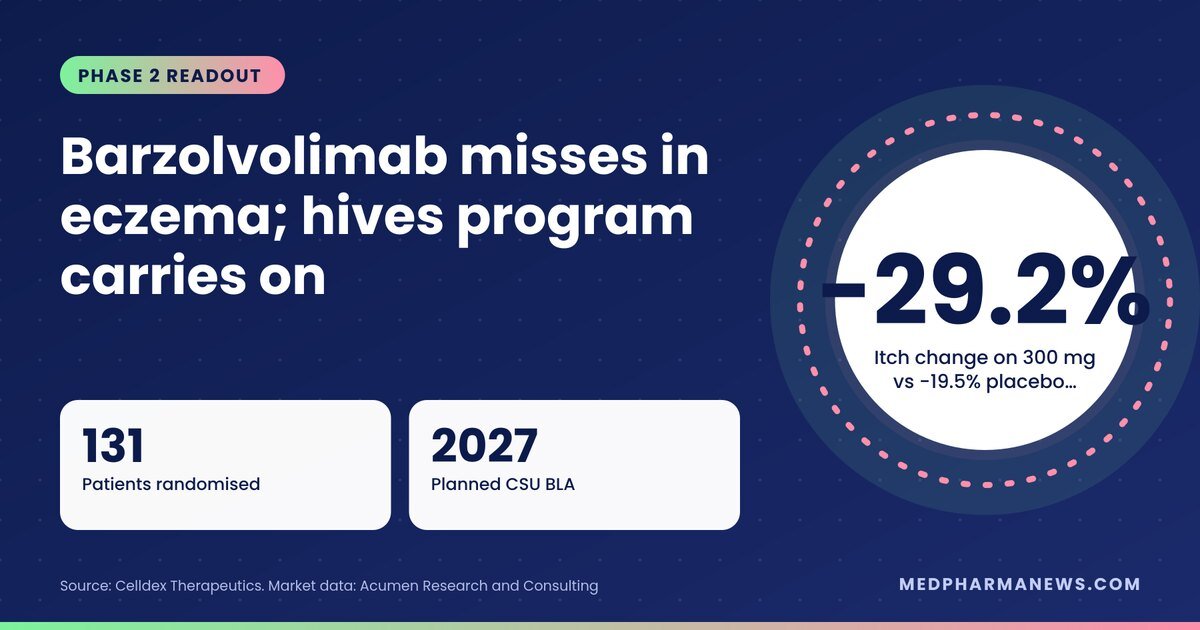
Celldex Therapeutics is ending development of barzolvolimab in atopic dermatitis after a 131-patient Phase 2 study, reported on 19 November 2026, failed to separate from placebo on its primary itch endpoint at either dose. At week 16, patients on the 300 mg dose saw their peak itch score fall 29.2% against 19.5% on placebo (p=0.187), while the 150 mg dose did worse than placebo. The decision narrows the mast-cell antibody back to the hives indications where it has already delivered positive Phase 3 data, with a US filing planned for 2027.
Key takeaways on barzolvolimab atopic dermatitis
- The Phase 2 trial (NCT06727552) missed its primary endpoint, percent change in weekly Peak Pruritus NRS at week 16, at both 150 mg and 300 mg every four weeks.
- Key secondary measures of skin clearance, EASI and IGA 0/1, did not meaningfully differ from placebo, and longer dosing to week 32 did not help.
- The drug still depleted mast cells, shown by rapid, deep falls in blood tryptase, so the failure points to biology rather than a dosing problem.
- Celldex says mast cells contribute to eczema but are not a primary driver of it.
- Chronic spontaneous urticaria (CSU) remains the lead program, with a BLA expected in 2027; Phase 3 studies in cold urticaria and symptomatic dermographism are enrolling.
The numbers behind the miss
The study enrolled adults with moderate to severe atopic dermatitis at 28 US centres and randomised them equally to barzolvolimab 150 mg, 300 mg (both after a 450 mg loading dose) or placebo for 16 weeks. Placebo patients then crossed over to active drug for a further 16 weeks. Notably, Celldex designed the trial with a relaxed statistical bar, a type I error threshold of p=0.1 with 80% power, typical of a proof-of-concept study. Even against that lower hurdle, neither arm qualified.
| Week 16 arm | Change in peak itch (PP-NRS) | Difference vs placebo (90% CI) | p-value |
|---|---|---|---|
| Placebo | -19.5% | – | – |
| Barzolvolimab 150 mg Q4W | -16.2% | +3.3 (-8.7 to 15.3) | 0.651 |
| Barzolvolimab 300 mg Q4W | -29.2% | -9.7 (-21.7 to 2.4) | 0.187 |
By our calculation, the best arm delivered a placebo-adjusted itch reduction of under 10 percentage points. For context, approved eczema biologics are generally judged on whether a large share of patients reach a meaningful itch improvement of several points on the 0 to 10 scale, and a lower dose underperforming placebo is a further sign there was no consistent drug effect. Celldex described some benefit but said it fell short of its internal hurdle for continued development. Safety was described as favourable and in line with earlier studies, though the release gave no adverse event rates.
Why a mast-cell drug that works in hives failed in eczema
Barzolvolimab is a monoclonal antibody that blocks KIT, the receptor mast cells depend on to survive. Remove the signal and mast cells die off, which is exactly what tryptase readings showed in this study. In chronic urticaria, where mast cells release the histamine that causes wheals and itch, that approach has produced strong results. Atopic dermatitis is different: its inflammation is driven mainly by type 2 immune signalling through cytokines such as IL-4, IL-13 and IL-31, plus a damaged skin barrier. The new data suggest that clearing mast cells does not switch off that core loop. For the field, that is a useful negative result; it argues against mast-cell depletion as a stand-alone eczema strategy and supports the cytokine-targeted approach that dominates the market today.
What is left in the barzolvolimab pipeline
- Chronic spontaneous urticaria: two Phase 3 studies reported in September 2026 met their primary and all key secondary endpoints at 12 weeks. Treatment continues to 52 weeks, and Celldex plans a BLA submission in 2027.
- Cold urticaria and symptomatic dermographism: the EMBARQ-ColdU and EMBARQ-SD Phase 3 trials are enrolling.
- New indications: the company says more will be announced by year end, without naming them.
Chief executive Anthony Marucci framed the setback around those programs, saying the company has “delivered best in disease data in chronic spontaneous urticaria, cold urticaria and symptomatic dermographism.” Stopping eczema work also frees spending for the hives launch preparation. Celldex shares fell a little over 3% in extended trading after the update, according to Reuters, a muted move that suggests investors had placed most of the drug’s value on CSU.
Market context: itch is a big target
The commercial prize for any itch-relieving drug is substantial. Acumen Research and Consulting estimates the global pruritus therapeutics market at USD 8.4 billion in 2022, rising to USD 12.1 billion by 2032 at a 3.9% compound annual growth rate, with atopic dermatitis the largest disease segment and North America the leading region. Those figures date from September 2023 and are indicative. They underline why Celldex tested barzolvolimab in eczema, and why urticaria, a smaller but less crowded segment within the same market, is now its clearer path.
What to watch next
The key milestones are 52-week CSU durability and safety data, the 2027 BLA filing, and the new indications Celldex has promised before the end of 2026. A full presentation of the eczema data, including the missing EASI and IGA figures and adverse event rates, would also help clinicians judge whether any subgroup responded. This is the latest in a run of mid-stage setbacks we have tracked, including Actinogen’s Xanamem miss and Merck’s nemtabrutinib exit.
FAQ
Did barzolvolimab work for eczema?
No. In Phase 2, neither dose significantly reduced itch versus placebo at week 16, and skin clearance scores were similar to placebo.
Is Celldex stopping barzolvolimab entirely?
No. Only the atopic dermatitis program ends. Development continues in chronic spontaneous urticaria, cold urticaria and symptomatic dermographism.
When could barzolvolimab be approved for hives?
Celldex plans to submit a BLA for chronic spontaneous urticaria in 2027. Approval timing would depend on FDA review.
Sources: Celldex Therapeutics press release; Reuters. Market data: Acumen Research and Consulting. More in Pharmaceuticals. Not medical or investment advice. Last updated 21 November 2026.