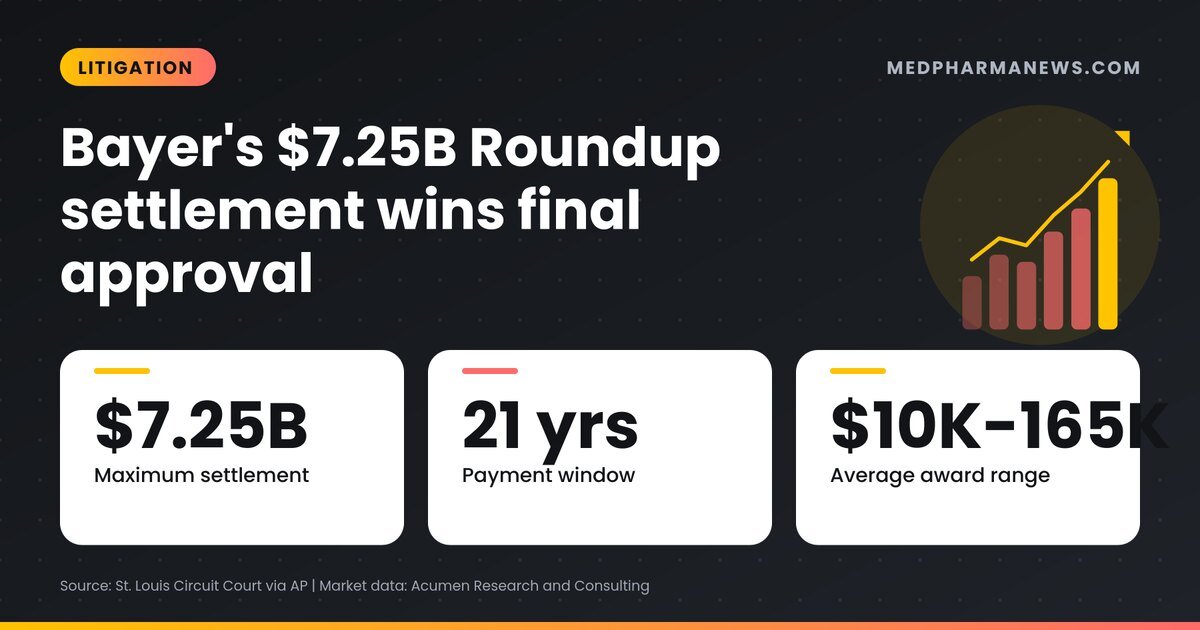
The Roundup settlement is now final. On Friday, 20 November 2026, Judge Timothy Boyer of the St. Louis Circuit Court in Missouri approved Bayer’s class settlement of up to $7.25 billion to resolve current and future claims that its Roundup weed killer causes non-Hodgkin lymphoma. Payments will flow into a dedicated fund for up to 21 years, with average awards ranging from about $10,000 to $165,000 depending on exposure, age at diagnosis and disease severity, according to the Associated Press.
Key takeaways on the Roundup settlement
- Final approval came on 20 November 2026 in a written judgment from Judge Timothy Boyer.
- Bayer will pay up to $7.25 billion over as long as 21 years into a special fund.
- The class covers people already diagnosed with non-Hodgkin lymphoma and those diagnosed in future, if exposed to Roundup before the deal was proposed in February 2026.
- Average payouts run from roughly $10,000 to $165,000.
- Bayer still denies that Roundup causes cancer; the judgment can be appealed.
How the payouts are tiered
Unlike a typical mass tort deal that pays a fixed pool to people who have already sued, this is a class settlement that also binds people who may be diagnosed years from now. That is why it runs so long and why the payment grid matters more than the headline figure.
| Claimant profile (as described by AP) | Average award |
|---|---|
| Agricultural, industrial or turf workers with long exposure, diagnosed with an aggressive form before age 60 | About $165,000 |
| Other claimants, depending on how the product was used, age at diagnosis and severity | Between the two ends of the range |
| People diagnosed at age 78 or older | About $10,000 |
Roughly 200,000 Roundup-related claims have been filed against Bayer over the years. By our calculation, if the full $7.25 billion were split evenly across that many claims, it would come to about $36,000 each before legal fees, though actual awards will depend on the grid and on how many future claimants come forward.
Why Bayer wanted a class deal
Bayer inherited Roundup when it bought Monsanto in 2018, and the litigation has weighed on the company ever since. AP reports the new deal sits on top of about $16 billion Bayer had earlier earmarked for Roundup cases. Jury verdicts have swung both ways: a Georgia jury awarded $2.1 billion earlier, while in October a Missouri jury sided with Bayer on design defect, negligence and fraud claims.
The US Supreme Court changed the picture in June, ruling that Bayer cannot be sued in state courts on failure-to-warn claims about cancer, because federal pesticide rules do not require a cancer warning and states cannot add labelling requirements. That narrowed one major legal theory, but other claims remained. A class settlement covering future diagnoses is designed to cap the long tail. Chief executive Bill Anderson called the approval “a decisive milestone” in reducing the risk from pending and future Roundup litigation.
The science dispute behind the lawsuits
Roundup’s active ingredient, glyphosate, has been on the market since the product launched in 1974. In 2015 the World Health Organization’s cancer research agency, IARC, classified glyphosate as “probably carcinogenic to humans”, largely on the basis of limited human evidence for non-Hodgkin lymphoma. The US Environmental Protection Agency has concluded that glyphosate is not likely to cause cancer in humans when used according to the label. Bayer has removed glyphosate from new residential Roundup formulations, though it remains in agricultural products.
The settlement does not resolve that scientific disagreement. It is a financial and legal resolution, not a finding that Roundup causes cancer.
Critics and what happens next
Not every lawyer is on board. Some plaintiffs’ attorneys argued at a September fairness hearing that the payments are too small, particularly for people who will only be diagnosed in the future and who are bound by terms set today. Court-appointed class counsel Christopher Seeger, by contrast, said the order delivers guaranteed compensation to people who have waited more than a decade. Judge Boyer found the payouts fair and adequate and described the total as among the largest mass tort personal-injury class settlements on record.
Objectors can still appeal, which could delay payments. Claimants should watch for notices from the settlement administrator on filing deadlines and documentation such as proof of diagnosis and exposure. For more on large pharma and health-sector settlements, see our coverage of the Teva generic drug price-fixing settlement. On Bayer’s pharmaceutical side, read about the FDA approval of its stroke pill Sunharbo.
Market context: herbicides
Glyphosate remains one of the world’s most widely used herbicides, which is why the litigation has mattered so much to Bayer’s crop science business. Acumen Research and Consulting projected the global herbicides market to reach about US$44.5 billion by 2027, growing at around 5.1% a year from 2020, with Asia-Pacific holding the largest share and synthetic, selective herbicides leading by segment. That report was last updated in 2020, so the figures are dated and indicative.
FAQ
Was the Roundup settlement approved?
Yes. Judge Timothy Boyer of the St. Louis Circuit Court gave final approval on 20 November 2026. It can still be appealed.
How much will I get from the Roundup settlement?
Average awards range from about $10,000 to $165,000, based on how you used Roundup, your age at diagnosis and how severe the lymphoma is.
Who qualifies for the Roundup class action?
People exposed to Roundup before February 2026 who have been, or are later, diagnosed with non-Hodgkin lymphoma, unless they opted out.
Does Roundup cause cancer?
Regulators disagree. IARC classifies glyphosate as probably carcinogenic; the US EPA says it is not likely to cause cancer when used as directed. Bayer denies any link.
Sources: St. Louis Circuit Court judgment of 20 November 2026 as reported by the Associated Press; IARC and US EPA assessments of glyphosate. Market data: Acumen Research and Consulting. More in Industry Insights. Not legal, medical or investment advice. Last updated 22 November 2026.