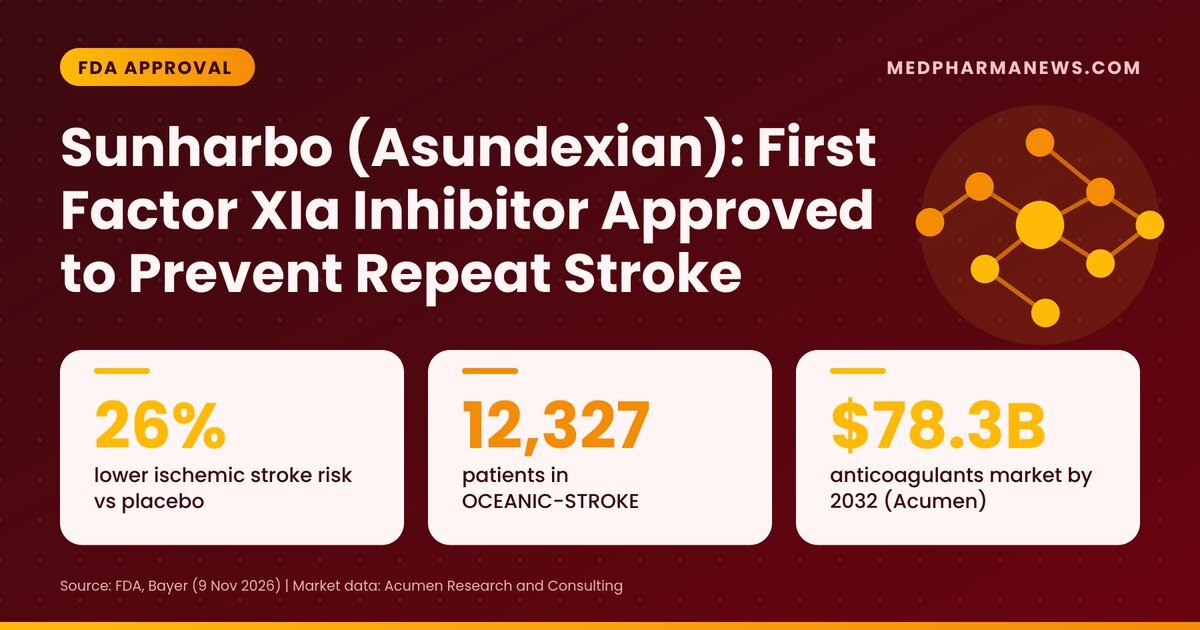
The asundexian FDA approval gives doctors a new kind of blood thinner for people who have just had a stroke. On 9 November 2026 the US Food and Drug Administration approved Bayer’s Sunharbo (asundexian) 50 mg tablets, the first factor XIa inhibitor cleared in the United States, for use with antiplatelet therapy to reduce the risk of stroke in adults after a recent mild-to-moderate non-cardioembolic ischemic stroke or a high-risk transient ischemic attack (TIA, often called a mini-stroke). In the Phase 3 OCEANIC-STROKE trial of 12,327 patients, once-daily Sunharbo cut the risk of ischemic stroke by 26% compared with placebo over a median of 14.2 months, while overall major bleeding was similar between the groups.
Key takeaways on the asundexian FDA approval
- Sunharbo is the first approved drug in a new anticoagulant class that targets factor XIa.
- It is taken as one 50 mg tablet a day, added to standard antiplatelet therapy.
- It reduced ischemic stroke risk by 26% versus placebo in 12,327 patients.
- Major bleeding was similar overall, but higher in people over 75 and during the first 90 days.
- It is not approved for stroke prevention in atrial fibrillation.
Who Sunharbo is for
The label covers adults who have recently had a non-cardioembolic ischemic stroke, meaning the clot did not come from the heart, of mild-to-moderate severity, or a high-risk TIA. Patients in the trial had an NIH Stroke Scale score of 15 or less and were randomised within 72 hours of their symptoms starting. This is the setting known as secondary stroke prevention, where the goal is to stop a second, often more disabling stroke. The FDA announcement noted that stroke is a leading cause of disability and death in the United States and that survivors remain at risk of another event.
OCEANIC-STROKE results at a glance
| Measure | Result |
|---|---|
| Design | Multicentre, randomised, double-blind, placebo-controlled Phase 3 |
| Patients | 12,327 adults, all also on antiplatelet therapy |
| Dose | Asundexian 50 mg once daily |
| Median treatment | 14.2 months |
| Ischemic stroke | 26% relative risk reduction vs placebo |
| Any stroke (as reported from the trial) | 6.6% vs 8.8%; hazard ratio 0.74 |
| Major bleeding | Similar overall; higher in patients over 75 and in the first 90 days |
| Most common side effect | Diarrhoea (at least 3% of patients) |
By our calculation, the any-stroke figures equal an absolute reduction of 2.2 percentage points, or roughly one stroke prevented for every 45 patients treated over the trial period. That is a simple estimate from headline numbers and not a substitute for the full trial publication. Gastrointestinal bleeding was more common with Sunharbo than with placebo.
How factor XIa inhibitors work
Existing oral anticoagulants such as apixaban and rivaroxaban block factor Xa, a central step in clotting. Factor XIa sits further up the chain and mainly amplifies thrombin generation; it plays a smaller role in forming the plug that seals an injured blood vessel. That is why researchers have long hoped factor XI drugs could prevent dangerous clots with less bleeding. Earlier attempts to add an anticoagulant to antiplatelet therapy after stroke failed because of too little benefit, too much bleeding, or both, which makes OCEANIC-STROKE a notable result.
Label restrictions and safety
- Not recommended with drugs that combine P-gp and strong CYP3A4 induction, such as carbamazepine, which may reduce its effect.
- Not recommended in moderate or severe liver impairment.
- Should be withheld for at least 24 hours before elective surgery or invasive procedures, and for at least 24 hours after clot-busting thrombolysis for acute stroke.
- Not approved for atrial fibrillation. Bayer’s separate OCEANIC-AF trial in atrial fibrillation was stopped early in 2023 after asundexian proved less effective than apixaban.
What the approval means for Bayer and the anticoagulant market
The approval came under Fast Track and Priority Review, and trade press has described Sunharbo as a potential blockbuster. For Bayer, whose older anticoagulant Xarelto now faces generic competition in several markets, a first-in-class stroke drug offers a new growth platform. According to Acumen Research and Consulting, the global anticoagulants market was valued at USD 37.2 billion in 2023 and is expected to reach USD 78.3 billion by 2032, a CAGR of 8.8% from 2024 to 2032. Acumen reports that North America accounted for about USD 18.2 billion in 2023, that Asia-Pacific is set to grow at more than 9.7% a year, and that factor Xa inhibitors (NOACs/DOACs) were the largest drug-class segment. A new factor XIa class could start to compete for part of that spending, starting in secondary stroke prevention. Acumen also projects the wider stroke management market to reach around USD 50 billion by 2027.
For related cardiovascular coverage, see our reports on Boston Scientific’s WATCHMAN SIMPLAAFY trial and Terumo Neuro’s Arsenal Medical deal, or browse our pharmaceuticals section.
What to watch next
- US launch timing and price, which Bayer has not detailed in the announcement.
- Uptake by stroke neurologists, and how guidelines position Sunharbo alongside antiplatelet therapy.
- Decisions by regulators outside the US.
- Results from other factor XI programmes in development across the industry.
FAQ: asundexian (Sunharbo)
What is asundexian used for?
Asundexian (Sunharbo) is used with antiplatelet therapy to lower the risk of another stroke in adults after a recent mild-to-moderate non-cardioembolic ischemic stroke or high-risk TIA.
Is asundexian a blood thinner?
Yes. It is an oral anticoagulant that blocks factor XIa, a different target from warfarin or factor Xa inhibitors such as apixaban.
Can asundexian be used for atrial fibrillation?
No. The FDA label states it is not approved for stroke prevention in atrial fibrillation.
What are the side effects of Sunharbo?
Diarrhoea was the most common side effect. Bleeding risk, including gastrointestinal bleeding, is the main safety concern, especially in patients over 75 and early in treatment.
Sources: FDA press announcement (9 November 2026); Bayer announcement; OCEANIC-STROKE data as reported by medical press. Market figures are attributed to Acumen Research and Consulting; calculations marked as ours are our own. This article is for information and is not medical advice. Last updated 10 November 2026.