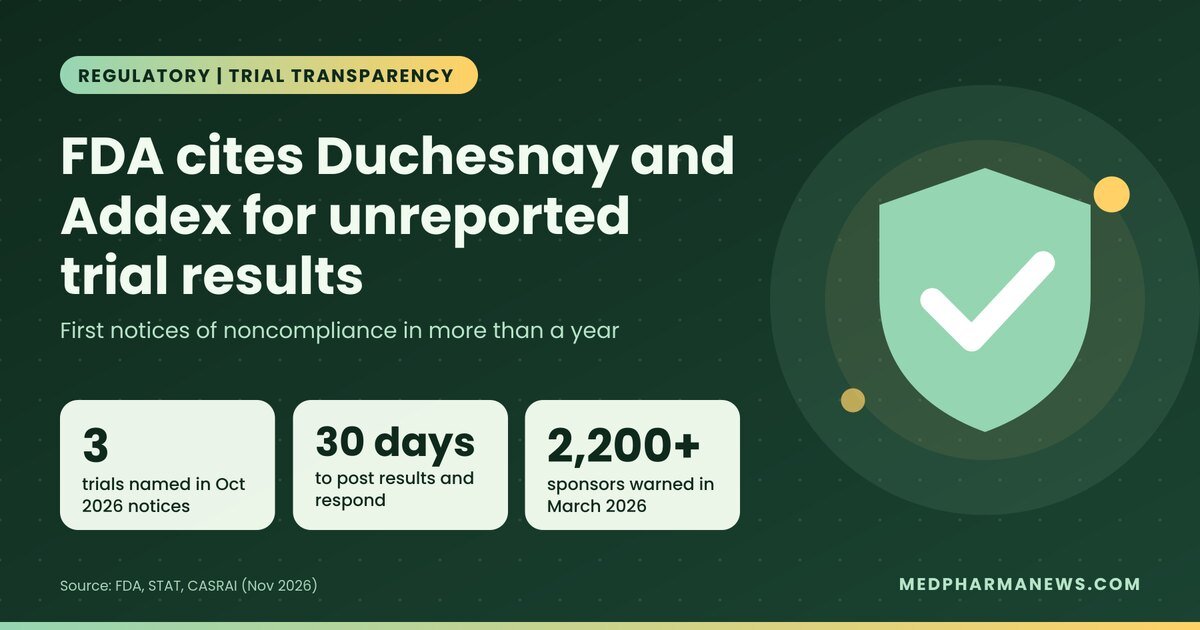
The FDA has issued FDA notices of noncompliance to two drugmakers, Duchesnay Inc. and Addex Pharma S.A., for failing to post required clinical trial results to ClinicalTrials.gov, in what STAT reported on 24 November 2026 as the agency’s first such notices in more than a year. The three notices, dated 7 and 19 October 2026, give each company 30 days to submit the missing results or face possible civil money penalties.
Key takeaways on FDA notices of noncompliance
- Addex received two notices over Parkinson’s disease studies of dipraglurant; Duchesnay received one over a Diclegis study in pregnant adolescents.
- All three trials passed their primary completion dates years ago (2017 and 2022) with no results posted.
- Each notice sets a 30-day window to submit results and respond in writing.
- The FDA’s public list now shows 11 notices in total since the reporting law took effect, which underlines how rarely the tool is used.
- The actions follow the FDA’s March 2026 reminders to more than 2,200 sponsors covering over 3,000 trials.
The three trials named
| Sponsor | Trial (NCT) | Drug and setting | Primary completion | Notice date |
|---|---|---|---|---|
| Duchesnay Inc. | NCT02045901 | Diclegis (doxylamine-pyridoxine), nausea and vomiting of pregnancy in adolescents | March 2017 | 19 Oct 2026 |
| Addex Pharma S.A. | NCT05116813 | Dipraglurant, open-label safety study in Parkinson’s disease | 17 June 2022 | 7 Oct 2026 |
| Addex Pharma S.A. | NCT04857359 | Dipraglurant, Phase 2b/3 study in Parkinson’s dyskinesia | 17 June 2022 | 7 Oct 2026 |
By our calculation, the Duchesnay results were more than eight years past primary completion when the notice went out, and the Addex results more than four years past. Under the law, results are generally due within 12 months of primary completion unless a sponsor files a certification of delay, an extension or a waiver.
The paper trail shows the FDA warned first. Addex was alerted in a letter dated 3 July 2025 and Duchesnay in March 2026, with follow-up emails before the formal notices. The Duchesnay notice also notes that results had been started in the registry’s data system in June 2022 but never completed; the agency says preliminary entries of that kind do not count as a submission.
What the law requires
Section 801 of the FDA Amendments Act of 2007 (FDAAA 801) and its final rule, 42 CFR Part 11, cover most interventional trials of FDA-regulated drugs, biologics and devices with a US connection. Phase 1 drug studies and small device feasibility studies are excluded. Sponsors must register a covered trial within 21 days of enrolling the first participant and post summary results within a year of primary completion. Failing to do so is a prohibited act under the Federal Food, Drug, and Cosmetic Act.
If a sponsor does not fix the problem within 30 days of a notice, the FDA says it may pursue enforcement that could include civil money penalties, injunctions or criminal prosecution. Law firm Greenberg Traurig puts the current inflation-adjusted maximum civil penalty at up to $15,107 per day of continued violation.
Why the FDA is acting now
Trial transparency has been a long-running gap between the law and its enforcement. On 13 April 2026 the FDA announced it had contacted more than 2,200 sponsors and researchers about more than 3,000 trials that appeared to be missing results or stuck in ClinicalTrials.gov’s quality control review. Its internal analysis found about 29.6% of likely applicable studies had no results posted. Commissioner Marty Makary framed the push bluntly: “Far too often, companies are suppressing unfavorable clinical trial results.”
Those spring letters were reminders, not formal notices. The October notices show that at least some cases are now moving to the enforcement track. A King and Spalding review cited by CASRAI counted 232 responsible parties with pre-notices on the FDA’s site as of April, against just 8 with full notices at that time.
Business read-through for sponsors
Neither company is a large-cap drugmaker, and neither trial is for a blockbuster. That is the point for the rest of the industry: the FDA appears to be working through its backlog by case, not by sponsor size. Smaller biotechs and specialty firms are most exposed because terminated or partnered programmes often lose the staff who would normally close out registry records. Practical steps for compliance teams include:
- Auditing every applicable trial, including terminated and out-licensed studies, against the 12-month results deadline.
- Checking that results marked as entered have actually cleared quality control review.
- Treating an FDA reminder or pre-notice as the start of a fixed clock, not a courtesy.
- Assigning registry ownership in partnership and divestiture agreements.
Reputational cost may matter more than fines. Notices are public and named, and investors and partners increasingly check registry hygiene in due diligence. For context on how regulators are tightening oversight elsewhere, see our coverage of the Teva generic price-fixing settlement and the latest industry insights.
What to watch
The 30-day windows from the October notices have now passed, so the next signal is whether results appear on ClinicalTrials.gov for the three NCT numbers or whether the FDA escalates. Neither company’s response had been published in the sources we reviewed. A first civil money penalty under FDAAA 801 would be a meaningful precedent; none has been widely reported to date.
FAQ
What is an FDA notice of noncompliance?
It is a formal FDA letter telling a trial sponsor it has failed to register a trial or submit results to ClinicalTrials.gov as the law requires, giving 30 days to correct the problem before possible enforcement.
Which companies did the FDA cite in 2026?
Duchesnay Inc., over a Diclegis trial, and Addex Pharma S.A., over two dipraglurant Parkinson’s disease trials.
What is the penalty for not reporting trial results?
The FDA can seek civil money penalties, currently up to about $15,107 per day according to Greenberg Traurig, as well as injunctions or criminal action. Federally funded researchers can also lose grant funding.
How long do sponsors have to post results?
Generally no later than one year after the trial’s primary completion date, unless a delay certification, extension or waiver applies.
Sources: FDA ClinicalTrials.gov notices of noncompliance; FDA announcement, 13 April 2026; STAT; CASRAI; Greenberg Traurig. Not legal or investment advice. Last updated 25 November 2026.