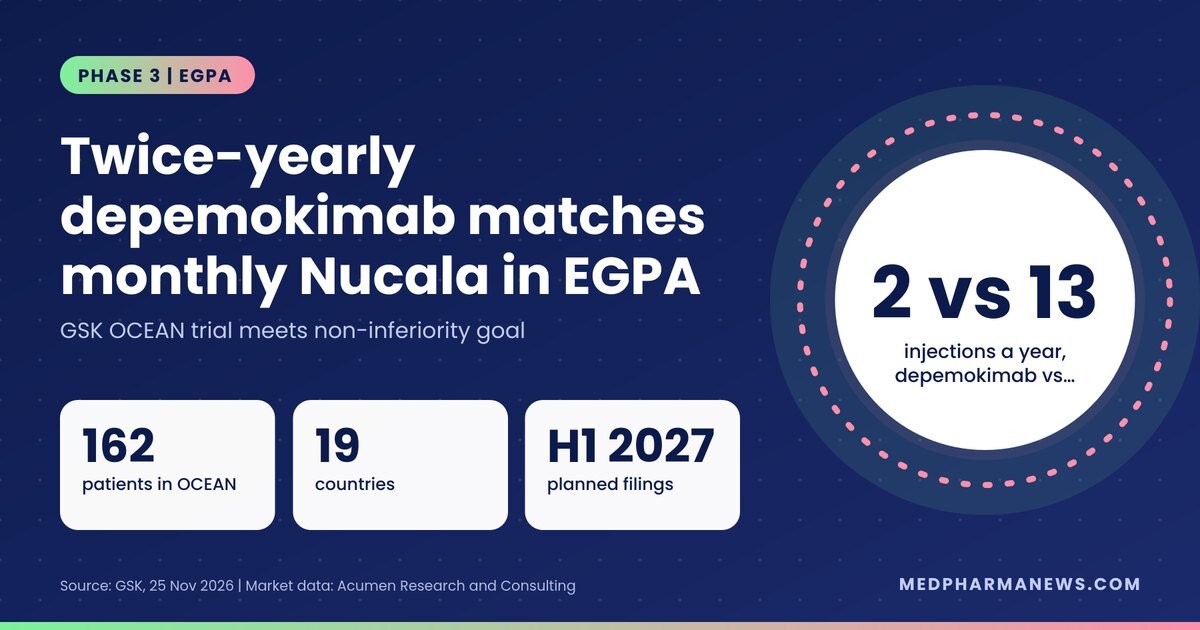
GSK said on 25 November 2026 that depemokimab EGPA data from the phase III OCEAN trial met the primary endpoint, with its twice-yearly antibody Exdensur proving non-inferior to the company’s own monthly Nucala (mepolizumab) at putting patients with eosinophilic granulomatosis with polyangiitis into remission. The 162-patient study ran for 52 weeks across 19 countries, and GSK plans to file with regulators in the first half of 2027.
Key takeaways on depemokimab EGPA
- OCEAN compared depemokimab 200 mg every 26 weeks with mepolizumab 300 mg every 4 weeks, both on top of standard corticosteroid-based care.
- The primary endpoint was remission, defined as a Birmingham Vasculitis Activity Score (BVAS) of 0 plus an oral corticosteroid dose of 4 mg a day or less at both week 36 and week 52.
- Adverse events were similar in incidence and severity between arms; GSK has not yet released remission rates or confidence intervals.
- Depemokimab is approved for severe asthma in the US and for severe asthma and nasal polyps in the EU, UK, Japan and China, but not for EGPA anywhere.
- GSK shares rose about 1% in London on the news.
OCEAN at a glance
| Design feature | Depemokimab (Exdensur) | Mepolizumab (Nucala) |
|---|---|---|
| Dose | 200 mg | 300 mg |
| Interval | Every 26 weeks | Every 4 weeks |
| Injections in a year | 2 | 13 (by our calculation) |
| Background therapy | Oral corticosteroids, with or without immunosuppressants | |
| Population | Adults with relapsing or refractory EGPA; 162 participants, 19 countries | |
| Blinding | Randomised, double-blind, double-dummy | |
| Primary endpoint | Remission (BVAS 0 and steroids 4 mg/day or less) at weeks 36 and 52 | |
| Result | Non-inferiority met; similar safety | |
The double-dummy design matters: every patient received injections on both schedules, half of them placebo, so neither patients nor investigators could tell from the dosing pattern which drug was active. That makes the non-inferiority finding harder to dismiss as an artefact of open-label bias.
Why an ultra-long-acting option matters in EGPA
EGPA is a rare vasculitis, affecting an estimated 34 people per million worldwide, in which eosinophil-driven inflammation damages small and medium blood vessels. GSK notes that more than 90% of patients have asthma, about 54% have chronic rhinosinusitis with nasal polyps and 60% to 80% have ear, nose and throat complications. Left uncontrolled it can injure the heart, nerves and kidneys.
Standard care leans on high-dose oral steroids and immunosuppressants, which carry their own long-term harms and do not prevent relapse in many patients. Biologics that block the interleukin-5 pathway reduce eosinophils and allow steroid tapering. Depemokimab binds IL-5 with high affinity and has an extended half-life, which is what lets GSK dose it twice a year. GSK’s R&D head for respiratory and immunology, Kaivan Khavandi, said the data show the drug could help patients reach remission while “reducing the need for corticosteroids and other immunosuppressive therapies”.
The business logic: GSK cannibalising its own franchise
OCEAN is unusual in that GSK tested its new drug head-to-head against its own established product. Nucala was the first biologic approved for EGPA, so the comparator was the clearest benchmark available. Strategically, the trial gives GSK a path to move patients from a monthly to a twice-yearly regimen within its own portfolio before the older drug faces more competition, including from AstraZeneca’s Fasenra, which gained US approval in EGPA in 2024.
EGPA alone is a small market, but each new indication strengthens Exdensur’s pitch to payers and specialists in the larger asthma and nasal polyp segments, where convenience of two clinic visits a year is the main selling point. GSK is also exploring depemokimab in chronic obstructive pulmonary disease. For more on GSK’s recent pipeline wins, see our coverage of the Hibsago hepatitis B approval, and for another immunology readout this week, the Kymera KT-621 eczema data.
Market context
Depemokimab sits in the fastest-growing class of medicines. Acumen Research and Consulting valued the global monoclonal antibodies market at $195.6 billion in 2022 and projects $612.2 billion by 2032, a compound annual growth rate of 12.3%, with Asia-Pacific the fastest-growing region and human antibodies holding the largest share. Within that market, dosing frequency is becoming a competitive weapon as companies extend half-lives to cut clinic visits, a trend OCEAN supports.
What GSK has not disclosed yet
- Remission rates: the headline release gives no percentages for either arm, nor the non-inferiority margin.
- Secondary endpoints: relapse rates, steroid-sparing effect and time in remission will determine how clinicians compare the two drugs.
- Subgroups: results in refractory versus relapsing disease are not yet known.
- Pricing: whether GSK prices a twice-yearly regimen at parity with a year of Nucala will shape uptake.
GSK said full results will be presented at a scientific congress and published in a peer-reviewed journal before filings in the first half of 2027.
FAQ
What is depemokimab?
Depemokimab, sold as Exdensur, is GSK’s long-acting anti-IL-5 monoclonal antibody given as an injection every six months. It is approved for severe asthma with type 2 inflammation and, outside the US, for chronic rhinosinusitis with nasal polyps.
Is depemokimab approved for EGPA?
No. It is not approved for EGPA in any country. GSK plans regulatory submissions in the first half of 2027 based on OCEAN.
How does depemokimab compare with Nucala?
In OCEAN, twice-yearly depemokimab was non-inferior to monthly Nucala on remission at weeks 36 and 52, with similar side effects. Detailed efficacy numbers have not yet been published.
What is EGPA?
Eosinophilic granulomatosis with polyangiitis, formerly called Churg-Strauss syndrome, is a rare inflammatory disease of the blood vessels that usually occurs in people with asthma and can damage multiple organs.
Sources: GSK regulatory announcement, 25 November 2026 (RNS); ClinicalTrials.gov NCT05263934; Sharecast share price data; market data from Acumen Research and Consulting. Not medical or investment advice. More in Pharmaceuticals. Last updated 25 November 2026.