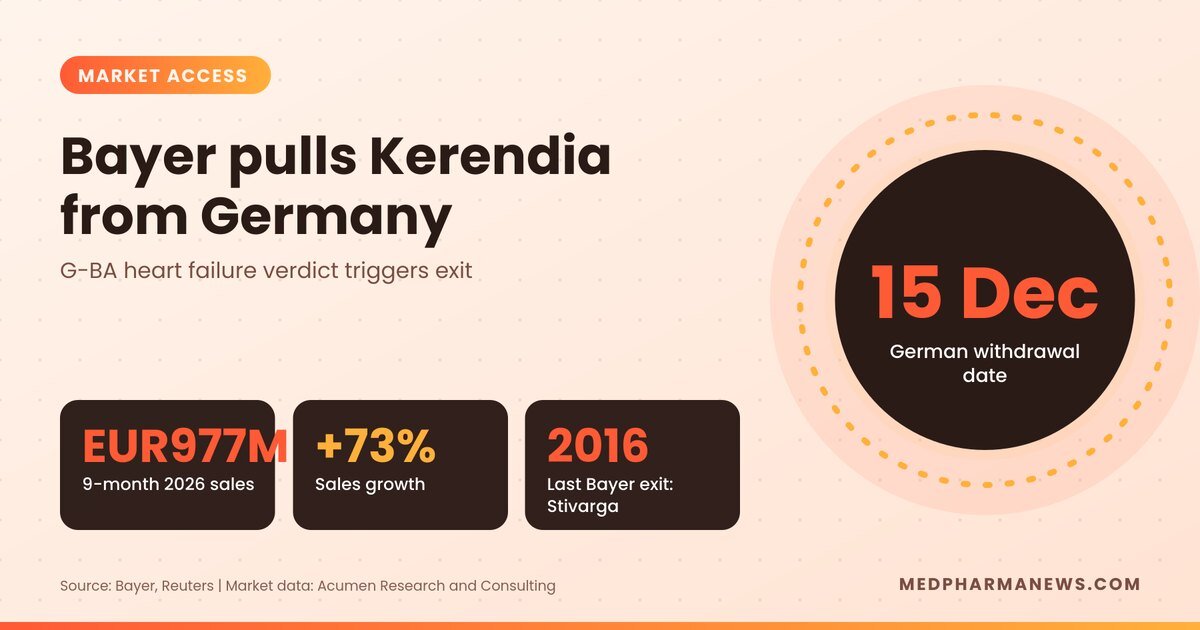
Kerendia Germany availability is ending: Bayer said on 24 November 2026 that it will withdraw its kidney and heart drug Kerendia (finerenone) from the German market from 15 December, after the country’s Federal Joint Committee (G-BA) ruled in October that the medicine offers no added benefit for certain patients with symptomatic chronic heart failure. Bayer says the reimbursement terms that follow from that ruling make continued sales commercially unviable. The marketing authorisation and supply in other countries are not affected.
The move lands while Kerendia is one of Bayer’s fastest-growing products. Nine-month sales rose 73% to €977 million (about $1.1 billion), driven mainly by the United States and China, according to Reuters.
Key takeaways on Kerendia Germany
- Bayer will stop marketing Kerendia in Germany from 15 December 2026.
- Trigger: an October 2026 G-BA decision of “no added benefit” over comparator therapy for certain symptomatic chronic heart failure patients.
- Bayer calls the resulting price conditions commercially unviable; authorisation and other markets are unaffected.
- Kerendia sales were €977 million in the first nine months of 2026, up 73%.
- Bayer previously pulled cancer drug Stivarga from Germany in 2016 for similar reasons.
How Germany’s benefit verdict turns into a price
Under Germany’s AMNOG system, a new medicine or a new indication can be sold at the company’s chosen price at launch, but the G-BA then assesses whether it offers an added benefit over an appropriate comparator. That rating drives the price that statutory health insurers will pay after negotiation. A verdict of no added benefit generally anchors the reimbursed price to the cost of the comparator, which for heart failure includes long-established, inexpensive generics.
Because a drug carries one reimbursed price in Germany regardless of indication, a weak score in a new, large indication can drag down the economics of the whole product. That appears to be what happened here: the October ruling concerned the heart failure use, yet the withdrawal covers Kerendia entirely, including its older kidney indication. Christian Lauterbach, head of Bayer’s German pharma business, argued that if the system does not recognise an innovation’s value, the drug “cannot remain permanently available”.
What Kerendia is used for
Finerenone is a once-daily, non-steroidal mineralocorticoid receptor antagonist. It was first approved for chronic kidney disease associated with type 2 diabetes, on the basis of the FIDELIO-DKD and FIGARO-DKD outcome trials, and later gained a heart failure indication for patients with a left ventricular ejection fraction of 40% or above, based on FINEARTS-HF. That heart failure group, often called HFmrEF and HFpEF, has had few proven options, which is why cardiologists watched the launch closely.
| Item | Detail |
|---|---|
| Drug | Kerendia (finerenone), Bayer |
| Class | Non-steroidal mineralocorticoid receptor antagonist |
| Uses | CKD with type 2 diabetes; chronic heart failure with LVEF 40% or more |
| G-BA decision | October 2026: no added benefit for certain symptomatic chronic heart failure patients |
| German withdrawal date | 15 December 2026 |
| 9-month 2026 sales | €977 million, up 73% |
| Precedent | Stivarga withdrawn from Germany in 2016 |
What it means for patients in Germany
Bayer has not, in the statements we have seen, set out how patients already taking Kerendia will be transitioned. Anyone on the drug in Germany should speak to their nephrologist, cardiologist or GP well before mid-December rather than stopping treatment on their own. Doctors can choose among other kidney-protective and heart failure therapies, such as SGLT2 inhibitors, ACE inhibitors or ARBs, and steroidal MRAs, though these are not interchangeable and the right switch depends on kidney function and potassium levels. This article does not give dosing or treatment advice.
Why Bayer is taking a hard line now
Germany is often a reference point for prices across Europe, and increasingly for the United States, where most-favoured-nation pricing pressure has made drugmakers wary of low list prices abroad. Accepting a generic-level price in Germany could ripple into other negotiations. By our reading, Bayer is betting that a modest loss of German revenue is cheaper than a lower reference price. The company has used the tactic before with Stivarga, and other drugmakers have withdrawn medicines from Germany after unfavourable assessments.
The timing also fits Bayer’s broader reset. The company has just secured final approval of its $7.25 billion Roundup settlement and is leaning on newer launches such as the stroke drug Sunharbo (asundexian) to replace revenue as older brands lose exclusivity. Bayer shares slipped about 1.8% intraday after the announcement.
Market context
The commercial stakes in heart failure are rising. Acumen Research and Consulting estimates the global congestive heart failure drugs market at $6.9 billion in 2022 and projects $26.1 billion by 2032, a compound annual growth rate of 14.3%, with ACE inhibitors holding the largest share by class. That gap between cheap legacy classes and newer branded agents is exactly the tension the German pricing system is built to police.
What remains unclear
- Which heart failure subgroups the G-BA decision covers in detail, and whether Bayer will appeal or seek a new assessment.
- Whether German patients will be able to obtain the drug through individual imports after 15 December.
- Whether medical societies in Germany will push for a negotiated compromise before the deadline.
More pricing and market access news is in our Pharmaceuticals section.
FAQ
Why is Kerendia being withdrawn in Germany?
The G-BA found no added benefit for certain chronic heart failure patients in October 2026, and Bayer says the reimbursement conditions that follow make German sales commercially unviable.
When will Kerendia stop being available in Germany?
Bayer will withdraw it from 15 December 2026.
Is Kerendia being withdrawn in other countries?
No. Bayer says the marketing authorisation and availability elsewhere are not affected.
What should German patients taking finerenone do?
Talk to the prescribing doctor before December about alternatives. Do not stop the medicine without medical advice.
Sources: Bayer statement as reported by Reuters and Bloomberg, 24 November 2026. Market data: Acumen Research and Consulting, Congestive Heart Failure Drugs Market report. Not medical or investment advice. Last updated 25 November 2026.