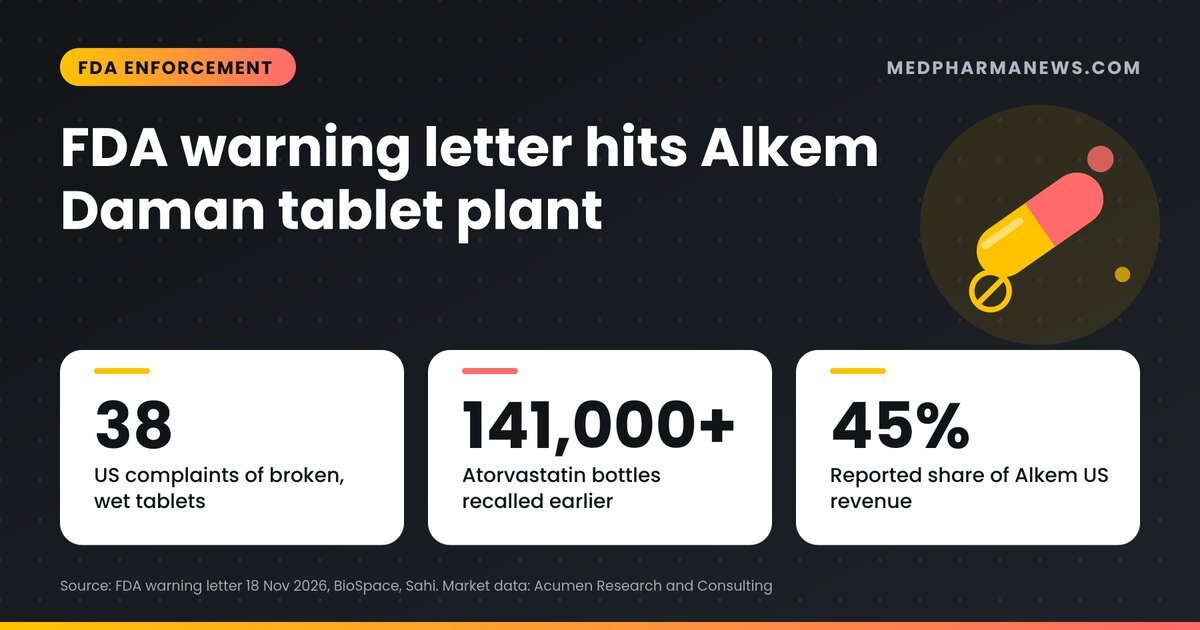
The US Food and Drug Administration has issued an Alkem FDA warning letter to the Mumbai-based generics maker, dated 18 November 2026, citing slow investigations into failing dissolution results, weak handling of customer complaints and lapses in equipment maintenance at its tablet plant at Amaliya, Daman. The plant reportedly supplies about 45% of Alkem’s US revenue, and the FDA warned it may withhold approval of new applications naming the site until the problems are fixed.
Key takeaways on Alkem FDA warning letter
- The letter follows an FDA inspection of the Daman plant from 20 April to 1 May 2026, later classified Official Action Indicated.
- FDA says a 2021 study had already linked new excipient suppliers to slower tablet dissolution, but Alkem did not open an investigation until batches failed in March 2025.
- Alkem recalled US batches of the affected tablet made between July 2024 and August 2025; some potentially affected batches stayed on the market until expiry.
- About 38 complaints of broken and wet tablets were logged in the US since September 2025, and complaints continued after Alkem’s fix.
- Alkem says it will respond on time and continues to supply approved products from the plant.
The four problems FDA put in writing
The published warning letter redacts product names, but its findings are specific. We have grouped them below.
| Finding | What inspectors saw | Regulation cited |
|---|---|---|
| Late dissolution investigation | Quality signals in 2021 and a low July 2022 batch result were not investigated until out-of-specification results in March 2025 | 21 CFR 211.192 |
| Weak complaint follow-up | About 38 US complaints of broken, wet tablets; fix did not stop complaints; field alert report filed only after the inspection began | 21 CFR 211.192 |
| Process not in control | Multiple batches failed dissolution since 2021; process parameters changed without scientific justification | 21 CFR 211.100(a) |
| Equipment oversight | Damaged parts destroyed without assessing product impact; rust-like marks on equipment cleaned weeks earlier | CGMP equipment rules |
The FDA rejected parts of Alkem’s May 2026 response as inadequate. In the agency’s words, the firm’s handling of parameters reflects “a deficient process validation program.” That language matters: it moves the case from one bad product to the way the whole site develops and controls its tablets.
The atorvastatin recall behind the inspection
The letter does not name the drug, but trade press including BioSpace linked the inspection to an earlier recall by Ascend Laboratories, Alkem’s US distributor, of more than 141,000 bottles of atorvastatin, the generic form of Lipitor, after tablets failed dissolution tests. Dissolution measures how quickly a tablet releases its drug. A tablet that dissolves too slowly may deliver less medicine than intended, which is why regulators treat repeated failures seriously even when no harm has been reported.
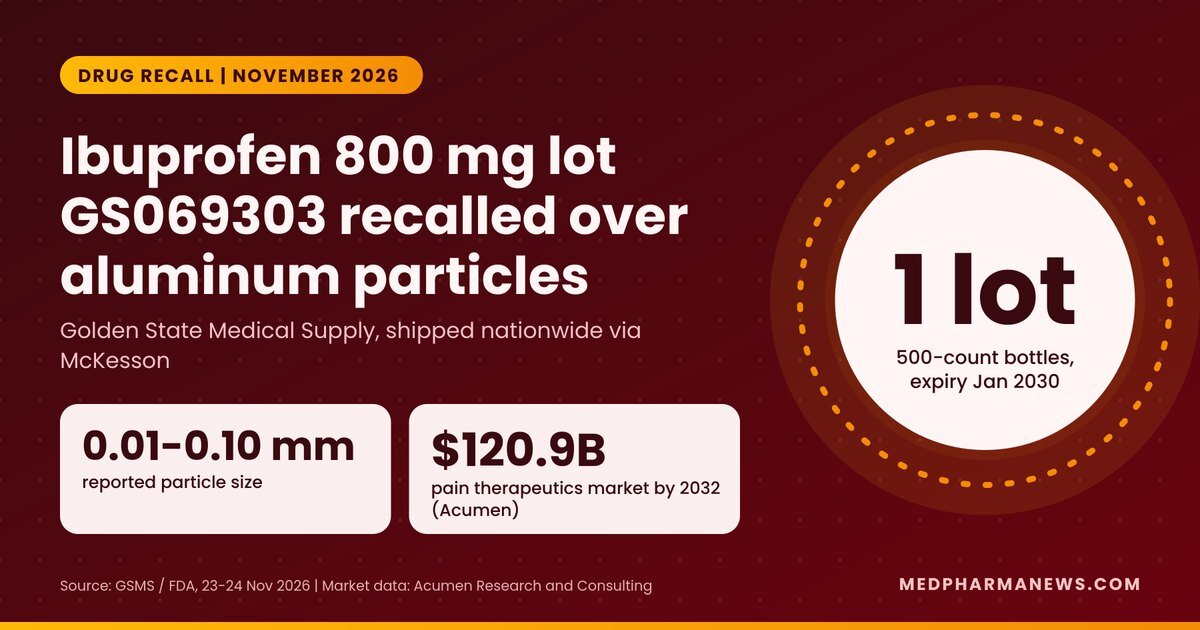
Patients taking atorvastatin or any Alkem-made product should not stop treatment on their own. Recalled lots are listed on FDA’s recall pages, and a pharmacist can check the lot number on a bottle. Our recent coverage of the ibuprofen 800 mg recall explains how lot-level recalls work.
What it means for Alkem’s US business
Warning letters rarely stop shipments of existing products, and Alkem told Indian stock exchanges it continues to make and supply approved medicines from Amaliya. The bigger commercial risk is in the pipeline. The FDA said it may hold back approval of new drug applications or supplements listing the site, a standard step that can delay generic launches for a year or more. A market note from Sahi put the plant at 45% of Alkem’s US revenue, a figure it said came from the company’s alert and was not independently verified.
The FDA also recommended that Alkem hire a qualified CGMP consultant and asked for independent, retrospective reviews of three years of out-of-specification results, its supplier qualification system and its corrective-action programme. Those reviews are expensive and slow, and they usually precede a reinspection rather than replace it.
A wider signal for Indian generics
Alkem is one of several Indian manufacturers facing tougher US scrutiny in 2026, as FDA shifts toward more unannounced foreign inspections. The warning letter’s focus on supplier changes is a lesson for the whole sector: switching excipient vendors to cut costs is common, but FDA expects companies to test whether the change alters how a finished tablet behaves, and to look back at old assessments when gaps are found.
Market context: the generics stakes
Acumen Research and Consulting projected the global generic drugs market would grow at about 11.1% a year from 2020 to reach around US$627.6 billion by 2027. The report, last updated in 2021, is dated and indicative, but it shows why US quality compliance is worth so much to Indian exporters: the same report notes generics saved the US healthcare system an estimated US$1.68 trillion between 2005 and 2014.
Alkem warning letter FAQ
Which Alkem plant got the FDA warning letter?
The finished-dosage facility at Amaliya (Village Dabhel), Daman, in the union territory of Dadra and Nagar Haveli and Daman and Diu.
Are Alkem medicines unsafe to take?
The FDA has not ordered a halt to existing products. Specific recalled lots should be returned. Anyone worried should speak to a pharmacist or doctor before stopping a medicine.
How long does Alkem have to respond?
FDA warning letters typically ask for a written response within 15 working days. Alkem said it will reply within the stipulated timeline.
Sources: FDA warning letter to Alkem Laboratories (18 November 2026), Alkem stock exchange disclosure, BioSpace, Sahi. Market data: Acumen Research and Consulting. More in Pharmaceuticals and our report on the Par Health injectables recall. Not medical or investment advice. Last updated 26 November 2026.