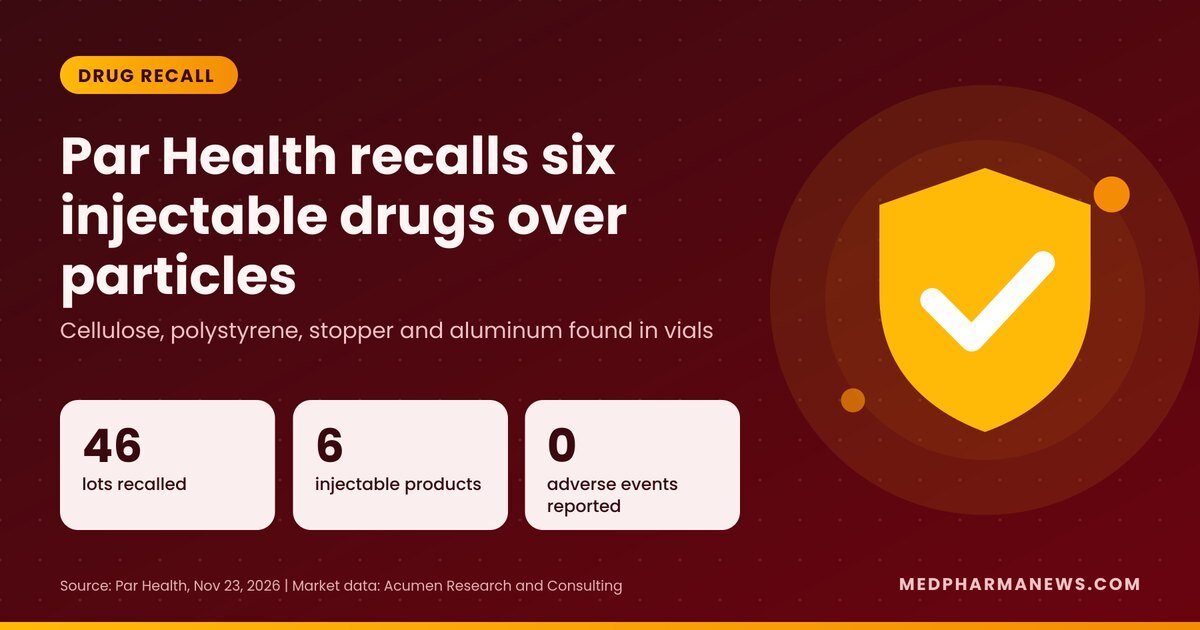
The latest Par Health recall covers 46 lots of six injectable drugs, announced on November 23, 2026 after the company found particulate matter, identified as cellulose, polystyrene, stopper material and aluminum, in certain vials. The affected products include Dantrium IV, the emergency treatment for malignant hyperthermia, the anaesthetic Brevital and the last-line antibiotic Coly-Mycin M. The lots were shipped nationwide to wholesalers and hospitals between July 2, 2024 and September 17, 2026, and Par says it has received no adverse event reports so far.
Key takeaways on the Par Health recall
- Scope: 46 lots across Brevital Sodium, Coly-Mycin M Parenteral, Dantrium Intravenous, Doxycycline for Injection, Ethacrynate Sodium for Injection and Micafungin for Injection (50 mg and 100 mg).
- Level: hospital and user level, conducted with the knowledge of the FDA.
- Risk: particles injected into a vein can cause pulmonary emboli, blockages in other blood vessels and vein inflammation that may lead to clotting.
- Biggest share: Brevital (20 lots) and Dantrium IV (15 lots) account for about three-quarters of the recalled lots, by our calculation.
- Action: hospitals and distributors should stop using and distributing the affected lots and return stock through Inmar.
Which products and how many lots
| Product | Use | NDC | Lots recalled |
|---|---|---|---|
| Brevital Sodium (methohexital) 500 mg multi-dose vial | Induction of anaesthesia, procedural sedation | 42023-105-01 | 20 |
| Dantrium Intravenous (dantrolene) 20 mg | Treatment and prevention of malignant hyperthermia | 42023-123-06 | 15 |
| Doxycycline for Injection 100 mg | Broad-spectrum antibiotic, including anthrax | 42023-244-10 | 4 |
| Micafungin for Injection 100 mg | Serious Candida infections | 42023-230-10 | 4 |
| Micafungin for Injection 50 mg | Serious Candida infections | 42023-229-10 | 1 |
| Coly-Mycin M Parenteral (colistimethate) 150 mg | Gram-negative infections, including Pseudomonas and Klebsiella | 42023-107-01 | 1 |
| Ethacrynate Sodium for Injection 50 mg | IV diuretic for oedema | 42023-157-01 | 1 |
Expiry dates on the recalled lots run from November 2026 to September 2028, so many affected vials could still be on pharmacy shelves. Pharmacists should check lot numbers against the full Par Health notice rather than relying on product names alone, because only specific lots are affected.
Why particles in injectables are a serious problem
Injectable drugs skip the body’s natural filters. A fragment of rubber stopper or a fibre of cellulose that enters a vein travels to the lungs, where it can lodge in small vessels. Par’s risk statement says this has a reasonable probability of causing life-threatening outcomes, including pulmonary emboli, blocked blood vessels that can lead to tissue death, and phlebitis that may lead to clotting. Patients in intensive care or theatre are often already fragile, which raises the stakes.
The mix of contaminants matters too. Cellulose and polystyrene point to filtration or packaging materials, stopper fragments point to vial closure or coring, and aluminum suggests contact with metal components. A recall that spans several particle types and six products made over more than two years suggests a broader manufacturing or quality-control issue rather than a single bad batch, although Par has not disclosed a root cause.
The Dantrium question for hospitals
Dantrium IV is the product most likely to worry anaesthesia departments. Malignant hyperthermia is a rare, inherited reaction to certain anaesthetic gases and the muscle relaxant succinylcholine, and dantrolene is the only specific antidote. Hospitals that use those agents keep dantrolene stocked for emergencies. Facilities that hold affected Dantrium lots will need to confirm that unaffected supply, from Par or from other dantrolene products such as Ryanodex or Revonto, is in place before pulling stock. The same applies, on a smaller scale, to Coly-Mycin M, which clinicians reserve for drug-resistant gram-negative infections where few alternatives exist.
A pattern of quality problems
This is not Par’s first particulate recall. FDA recall postings show Par Health has recently pulled lots of argatroban injection and dexmedetomidine in sodium chloride over particulate matter, and the FDA issued a warning letter to Par Health USA and Endo USA dated April 15, 2026. Par Health, the successor distributor to Par Pharmaceutical and Endo USA, has not linked these actions publicly. For sterile injectable makers, repeat findings like these tend to invite closer FDA inspection, as the agency’s recent warning letters to compounding API suppliers and its move against FloLipid show a tougher stance on manufacturing compliance.
Market context: the antifungal angle
Five of the 46 lots are micafungin, an echinocandin used for invasive Candida infections and as prevention in stem cell transplant patients. According to Acumen Research and Consulting, the global antifungal drugs market was worth USD 14.8 billion in 2022 and is expected to reach USD 20.9 billion by 2032, growing at 3.5% a year, with North America the largest region. Generic injectable antifungals are a low-margin, multi-supplier segment, so a recall of this size is more likely to shift orders to other manufacturers than to cause a shortage, though hospitals should confirm with their wholesalers.
What hospitals and patients should do
Hospital pharmacies and wholesalers should quarantine affected lots immediately, notify any sites they redistributed to and arrange returns through Inmar (1-844-940-1986, weekdays 9 a.m. to 5 p.m. ET). Product complaints and adverse events go to Par on 1-800-828-9393 and can also be reported to FDA MedWatch. These drugs are given in hospitals and clinics, so patients do not need to take any action at home. Anyone who received one of these drugs recently and has questions should talk to their care team. More pharmaceutical news is available in our pharma section.
FAQ
What drugs are in the Par Health recall?
Brevital Sodium, Coly-Mycin M Parenteral, Dantrium Intravenous, Doxycycline for Injection, Ethacrynate Sodium for Injection and Micafungin for Injection (50 mg and 100 mg), 46 lots in total.
Why were the Par injectables recalled?
Particulate matter, identified as cellulose, polystyrene, stopper material and aluminum, was found in certain lots.
Has anyone been harmed?
Par Health says it has not received any adverse event reports linked to the recall as of November 23, 2026.
Do patients need to do anything?
No home action is needed because these are hospital-administered drugs. The recall is aimed at hospitals, pharmacies and distributors.
Sources: Par Health voluntary recall notice (November 23, 2026); FDA recall and warning letter postings. Market data: Acumen Research and Consulting, Antifungal Drugs Market report. This article is not medical or investment advice. Last updated: November 24, 2026.