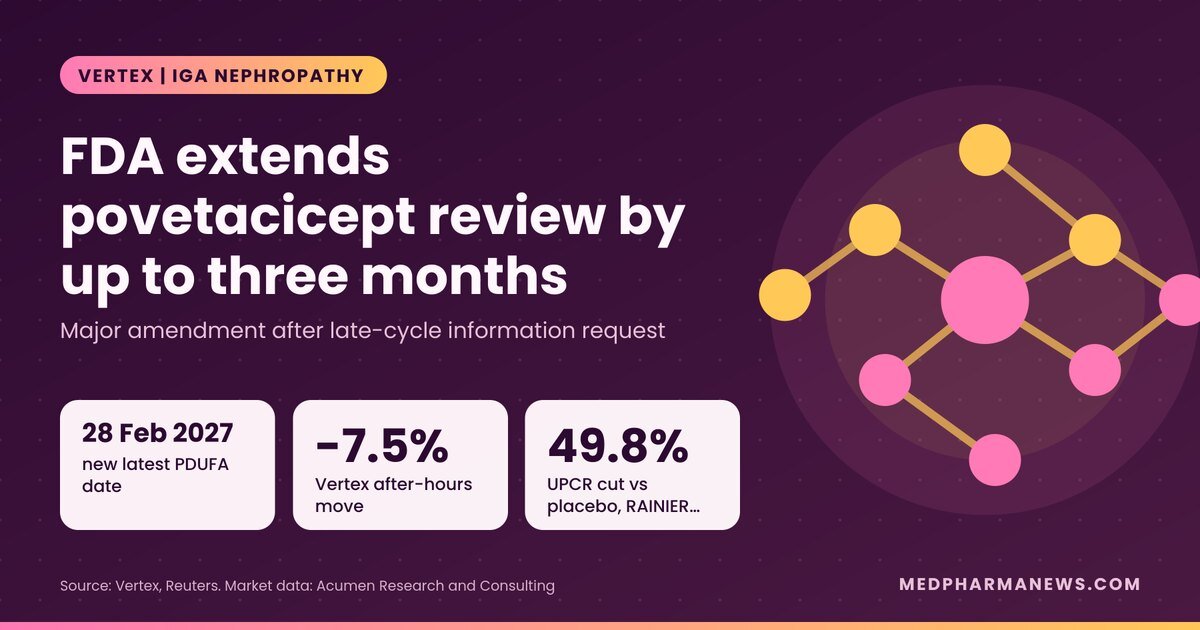
The povetacicept FDA decision will not come this month. Vertex Pharmaceuticals said after the market closed on 25 November 2026 that the US Food and Drug Administration has pushed back its review of the IgA nephropathy (IgAN) drug by up to three months, moving the target action date from 30 November 2026 to no later than 28 February 2027. The agency told Vertex on 24 November that the company’s response to a late-cycle information request counts as a major amendment to the biologics license application. Vertex shares fell about 7.5% in after-hours trading, while rival Vera Therapeutics jumped more than 18%.
Key takeaways on the povetacicept FDA decision
- New PDUFA goal date: no later than 28 February 2027, up from 30 November 2026.
- Trigger: an FDA information request near the end of the review cycle; Vertex answered promptly, and the FDA classed the submission as a major amendment.
- No rejection and no new safety issue has been disclosed. Vertex says it remains confident in the data behind the filing.
- Povetacicept is a dual inhibitor of the BAFF and APRIL cytokines, acquired through Vertex’s $4.9 billion purchase of Alpine Immune Sciences in 2024.
- The delay narrows Vertex’s head start over Vera Therapeutics’ atacicept, another dual BAFF/APRIL blocker in IgAN.
What a major amendment means in practice
Under the FDA’s user-fee rules, when a sponsor submits substantial new information within three months of a goal date, the agency can extend the review clock by three months so it has time to assess it. The extension is procedural: it says the reviewers need more time, not that they have reached a negative view. Many drugs that receive this kind of extension go on to be approved, though the outcome is never guaranteed.
Vertex has not said what the FDA asked for. That silence is typical, but it is the main open question for investors. Requests late in a cycle often touch on manufacturing and controls, clinical data presentation or labeling detail, and each carries a different level of risk. In its release, Vertex said only that it is “confident in the data supporting the povetacicept BLA” and that it expects to complete the review with the agency.
The timeline so far
| Milestone | Date |
|---|---|
| Vertex closes Alpine Immune Sciences acquisition ($4.9B) | 2024 |
| Original PDUFA target action date | 30 November 2026 |
| FDA notifies Vertex of major amendment | 24 November 2026 |
| Vertex announces extension | 25 November 2026 (after market close) |
| New latest PDUFA date | 28 February 2027 |
Sources: Vertex press release via Business Wire (25 November 2026); Reuters.
The data behind the filing
The application rests on an interim analysis of RAINIER, a Phase 3 study that Vertex describes as the largest and fastest-enrolling contemporary trial in IgAN. As reported earlier this month, the interim readout showed a 49.8% reduction in urine protein-to-creatinine ratio (UPCR) versus placebo at week 36 in a cohort of about 605 patients. Proteinuria reduction is the accepted surrogate for accelerated approval in IgAN; full approval normally depends on longer-term kidney function data, measured by eGFR slope, from the same trial.
Povetacicept uses an engineered TACI receptor domain designed to bind BAFF and APRIL more tightly than earlier inhibitors in preclinical work. Both cytokines drive the B cells that produce the abnormal IgA1 at the root of the disease, so blocking both at once is meant to cut the immune complexes that damage the kidney’s filters.
How the delay reshapes the IgAN race
IgAN affects roughly 150,000 people in the United States and is a leading cause of kidney failure in young adults. The treatment landscape has moved quickly. Otsuka’s APRIL-targeting antibody sibeprenlimab (Voyxact) is already on the US market, alongside Novartis’ complement inhibitor Fabhalta, endothelin receptor antagonists such as Filspari, and the newer Vanrafia. Vertex had hoped to be first with a dual BAFF/APRIL agent.
That is why Vera’s stock moved so sharply. Atacicept targets the same two cytokines, and every month of delay for povetacicept improves the odds that the two drugs launch close together, turning a potential first-mover advantage into a head-to-head commercial contest. By our calculation, a 7.5% fall on a roughly $143 billion market capitalisation erased around $10 billion of Vertex’s value in after-hours trade, a large reaction to a three-month slip that reflects how much weight investors put on the kidney franchise.
Vertex is also running povetacicept in a Phase 3 study in primary membranous nephropathy and a Phase 2 program in generalised myasthenia gravis, with results expected next year. The company’s broader pipeline and recent financial performance are covered in our Vertex Q3 2026 results analysis.
Market context
IgAN is one of many conditions in the wider autoimmune therapy space. Acumen Research and Consulting projected the global autoimmune disease therapeutics market to reach around USD 155 billion by 2027, growing at a compound annual rate of about 4% from 2020, with North America the largest regional market. That report was last updated in July 2020, so its figures are dated and should be read as indicative; they predate the recent wave of targeted kidney immunology drugs.
What to watch next
- Any detail on the information request, for example on a Vertex earnings call or at an investor conference.
- Atacicept’s regulatory timeline, which now matters more to how the BAFF/APRIL class launches.
- A decision before 28 February: the FDA can act earlier than the extended date if its review finishes sooner.
- Longer-term RAINIER eGFR data, needed to convert any accelerated approval into full approval.
For another recent example of an FDA timeline slipping, see our report on the Savara molgramostim decision delay. More drug news is in our Pharmaceuticals section.
FAQ
When will the FDA decide on povetacicept?
The FDA’s new target action date is no later than 28 February 2027, after a three-month extension announced on 25 November 2026. The original date was 30 November 2026.
Why did the FDA delay the povetacicept review?
Vertex responded to an FDA information request late in the review, and the agency classified that response as a major amendment, which allows it up to three more months. Vertex has not disclosed what the request covered.
Does the extension mean povetacicept will be rejected?
No. An extension is a procedural step to review new information. It is not a complete response letter, and Vertex has not reported any new safety concern.
How is povetacicept different from atacicept?
Both block BAFF and APRIL. Povetacicept is built on an engineered TACI domain that Vertex says showed stronger binding and potency in preclinical studies; head-to-head clinical comparisons have not been done.
Sources: Vertex press release (Business Wire, 25 Nov 2026); Reuters; BigGo Finance. Market data: Acumen Research and Consulting. Not medical or investment advice. Last updated 26 November 2026.