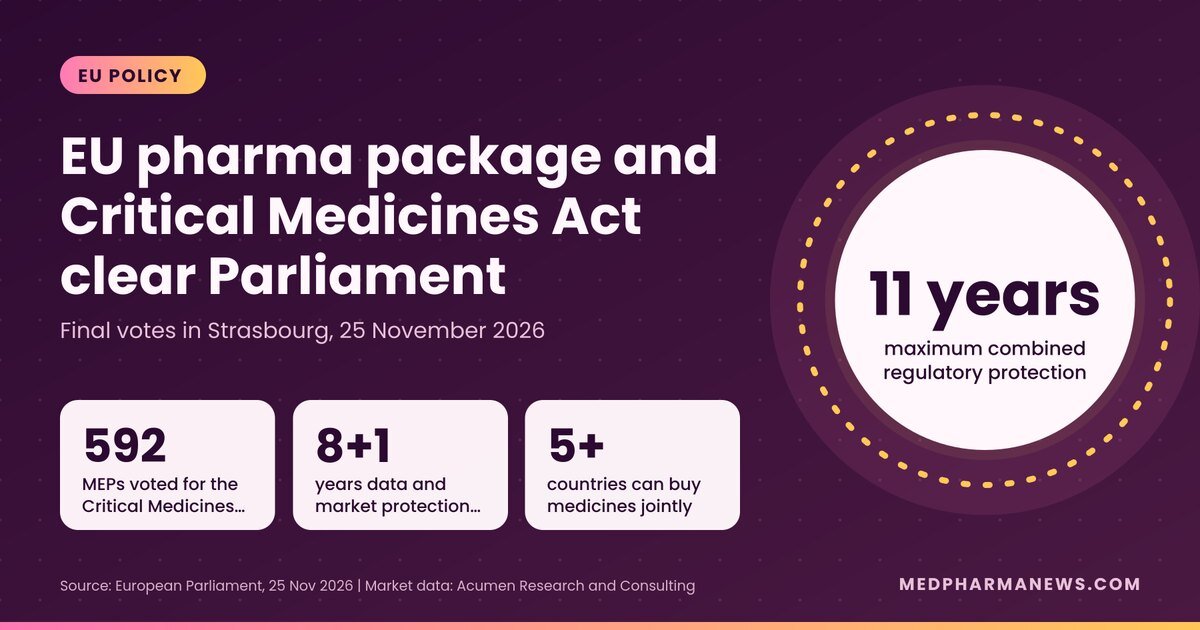
The EU pharma package cleared its last parliamentary step on 25 November 2026, when the European Parliament in Strasbourg gave final approval to the biggest rewrite of EU medicines law in about two decades and, the same day, adopted the Critical Medicines Act by 592 votes to 35 with 30 abstentions. The reform caps combined regulatory protection for new medicines at 11 years, gives antibiotic developers a transferable exclusivity voucher, lets generics prepare for launch earlier and allows governments to require companies to keep markets supplied.
Key takeaways on the EU pharma package
- Protection: 8 years of data protection plus 1 year of market protection as the baseline, with extra market protection possible if conditions are met, up to 11 years in total.
- Antibiotics: each new priority antimicrobial can earn a transferable voucher worth one extra year of data protection.
- Generics and biosimilars: certain preparatory activities will be allowed during the originator’s market protection, so launches can follow expiry more quickly.
- Supply: member states can require companies to supply enough medicine to meet patient need, and shortage monitoring is tightened.
- Critical Medicines Act: EU strategic manufacturing projects, an “EU preference” in public procurement and voluntary joint buying by five or more countries.
What changes for drugmakers: old rules versus new
| Element | Current EU framework | Reformed framework |
|---|---|---|
| Data protection | 8 years | 8 years |
| Baseline market protection | 2 years | 1 year |
| Extra protection | +1 year for a significant new indication | Additional market protection when specified conditions are met |
| Maximum combined protection | 11 years | 11 years |
| Antibiotic incentive | None specific | Transferable exclusivity voucher (+1 year data protection) |
| Antimicrobial prescribing | Varies by country | Prescription required for all antimicrobials |
By our calculation, the headline ceiling is unchanged but the default falls from 10 to 9 years. Companies that want the full 11 now have to earn the extra time by meeting conditions written into the final texts, rather than receiving most of it automatically. That is a smaller cut than the European Commission proposed in April 2023, when it suggested lowering baseline data protection to six years, and reflects heavy industry lobbying during the trilogue that ended in a deal in December 2025.
The antibiotic voucher and why it matters
New antibiotics are commercially weak because doctors hold them in reserve to slow resistance, so sales stay low. The transferable exclusivity voucher tries to fix that by rewarding the developer of a priority antimicrobial with one extra year of data protection that it can sell to another company, which would then apply it to a different, potentially high-earning product. The value of a voucher therefore depends on the blockbuster it ends up extending, and critics have warned it could raise costs for health systems elsewhere. According to Europe Pharma Today, the European Medicines Agency opened a consultation on voucher eligibility criteria on 25 November, with the scheme flagged to start in December 2026. The parallel rule making all antimicrobials prescription-only targets over-the-counter antibiotic sales that persist in some member states.
Critical Medicines Act: production and procurement
Proposed in March 2025 after repeated shortages of antibiotics and other basic drugs, the Critical Medicines Act focuses on supply security rather than innovation. It defines criteria for “strategic projects” that build, modernise or expand EU manufacturing capacity for critical medicines. Companies that receive national or EU funding take on obligations, including giving priority to supplying the EU market.
The most commercially significant clause is the procurement rule. Public tenders will reward suppliers in proportion to the share of their medicines and active pharmaceutical ingredients made inside the Union, which Parliament calls an EU preference. Groups of at least five member states will also be able to buy critical medicines, orphan medicines and other medicines of common interest jointly on a voluntary basis. Parliament named insulin, painkillers, vaccines and antibiotics among the products it wants made in Europe. Rapporteurs were Tiemo Wölken (S&D, Germany) for the regulation, Dolors Montserrat (EPP, Spain) for the directive and Tomislav Sokol (EPP, Croatia) for the Act.
Market context: the API supply chain at stake
The EU preference goes straight at where active ingredients are made. Acumen Research and Consulting estimates the global active pharmaceutical ingredient market at USD 255.47 billion in 2025, rising to USD 473.20 billion by 2035 at a 6.3% compound annual growth rate. Europe held about 22% of the market in 2025, roughly USD 56 billion by our calculation, while Asia Pacific held 25% and is forecast to grow fastest, at 8.5% a year. Generic APIs made up 34% of the market. That split explains the tension: Europe wants more domestic supply of cheap, old molecules, while much of that volume comes from India and China at prices EU plants struggle to match.
Winners, losers and what is still undecided
- Originator companies lose a year of default market protection and face supply obligations, but keep an 11-year ceiling and gain the voucher route for antibiotics.
- Generic and biosimilar makers gain earlier preparation rights; those with EU plants also gain in tenders.
- Indian and Chinese API exporters may face tougher tender scoring in Europe, though the preference is proportional rather than a ban.
- Patients should see fewer shortages if the supply duties are enforced, but cost effects of the voucher are uncertain.
Adoption is not application. The Critical Medicines Act still needs formal Council approval, and both laws must be published in the Official Journal before transition clocks start. The conditions that unlock extra market protection, and how national authorities will enforce supply obligations, will only be clear in the final texts. Pricing pressure remains a separate national issue, as Bayer’s decision to pull a heart drug from Germany showed (Kerendia Germany Withdrawal), and manufacturing fragility persists, as in Pharming’s Ruconest supply interruption.
FAQ
What is the EU pharma package?
A new regulation and directive replacing the EU’s general pharmaceutical legislation, covering approvals, regulatory protection, shortages and antimicrobial use. Parliament gave final approval on 25 November 2026.
How long is data exclusivity under the new EU rules?
Eight years of data protection plus one year of market protection, with possible extra market protection, up to 11 years combined. Priority antibiotics can earn a voucher for one more year of data protection.
What does the Critical Medicines Act do?
It supports EU manufacturing of critical medicines, favours EU-made products and ingredients in public tenders and lets five or more countries buy medicines jointly.
When will the new EU medicines rules apply?
Not immediately. The texts must be published in the Official Journal, and the Critical Medicines Act needs Council sign-off; application dates follow from the final acts.
More analysis in Industry Insights.
Sources: European Parliament press release, 25 November 2026, via EuropaWire; Europe Pharma Today; European Commission proposal of April 2023. Market data: Acumen Research and Consulting. Not legal or investment advice. Last updated 27 November 2026.