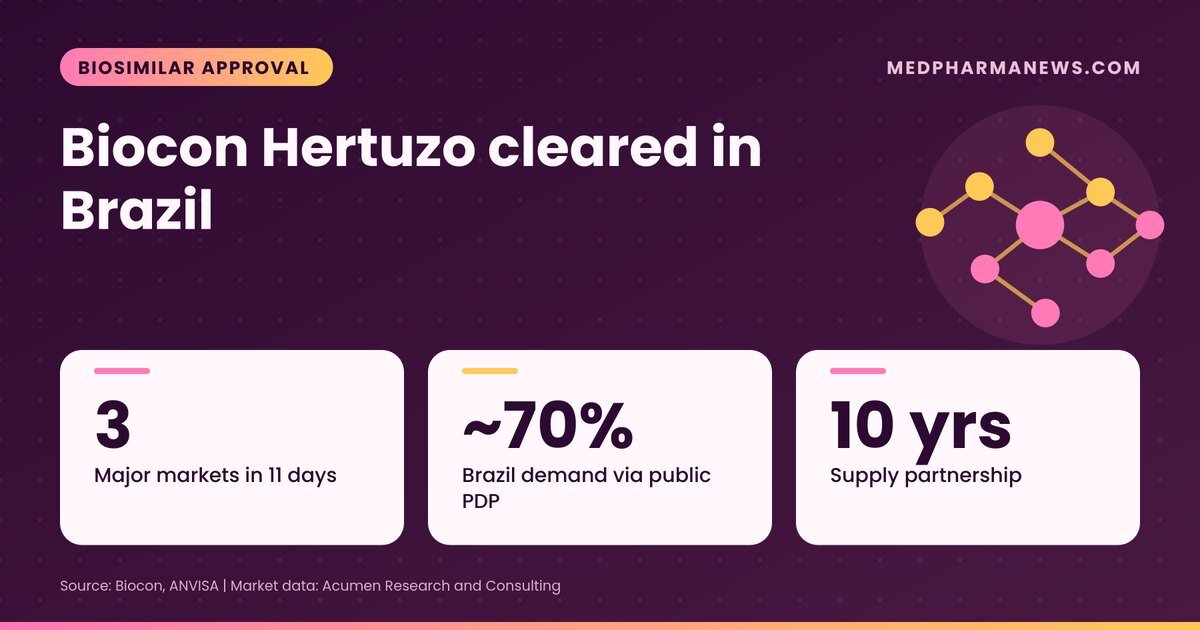
Biocon Hertuzo, the company’s biosimilar of Roche’s breast cancer antibody Perjeta (pertuzumab), has been approved by Brazil’s health regulator ANVISA for HER2-positive breast cancer, Biocon said on 27 November 2026. The clearance, secured through local partner Bionovis, gives the Bengaluru biologics maker its third major-market approval for the molecule in under a fortnight, after the US FDA on 16 November and the European Commission on 18 November. It also activates a 10-year public-supply partnership that covers roughly 70% of Brazil’s pertuzumab demand.
Key takeaways on Biocon Hertuzo
- ANVISA has approved Hertuzo, a pertuzumab biosimilar referencing Perjeta, for certain HER2-positive breast cancer patients across multiple disease stages.
- Approval came via Bionovis, Biocon’s Brazilian partner, within a Productive Development Partnership (PDP) that also includes the Bahia state laboratory Bahiafarma.
- The PDP, awarded in September 2026, gives the consortium 100% allocation for pertuzumab supply to Brazil’s public health system, which the companies put at about 70% of national demand.
- Biocon now holds pertuzumab biosimilar approvals in the US, the EU and Brazil within about 11 days.
- Biocon shares closed at Rs 364.90 on Thursday, up 2.43%.
Three regulators in 11 days: the approval timeline
| Date (2026) | Market | Regulator | What happened |
|---|---|---|---|
| 8 September | Brazil | Ministry of Health (PDP) | Biocon, Bahiafarma and Bionovis win 10-year pertuzumab PDP with 100% allocation |
| 16 November | United States | FDA | Pertuzumab-qcay biosimilar approved |
| 18 November | European Union | European Commission | Pebrilzo authorised, first under EMA’s tailored clinical approach |
| Announced 27 November | Brazil | ANVISA | Hertuzo approved for HER2-positive breast cancer |
Few biosimilar launches line up this tightly. The sequencing matters because Brazilian public procurement under a PDP depends on local registration, so the ANVISA decision is the step that turns a supply contract signed in September into potential orders.
How Brazil’s PDP model changes the economics
Brazil’s Productive Development Partnerships pair a private drugmaker with a public laboratory. The private partner supplies the product and transfers technology over time, and in return the consortium gains exclusive access to the Ministry of Health’s purchases for the agreed period. For Hertuzo, Bahiafarma is the public lab and Bionovis is the Brazilian biotech partner. Biocon earns milestone payments and a share of revenues over the 10 years, with production to be localised in phases over the mid to long term. No contract value or volume commitments have been made public.
The structure trades margin for certainty. Biocon gives up some pricing power and eventually some manufacturing, but secures a near-guaranteed public channel in Latin America’s largest market without fighting tender by tender. Biocon has used Brazil as a beachhead before, with ANVISA approving its trastuzumab biosimilar with former partner Mylan in 2017.
What pertuzumab does for patients
Pertuzumab is a monoclonal antibody that binds the HER2 receptor at a different site from trastuzumab, blocking HER2 from pairing with related receptors that drive tumour growth. Given together with trastuzumab and chemotherapy, it is a standard regimen both before and after surgery for higher-risk early HER2-positive breast cancer and as first-line treatment for metastatic disease. HER2-positive tumours account for roughly one in five breast cancers. Brazil’s National Cancer Institute (INCA) estimates more than 70,000 new breast cancer cases a year, so even a partial shift from the branded product to a lower-cost biosimilar in the public system could widen access to dual HER2 blockade.
The business read for Biocon and Roche
For Biocon, pertuzumab extends an oncology biosimilar franchise built on trastuzumab and bevacizumab and gives its sales teams a natural bundle: the same oncologists and payers buy both HER2 antibodies. Biocon has also settled litigation over the product, as covered in our report on the Pebrilzo settlement. For Roche, Perjeta faces biosimilar pressure on several fronts at once, although the company has been moving patients to Phesgo, its fixed-dose subcutaneous combination of pertuzumab and trastuzumab, which IV biosimilars do not directly copy. Competition is also intensifying among biosimilar makers more broadly, as the Teva and Samsung Bioepis US deal shows. More approvals news is in our pharmaceuticals section.
Market context
Acumen Research and Consulting sizes the global biosimilars market at $26.7 billion in 2023 and projects $113.2 billion by 2032, a compound annual growth rate of 17.5% from 2024. Acumen expects Asia-Pacific to post the fastest growth while North America remains the largest region. The report page carries an older last-updated stamp, so these figures are best read as indicative. By our calculation, the projection implies the market more than quadrupling in nine years, which helps explain why Indian manufacturers are racing to secure early, multi-region approvals for each new molecule.
What is still unknown
- The exact ANVISA decision date and the full list of approved indications.
- When the first Ministry of Health orders will be placed and at what price versus Perjeta.
- Where Hertuzo for Brazil will be manufactured before localisation begins.
- The financial value of the 10-year PDP, which has not been disclosed.
Frequently asked questions
What is Hertuzo?
Hertuzo is Biocon’s brand name in Brazil for its biosimilar of pertuzumab, the antibody sold by Roche as Perjeta, used to treat HER2-positive breast cancer.
Is Hertuzo the same as Pebrilzo?
Both are names for Biocon’s pertuzumab biosimilar. Pebrilzo is the brand authorised in the EU, while Hertuzo is the brand approved in Brazil.
Who will supply Hertuzo in Brazil?
Biocon will supply it with partners Bionovis and Bahiafarma under a 10-year Productive Development Partnership for Brazil’s public health system.
How did Biocon shares react?
Biocon closed at Rs 364.90 on Thursday, up 2.43%, and was in focus on Friday as the approval was announced.
Sources: Biocon announcement; Business Today market report (27 November 2026); Biocon PDP announcement (8 September 2026). Market data: Acumen Research and Consulting. Not medical or investment advice. Last updated 27 November 2026.