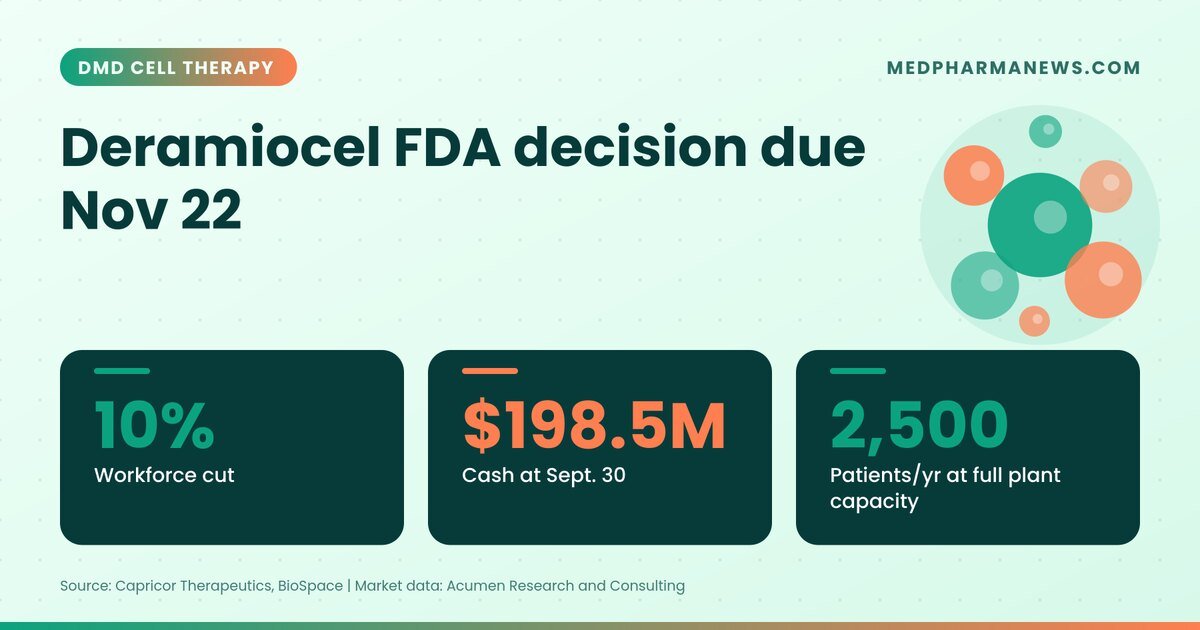
The deramiocel FDA decision is nine days away: the agency’s target action date for Capricor Therapeutics’ cell therapy for Duchenne muscular dystrophy (DMD) is November 22, 2026. In the run-up, the San Diego company has cut about 10% of its staff, paused work outside its lead product and told investors it is ready to launch on its own. For DMD families, it is a second chance at a therapy the FDA turned down in July 2025.
Key takeaways on deramiocel FDA decision
- The FDA’s goal date is November 22, 2026, moved from August 22 after Capricor filed a major amendment.
- The application now focuses on preserving upper limb function in DMD, the primary endpoint HOPE-3 met.
- Capricor laid off roughly 10% of its workforce and slowed its exosome platform to concentrate cash on deramiocel.
- The company held about $198.5 million at September 30, which it says funds operations for at least 12 months.
- A launch would be done without former partner NS Pharma, with which Capricor is in arbitration.
From rejection to resubmission: the timeline
Deramiocel is an allogeneic therapy built from cardiosphere-derived cells, grown from donor heart tissue and given by infusion, typically every three months. Capricor says the cells release exosomes that push immune cells called macrophages away from an inflammatory state, which it argues slows the scarring that destroys skeletal and heart muscle in DMD.
| Date | Event |
|---|---|
| July 2025 | FDA rejects the first application, citing a lack of substantial evidence of effectiveness |
| December 2025 | Phase 3 HOPE-3 reports a statistically significant benefit on upper limb function |
| 2026 | Resubmission; FDA reviewers question which statistical analysis plan governs HOPE-3 |
| August 2026 | Capricor adds 24-month extension data and a refined indication; goal date moves to November 22 |
| November 2026 | About 10% workforce cut; Q3 results confirm launch preparations |
What HOPE-3 showed, and where the debate sits
HOPE-3 met its primary endpoint, a measure of upper limb function that matters because many boys with DMD have already lost the ability to walk. The trial’s key cardiac secondary endpoint, left ventricular ejection fraction, showed slower decline but did not reach statistical significance across all patients. In those who already had cardiomyopathy, CEO Linda Marbán has said ejection fraction improved by about 2.8 percentage points relative to placebo, and cardiac MRI showed slower scarring. In the open-label extension, patients who switched from placebo saw their upper limb decline slow by 76% compared with the prior year, according to BioSpace’s account of company data.
The friction with regulators has been methodological. FDA reviewers questioned whether HOPE-3 met its pre-specified endpoints because they read the results against a different version of the statistical analysis plan; Capricor maintains that version 3.0, finalized before unblinding, is the correct one. Marbán told investors a second advisory committee is unlikely given how little time remains before the goal date, and declined to discuss label language.
The business case: cash, cuts and capacity
The 10% reduction, which BioSpace estimates at about 23 people based on a year-end headcount of 231, is meant “to align our organization with our near-term priorities,” in Marbán’s words. Spending is shifting from research to manufacturing.
| Metric | Q3 2026 | Q3 2025 |
|---|---|---|
| Operating expenses | ~$44.7M | ~$26.3M |
| Net loss | ~$42.7M ($0.73/share) | ~$24.6M ($0.54/share) |
| Nine-month net loss | ~$117.3M | ~$74.9M |
| Cash and investments (Sept. 30) | ~$198.5M | n/a |
By our calculation, operating expenses rose about 70% year on year. Most of that is the San Diego GMP plant: the first-floor clean room can supply about 250 patients a year (roughly 1,000 doses), and the largely built second floor would lift capacity to about 2,500 patients a year, a tenfold increase. Against an estimated 15,000 people with DMD in the US, full build-out would cover around one in six, by our calculation, before any new site is added.
Pressure is also coming from shareholders. Kaos Capital wrote in August asking for a board change and a capital-preservation plan, and the cut outside deramiocel goes some way toward that request.
Why a priority review voucher is on the table
Deramiocel carries Orphan Drug, RMAT and Rare Pediatric Disease designations in the US. An approval could therefore bring a priority review voucher, a tradeable asset that has recently sold for around $200 million; this week BioNTech agreed to pay Scholar Rock $205 million for one (our coverage). For a company burning more than $40 million a quarter, a voucher sale could be material.
Market context for cell therapy
Acumen Research and Consulting valued the global cell therapy technologies market at USD 3,108 million in 2021 and projected USD 9,967 million by 2030, a 14.1% CAGR, with North America the largest region. The report dates from September 2022, so the numbers are indicative rather than current, but they show the scale of investment that a first approved cell therapy for DMD skeletal muscle would sit within.
What happens next
- November 22: FDA action. Watch whether the label is limited to upper limb function or mentions cardiomyopathy.
- Launch: Capricor plans to commercialize alone; the NS Pharma arbitration hearing is expected in mid-2027.
- Expansion: younger patients and Becker muscular dystrophy are under consideration, with Europe and Japan engagement started.
Related: Novo Nordisk’s etavopivat filing and more in Pharmaceuticals.
FAQ
When will the FDA decide on deramiocel?
The target action date is November 22, 2026.
What is deramiocel used for?
It is an investigational cell therapy for Duchenne muscular dystrophy, now proposed for preserving upper limb function. It is not yet approved.
Why did the FDA reject deramiocel before?
In July 2025 the FDA said the evidence of effectiveness was insufficient. HOPE-3 data followed in December 2025.
Why did Capricor lay off staff?
To focus resources on deramiocel’s decision and launch; about 10% of employees were let go and non-core programs slowed.
Sources: Capricor Q3 2026 results and earnings call; BioSpace; BioPharm International. Market data: Acumen Research and Consulting. Not medical or investment advice. Last updated November 13, 2026.