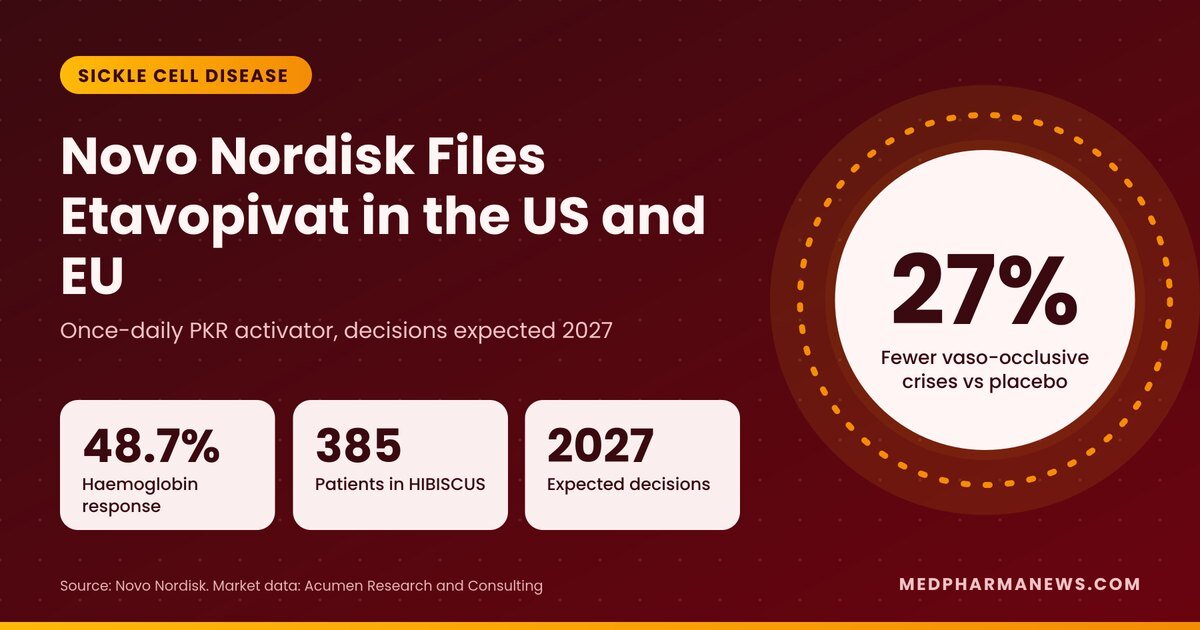
Novo Nordisk said on 13 November 2026 that it has filed etavopivat, a once-daily pill for sickle cell disease, with both the US FDA and the European Medicines Agency, seeking approval for patients aged 12 and older. The submissions rest on the Phase 3 HIBISCUS trial, in which etavopivat cut vaso-occlusive crises (VOCs) by 27% versus placebo and lifted haemoglobin in nearly half of treated patients. Novo expects regulators on both sides of the Atlantic to decide in 2027.
Key takeaways on etavopivat
- Etavopivat is an oral, once-daily activator of pyruvate kinase in red blood cells (PKR), a new mechanism for sickle cell disease.
- HIBISCUS (385 patients aged 12+, 400 mg daily) met both co-primary endpoints: 27% fewer VOCs and a haemoglobin response in 48.7% vs 7.2% on placebo.
- The first VOC was delayed by about four months compared with placebo.
- The drug holds FDA Fast Track, Rare Pediatric Disease and Orphan Drug designations, plus EU orphan status.
- Agios’ rival PK activator mitapivat faces an FDA decision on 1 February 2027, so the two could reach US patients within months of each other.
Why Novo’s filing matters for a thin pipeline
Sickle cell disease affects about 8 million people worldwide, around 100,000 in the United States and 110,000 in Europe, according to Novo. Yet the menu of disease-modifying pills is short. Hydroxyurea, a decades-old chemotherapy drug, remains the backbone. Pfizer withdrew the oral drug Oxbryta (voxelotor) worldwide in 2024 over safety concerns, and the two approved gene therapies, Casgevy and Lyfgenia, involve chemotherapy conditioning, hospital stays and multimillion-dollar prices that put them out of reach for most patients.
That gap is the commercial thesis behind Novo’s 2022 purchase of Forma Therapeutics, the biotech that discovered etavopivat, for about $1.1 billion. The filing is the first major payoff from that deal and marks a rare non-obesity, non-diabetes regulatory submission for a company whose recent news flow has been dominated by GLP-1 drugs. It follows Novo’s separate $200 million World Diabetes Foundation pledge, part of a push to show breadth beyond Wegovy.
How PKR activation targets sickling
In sickle cell disease, an abnormal haemoglobin polymerises when it releases oxygen, bending red cells into rigid crescents that block small blood vessels and trigger painful crises. Pyruvate kinase R controls a key energy step in red cells. Activating it lowers levels of 2,3-DPG, a molecule that pushes haemoglobin to release oxygen, and raises ATP, which helps keep cell membranes healthy. The net effect is intended to be fewer sickled cells, longer red cell survival and less haemolysis.
Because it is a daily pill rather than a one-time procedure or an infusion, etavopivat would slot in alongside hydroxyurea rather than replacing specialist care.
Etavopivat vs mitapivat: the PK activator race
Agios’ mitapivat (sold as Pyrukynd for other blood disorders) uses the same mechanism and is further along. The FDA extended its sickle cell review to 1 February 2027 after asking whether a risk-management programme (REMS) is needed, a question linked to liver injury seen in thalassaemia studies. The headline Phase 3 numbers differ in an important way, as the table shows.
| Measure | Etavopivat (HIBISCUS) | Mitapivat (RISE UP) |
|---|---|---|
| Patients | 385, aged 12+ | 207, aged 16+ |
| Dosing | 400 mg once daily | 100 mg twice daily |
| Haemoglobin response, drug vs placebo | 48.7% vs 7.2% | 40.6% vs 2.9% |
| Pain crisis / VOC reduction | 27% (significant) | 2.62 vs 3.05 annualised rate (not significant) |
| Regulatory status | FDA and EMA filed 13 Nov 2026; decisions in 2027 | FDA decision due 1 Feb 2027 |
By our calculation, the placebo-adjusted haemoglobin response gap is about 41.5 percentage points for etavopivat and 37.7 points for mitapivat, broadly similar. The bigger differentiator is the crisis endpoint: HIBISCUS showed a statistically significant drop in VOCs, while RISE UP did not, and pain crises are the outcome patients and payers care about most. The trials used different populations, durations and definitions, so head-to-head conclusions are not possible.
What is still missing
Novo has not yet published the detailed HIBISCUS data. Annualised crisis rates by arm, full safety tables and discontinuation figures will come at a future medical meeting and in a journal, the company said. Earlier Phase 2 results described the drug as well tolerated, but reviewers will look closely at liver signals given the scrutiny mitapivat is getting.
Longer-term evidence is also still accruing. The 52-week HIBISCUS 2 Phase 3b trial plans to enrol 510 people, and the FLORAL open-label extension is collecting long-term safety data. Price has not been discussed. Novo’s chief scientific officer, Martin Holst Lange, said the company hopes etavopivat can offer “a new disease-modifying treatment option” if approved.
Market context
Acumen Research and Consulting valued the global sickle cell anemia drug market at USD 1.2 billion in 2022 and projected USD 1.8 billion by 2032, a 4% CAGR, with hydroxyurea holding the largest share and North America the largest region. That forecast predates Oxbryta’s withdrawal and the gene therapy launches, so it should be read as indicative. Two new oral PK activators arriving in 2027 could shift growth back toward pills.
What to watch next
- FDA filing acceptance and whether the agency grants priority review, which would set a 2027 decision date.
- The full HIBISCUS presentation, likely at a haematology meeting, with VOC rates and safety.
- The 1 February 2027 mitapivat decision and whether a REMS is imposed, a read-across for etavopivat.
- Access in Africa and India, where most people with sickle cell live; earlier screening, such as Roche’s newborn screening test for SCD, increases the number of diagnosed patients.
FAQ
What is etavopivat used for?
It is an investigational once-daily pill for sickle cell disease in people aged 12 and older, designed to reduce painful crises and raise haemoglobin.
When will etavopivat be approved?
Novo expects FDA and European Commission decisions in 2027. No exact date has been announced.
Is etavopivat the same as mitapivat?
No. Both activate pyruvate kinase in red blood cells, but they are different molecules from different companies, with different dosing and trial results.
Sources: Novo Nordisk submission release (13 Nov 2026); Novo Nordisk HIBISCUS topline release (20 Apr 2026); Agios RISE UP data and FDA review update. Market data: Acumen Research and Consulting. More in Pharmaceuticals. Not medical or investment advice. Last updated 13 November 2026.