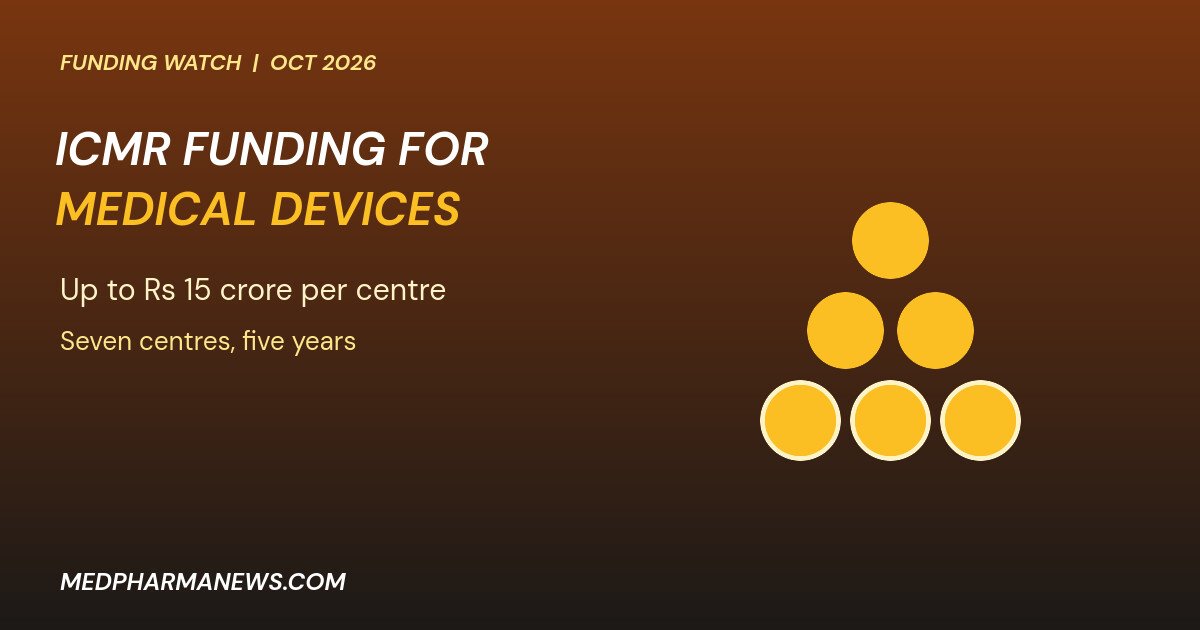
ICMR funding for medical devices has been reported at up to ₹15 crore for each of seven research centres over five years, a structure that could create openings for domestic manufacturers. Reports published on 16 October 2026 say the Indian Council of Medical Research selected five IITs (Kharagpur, Delhi, Bombay, Kanpur and Madras), the Indian Institute of Science in Bengaluru and Amrita Vishwa Vidyapeetham in Coimbatore. This industry-focused report explains the funding terms, the reported conditions and where companies might fit, and separates reported facts from our own analysis.
ICMR funding for medical devices: key takeaways
- Funding: up to ₹15 crore per centre over five years, as reported.
- Our arithmetic: up to ₹105 crore across seven centres at the maximum, if fully released.
- Scope: eight to ten technologies per centre from a catalogue of about 100 clinical needs.
- Conditions reported: compliance with the Medical Device Rules and plans to keep facilities running after the grant.
- Industry: no company partner is named in the summaries we reviewed.
What was reported about ICMR funding for medical devices
The reported provision is up to ₹15 crore per centre over five years. The word “up to” matters because it describes a ceiling and not an assured payment, and we have not seen how funds are released or whether releases depend on milestones. Our calculation, from the reported figures only, gives a ceiling of ₹105 crore across the seven centres, or about ₹3 crore per centre per year on average. These figures are our arithmetic and not an official total.
What ICMR funding for medical devices is meant to pay for
Summaries describe research and development of devices and diagnostics, with each centre taking on eight to ten technologies. At the maximum, that is about ₹1.5 crore to ₹1.9 crore per technology, assuming no overlap and full use of the grant on development, which is another of our calculations. A grant of that size is more likely to cover design, prototyping and testing than large-scale manufacturing, though the reports do not break down the budget.
The seven centres behind the ICMR funding for medical devices
IIT Delhi is linked to applied healthcare technologies and IIT Kanpur to a pipeline reported at ten priority products. IIT Bombay is linked to portable screening and point-of-care diagnostics, IIT Madras to translational diagnostics, IIT Kharagpur to frugal diagnostics and digital health, the Indian Institute of Science to biomaterials and implants, and Amrita Vishwa Vidyapeetham to ophthalmic and vascular devices. These roles come from secondary summaries, and we found no official list.
Where industry could fit in the ICMR funding for medical devices
What follows is our analysis and not a reported plan. Research centres can design and prototype, but selling a device requires a company to certify, manufacture and distribute it. Domestic manufacturers could look for technologies in the catalogue that match their capabilities, offer manufacturing and quality systems to a centre, or fund clinical validation. The summaries do not say whether the programme includes licensing terms or an industry-engagement route, so any partnership would depend on details we have not seen.
What a company would want to know before engaging
Again, this is our analysis. A manufacturer weighing a partnership would typically ask who owns the intellectual property created under the grant, whether the centre can license it exclusively, how clinical trials would be funded, and what the regulatory pathway looks like for the specific device class. It would also ask how long the centre expects to take from prototype to a design ready for transfer. None of these points is answered in the summaries we reviewed, so we cannot say whether the programme is open to industry on workable terms.
Regulatory conditions attached to ICMR funding for medical devices
The reports say the centres must align with the Medical Device Rules, which are administered by the CDSCO and set requirements for safety and performance. For a company considering a partnership, early alignment can reduce the time from prototype to approval. The reports also say host institutions are expected to sustain the facilities after the grant ends. We have not seen the call text, so we cannot say how that obligation is defined or enforced.
How ICMR funding for medical devices compares in scale
We do not have verified figures to compare this grant with commercial development budgets or with other government schemes, so we make no comparison. What can be said from the reported numbers is that a ceiling of about ₹3 crore per centre per year is a modest sum for developing several devices at once, which suggests the centres may lean on existing laboratory infrastructure and other funding. That inference is ours and not a reported fact.
What we could not verify
We could not find an ICMR press release, a list of principal investigators or the criteria used to choose the centres. Two summaries differ on the selection criteria and on which facility tiers were consulted. A separate ICMR special call for proposals is open with a reported deadline of 13 November 2026, and we could not confirm whether it relates to these seven centres.
Risks and caveats on ICMR funding for medical devices
- Funding is a ceiling, not a guaranteed amount.
- Details come from secondary summaries and not an ICMR notice.
- Grants support research and do not guarantee marketed products.
- This is news reporting, not advice.
In our assessment, ICMR funding for medical devices is best read as seed capital for the earliest stage, and the signal for industry will be whether the council publishes a technology catalogue and a route for company partners. See also BD ChloraPrep Applicator Recall: Dangerous Kit Fallout. More in our medical devices coverage.
What to watch next on ICMR funding for medical devices
- An official list of centres and the technology catalogue.
- Any industry partnership or licensing framework.
- How funds are released and what milestones apply.
Frequently asked questions
How much funding is reported for each centre?
Up to ₹15 crore over five years.
What is the maximum total?
By our arithmetic, up to ₹105 crore for seven centres, if all funds were released.
Are companies involved?
No company partner is named in the summaries we reviewed.
How we reported this: we relied on secondary summaries dated 16 October 2026 and the public pages of the institutions and regulator named. Our own calculations are labelled. Last updated: 19 October 2026. This article is news reporting and not advice.