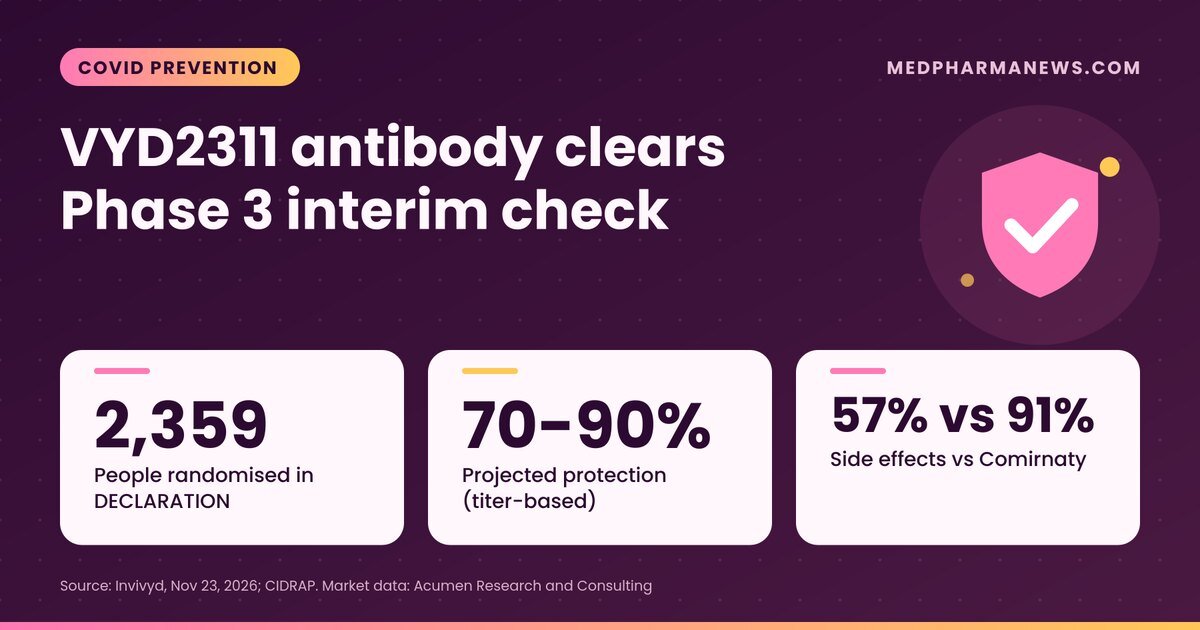
Invivyd said on November 23, 2026 that its VYD2311 COVID antibody met every primary and secondary endpoint in an interim analysis of the Phase 3 DECLARATION trial, which randomised 2,359 people to a single shot, monthly shots or placebo. The company plans to file for US accelerated approval in the first quarter of 2027, pitching the antibody as an alternative to vaccination. The catch: the clinical COVID-19 case counts are still blinded, so the protection figure it is promoting is a prediction, not an observed result.
Key takeaways on the VYD2311 COVID antibody
- DECLARATION interim data: 2,359 participants split 1:1:1 between one 250 mg intramuscular dose, monthly 250 mg doses, and saline placebo.
- Invivyd projects 70% to 90% protection over 90 days, based on antibody levels in the blood, not on counted infections.
- Safety in both dosing arms was described as in line with placebo.
- In the separate 210-person LIBERTY study, fewer people had side effects after VYD2311 than after Pfizer-BioNTech’s Comirnaty vaccine (57% vs 91%).
- A Biologics License Application for accelerated approval is planned for Q1 2027.
What Invivyd announced, and what it did not
DECLARATION is a triple-blind, placebo-controlled study that will enrol about 2,400 adults and adolescents, with and without risk factors for severe COVID-19, and measures outcomes over three months. The interim analysis covers 2,359 randomised participants.
The company’s release states that the trial met “all interim analysis primary and secondary endpoints” but does not list the metrics or effect sizes in its text, and it gives no confidence intervals or p-values. What it does say is that antiviral antibody titers were consistent with expected clinical protection of 70% to 90% for both dosing schedules during the 90-day window. Actual cases of symptomatic COVID-19 in each arm remain blinded.
That distinction matters. Titer-based predictions, sometimes called immunobridging, have been accepted by the FDA before for COVID antibodies, including Invivyd’s own pemivibart. But until case counts are unblinded, readers should treat 70% to 90% as Invivyd’s modelled estimate.
Side effects compared with an mRNA vaccine
Invivyd’s tolerability case rests on LIBERTY, a smaller study in 210 healthy US adults randomised to VYD2311, Comirnaty, or both. Its co-primary endpoints tracked reactions in the first six days.
| LIBERTY measure | VYD2311 | Comirnaty | Both |
|---|---|---|---|
| Any treatment-emergent event, injection-site reaction or hypersensitivity (first 6 days) | 57% | 91% | 79% |
| Systemic adverse events (first 6 days) | 44% | 68% | 50% |
| Any event, injection-site reaction or hypersensitivity (to day 56) | 61% | 91.4% | 83% |
Giving the antibody together with the vaccine more than doubled neutralising antibody levels, according to the company, which hints at a possible combined-use role. LIBERTY was not designed to show that VYD2311 prevents COVID-19 better than a vaccine, and no head-to-head efficacy comparison exists.
The vaccine-alternative pitch
Invivyd is positioning VYD2311 as a direct alternative to vaccination rather than only a niche product for immunocompromised people. It contrasts its projected 70% to 90% with manufacturer estimates that current vaccines cut medically attended COVID by about 30% to 35% over 90 days and 15% to 20% afterwards. Those comparison figures come from Invivyd’s own presentation, not from a randomised head-to-head trial.
Chief executive Marc Elia went further: “Today marks the dawn of a new era in our 300-year history of human immunization.” The company also says it expects a single dose to protect for about a year, an expectation the 90-day DECLARATION window cannot yet confirm.
The pitch lands in a charged US policy climate, with vaccine recommendations and FDA leadership both in flux. Our coverage of the FDA commissioner nomination fight explains why regulatory timelines are harder to predict this year.
Regulatory road to a 2027 filing
Invivyd intends to submit a BLA in Q1 2027 seeking accelerated approval to prevent symptomatic COVID-19, based on the DECLARATION interim results and LIBERTY. It expects the Center for Biologics Evaluation and Research (CBER) to review or advise on the application and says FDA feedback supports this route. Accelerated approval typically requires confirmatory evidence afterwards, which unblinded DECLARATION case data could supply.
VYD2311 shares its antibody backbone with pemivibart (Pemgarda), which has an FDA emergency use authorisation for pre-exposure prevention in certain immunocompromised people, first granted in March 2024. No price or launch plan has been disclosed.
Market context for antibody prevention
Monoclonal antibodies are already one of pharma’s largest product classes. Acumen Research and Consulting valued the global monoclonal antibodies market at $195.6 billion in 2022 and projects $612.2 billion by 2032, a 12.3% compound annual growth rate, with Asia-Pacific growing fastest and human-source antibodies holding the largest share. Most of that value sits in cancer and immunology; an approved, broadly used COVID prevention antibody would be a new kind of entry in a category vaccines have traditionally owned.
A checklist for the full data
- Unblinded symptomatic COVID-19 case counts in each arm, with confidence intervals.
- How well titers hold up beyond 90 days, since the one-year claim is untested.
- Activity against whichever variants dominate in 2027.
- Peer-reviewed publication and detailed adverse event tables.
- Price and reimbursement, which will decide whether healthy adults ever use it.
Frequently asked questions
What is VYD2311?
An investigational monoclonal antibody from Invivyd, given as an intramuscular injection, designed to prevent symptomatic COVID-19 by neutralising the virus directly rather than training the immune system as a vaccine does.
Is VYD2311 approved?
No. Invivyd plans to file for accelerated approval in the first quarter of 2027.
Does VYD2311 work better than a COVID vaccine?
That has not been shown. The 70% to 90% figure is a titer-based projection, and the vaccine numbers Invivyd compares it with come from different studies.
How is VYD2311 different from Pemgarda?
Both share an antibody backbone, but Pemgarda is authorised only for certain immunocompromised people, while VYD2311 is being studied in a broad population including healthy adults and adolescents.
Sources: Invivyd press release (November 23, 2026); CIDRAP. Market data: Acumen Research and Consulting. More in Pharmaceuticals. Not medical or investment advice. Last updated November 24, 2026.