Hydrogel Dressing Market Size
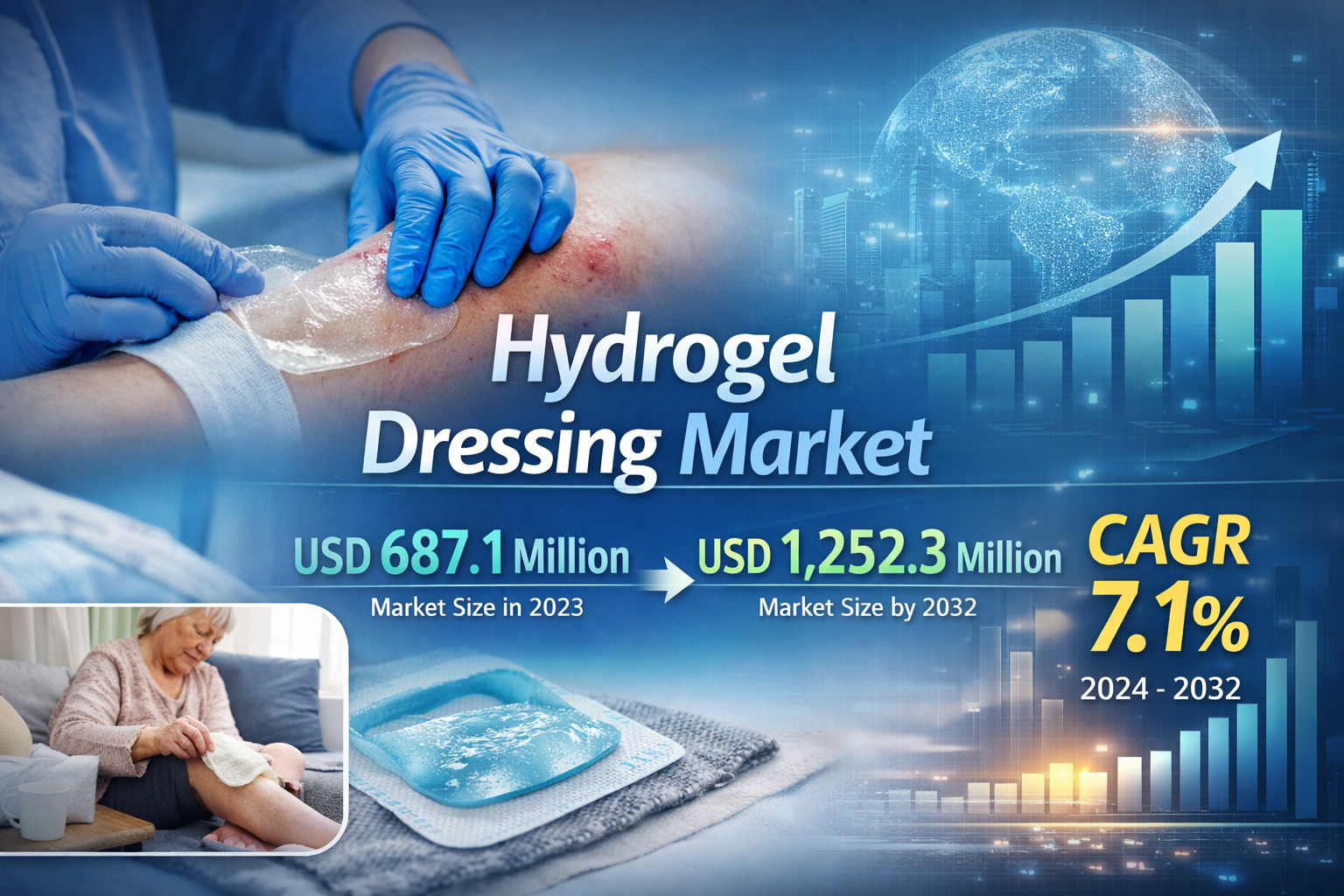
The global hydrogel dressing market was valued at approximately USD 687.1 million in 2023 and is projected to reach USD 1,252.3 million by 2032, growing at a CAGR of 7.1% from 2024 to 2032.
What Is the Hydrogel Dressing Market?
The Hydrogel Dressing Market refers to the global industry that produces and sells hydrogel‑based wound care products designed to manage and treat wounds by maintaining a moist and therapeutic healing environment. Hydrogel dressings are advanced wound care solutions formulated from water‑based gels — often made with natural, synthetic, or semi‑synthetic polymers — that deliver moisture, facilitate exudate absorption, promote tissue regeneration, and help reduce infection risk.
These products are commonly used for a broad range of acute and chronic wounds, including surgical and traumatic wounds, burns, diabetic foot ulcers, pressure ulcers, and venous leg ulcers. Their superior ability to soothe painful wounds — thanks to cooling properties — and promote faster healing makes them significant in modern wound management across hospitals, specialty clinics, and home care settings.
As chronic disease prevalence (like diabetes) and the global geriatric population continue to rise, so does the demand for effective wound care solutions, positioning the hydrogel dressing market as a critical segment within the broader wound care industry.
Get a Free Sample: https://www.acumenresearchandconsulting.com/request-sample/3736
Market Trends
The hydrogel dressing market has seen several significant trends that are shaping its current and future trajectory:
1. Rising Adoption of Advanced Wound Care Solutions
Healthcare providers increasingly prefer hydrogel dressings over traditional dressings due to their advanced moisture management, infection control, and pain‑relieving capabilities. This shift is driving market growth, particularly in developed regions with strong healthcare infrastructures.
2. Innovation in Hydrogel Formulations
Manufacturers are investing in new formulations — such as antimicrobial, temperature‑responsive, and drug‑loaded hydrogels — to enhance clinical effectiveness and extend applicability across complex wound types.
3. Home Healthcare Expansion
Another emerging trend is the increasing preference for at‑home wound care. Patients and caregivers are looking for user‑friendly hydrogel dressings suitable for self‑administration, reducing hospital visits and lowering overall care costs.
4. Segment Leadership of Amorphous Hydrogels
Among product types, amorphous hydrogel dressings — unstructured gels that easily conform to irregular wounds — have secured the largest market share due to their versatility and ease of application.
These trends collectively highlight a shift toward more personalized, effective, and convenient wound care solutions in both clinical and non‑clinical environments.
Market Dynamics
Understanding the market forces behind hydrogel dressings helps explain current performance and future prospects:
Drivers
Increasing chronic wound prevalence: Conditions such as diabetic foot ulcers and pressure ulcers drive demand for advanced dressings that promote moist healing and speed up tissue repair.
Geriatric population growth: Older individuals have higher susceptibility to wounds and slower healing rates, creating sustained demand for effective dressing solutions.
Technological innovation: Enhanced gel formulations and integration of antimicrobial properties are boosting product appeal and usage.
Restraints
Higher cost compared to traditional products: Advanced hydrogel dressings are generally more expensive, sometimes limiting adoption especially in low‑income regions.
Limited awareness in emerging economies: Despite clinical benefits, lack of understanding among healthcare professionals and patients can slow market penetration.
Application challenges: Improper use can potentially lead to issues such as maceration (over‑hydration) of the wound site.
Opportunities
Healthcare infrastructure development: Investments in healthcare facilities and services, particularly in emerging markets, present significant growth opportunities.
Expansion of self‑care trends: Continued consumer interest in home healthcare solutions opens avenues for novel hydrogel products tailored for home use.
These dynamics combine to create a market with robust growth prospects but also important challenges that players must strategically address.
Regional Analysis
The hydrogel dressing market exhibits clear regional variation in growth patterns:
North America
North America dominates the global market, supported by advanced healthcare infrastructure, high demand for innovative wound care solutions, and widespread clinical acceptance of hydrogel dressings. The region held the largest revenue share in 2023, with substantial contributions from both the U.S. and Canada.
Asia‑Pacific
The Asia‑Pacific market is among the fastest‑growing due to improving healthcare access, rising chronic disease prevalence, and expanding medical facilities. Countries such as China and India are experiencing significant growth as healthcare awareness and infrastructure improve.
Europe, Latin America, Middle East & Africa
Europe also holds a notable share, driven by increasing adoption of advanced wound care and government initiatives targeting chronic wounds. Latin America and the Middle East & Africa, while smaller in overall size, present emerging opportunities as healthcare systems evolve.
Overall, mature markets lead in size and innovation, while emerging economies are poised for accelerated growth in the coming decade.
Recent Developments
Key industry developments shaping the hydrogel dressing market include:
Innovation by key players: Leading companies are developing enhanced hydrogel dressings, including products with antimicrobial and other advanced features, to meet diverse clinical needs.
Home healthcare adoption: Expanded interest in self‑administered wound care is shaping product development and market strategies, with firms aligning their offerings to support home use.
The market is also influenced by major global players such as ConvaTec Group PLC, Smith & Nephew, 3M, Coloplast, and others, who continue to drive innovation and adoption worldwide.
Conclusion
The Hydrogel Dressing Market is experiencing substantial growth, driven by clinical efficacy, technological innovation, and rising wound care needs worldwide. With a projected market size of USD 1,252.3 million by 2032 and a strong CAGR of 7.1%, the sector holds promising potential across clinical and home healthcare settings.
As chronic disease prevalence climbs and healthcare systems modernize, demand for effective, easy‑to‑use wound care solutions like hydrogel dressings will continue to rise, offering growth opportunities for manufacturers and healthcare providers alike.
To Get Detailed Overview, Contact Us: https://www.acumenresearchandconsulting.com/contact-us