
The fenebrutinib priority review is the latest regulatory milestone for Roche: the U.S. Food and Drug Administration has accepted its New Drug Application for fenebrutinib and granted Priority Review designation for two forms of multiple sclerosis: relapsing multiple sclerosis and primary progressive multiple sclerosis. Roche announced the milestone on September 30, 2026.
The PDUFA target action date, the deadline by which the FDA is expected to complete its review, has not yet been publicly specified. Priority Review designation shortens the standard review period from twelve months to six.
What Fenebrutinib Is
Fenebrutinib is an oral, non-covalent Bruton’s tyrosine kinase inhibitor. BTK is a signaling enzyme expressed in B cells and myeloid cells, both of which are implicated in the inflammatory and neurodegenerative processes underlying multiple sclerosis. Covalent BTK inhibitors have been used in oncology for years, but their chronic use has raised questions about off-target effects on platelet function and other tissues.
Fenebrutinib’s non-covalent, reversible binding mechanism is designed to provide selective BTK inhibition with a more favorable safety profile for long-term dosing in an autoimmune indication. MS represents a new therapeutic territory for BTK inhibitors as a class.
The hypothesis driving their development in MS is that B cells, which play a central role in the inflammatory lesion activity that characterizes relapsing forms of the disease, also contribute to the compartmentalized inflammation within the central nervous system that drives progression in primary progressive and secondary progressive MS. BTK inhibition could theoretically address both compartments, an advantage over existing MS therapies that primarily modulate peripheral immune activity.
The Clinical Data Behind the Fenebrutinib Priority Review
The NDA submission is supported by the FENopta clinical program, which evaluated fenebrutinib in both relapsing and primary progressive MS. The relapsing MS trial, FENopta RMS, was a Phase III randomized controlled study that compared fenebrutinib against teriflunomide, an established oral MS therapy, on annualized relapse rate as the primary endpoint. The PPMS trial assessed fenebrutinib versus placebo on confirmed disability progression.
Roche has reported that fenebrutinib met its primary endpoints in both trials, providing the pivotal evidence base for the NDA. The company has not yet published the full dataset in peer-reviewed form at the time of this regulatory announcement, but the acceptance of the NDA by the FDA indicates that the submission package was sufficiently complete for the agency to begin its substantive review.
Why the Fenebrutinib Priority Review Matters for MS Patients
The FDA grants Priority Review to drugs that offer the potential for significant improvement in the safety or effectiveness of the treatment of a serious condition. Both relapsing and primary progressive MS qualify as serious conditions, and Priority Review for both indications simultaneously is relatively uncommon. It reflects the FDA’s assessment that fenebrutinib, if approved, could represent a meaningful advance in the treatment landscape.
For patients with primary progressive MS in particular, the Priority Review designation carries additional weight. PPMS has historically been the hardest form of MS to treat, with only ocrelizumab, Roche’s anti-CD20 monoclonal antibody, having demonstrated efficacy and securing approval in the indication. Fenebrutinib, if approved for PPMS, would offer a second approved option and the first oral therapy for that population.
Where the Fenebrutinib Priority Review Fits in the MS Landscape
The MS drug market is competitive and rapidly evolving. In the relapsing MS space, fenebrutinib would enter against a field that includes natalizumab, ocrelizumab, ofatumumab, ozanimod, siponimod, cladribine, and the fumarates, among others. The argument for fenebrutinib in that context rests partly on its oral administration, which is convenient compared to infused or injected therapies, and partly on its BTK mechanism, which may offer a differentiated profile on disability progression relative to purely anti-inflammatory agents.
Roche is not alone in pursuing BTK inhibition in MS. Sanofi’s tolebrutinib, another non-covalent BTK inhibitor, has also been in late-stage MS development, though it has encountered regulatory scrutiny over liver toxicity signals observed in clinical trials. The safety experience with tolebrutinib has sharpened attention on the hepatic profile of the BTK inhibitor class overall.
Roche has reported that fenebrutinib’s safety profile in the FENopta trials was acceptable, with no liver toxicity signals of the magnitude seen with tolebrutinib, but the FDA’s review will include a careful assessment of hepatic laboratory findings across the full trial database.
What the Fenebrutinib Priority Review Will Assess
During the six-month Priority Review period, the FDA will evaluate the clinical trial data for efficacy on relapse reduction and disability progression, the safety database including hepatic function, cardiac, and infection signals, the proposed prescribing information and risk management measures, and the manufacturing and quality control package for the oral tablet formulation.
An advisory committee meeting is possible given the novelty of the BTK mechanism in MS and the dual-indication submission, though the agency is not obligated to convene one. A decision is expected in the first half of 2027 if the six-month clock runs from the September 30 acceptance date. Roche has not announced specific PDUFA date details publicly.
Roche’s Position in Multiple Sclerosis
Roche, through its Genentech subsidiary, already has a substantial MS franchise anchored by ocrelizumab, marketed as Ocrevus, which has become one of the best-selling MS therapies globally since its 2017 approval in both relapsing and primary progressive forms. Fenebrutinib would complement rather than replace ocrelizumab in the portfolio, offering an oral BTK option for patients who prefer or require a non-infused treatment and potentially addressing disease compartments that anti-CD20 depletion does not fully reach.
The fenebrutinib NDA acceptance marks a significant step in Roche’s effort to maintain leadership in MS as ocrelizumab approaches biosimilar competition and the treatment landscape continues to evolve toward mechanisms that address both inflammation and neurodegeneration.
Related Coverage
For more regulatory and pipeline news, read our reports on Teva’s Weltruza approval for schizophrenia, AnnJi’s AJ201 Phase 3 trial for Kennedy’s disease and Roche’s newborn screening test launch, or browse more pharmaceuticals news.
Medical Disclaimer: This article is for informational purposes only and does not constitute medical advice. Patients with multiple sclerosis or questions about MS treatments should consult a qualified neurologist. Fenebrutinib is an investigational therapy and has not yet been approved by the FDA.
Bottom Line on the Fenebrutinib Priority Review
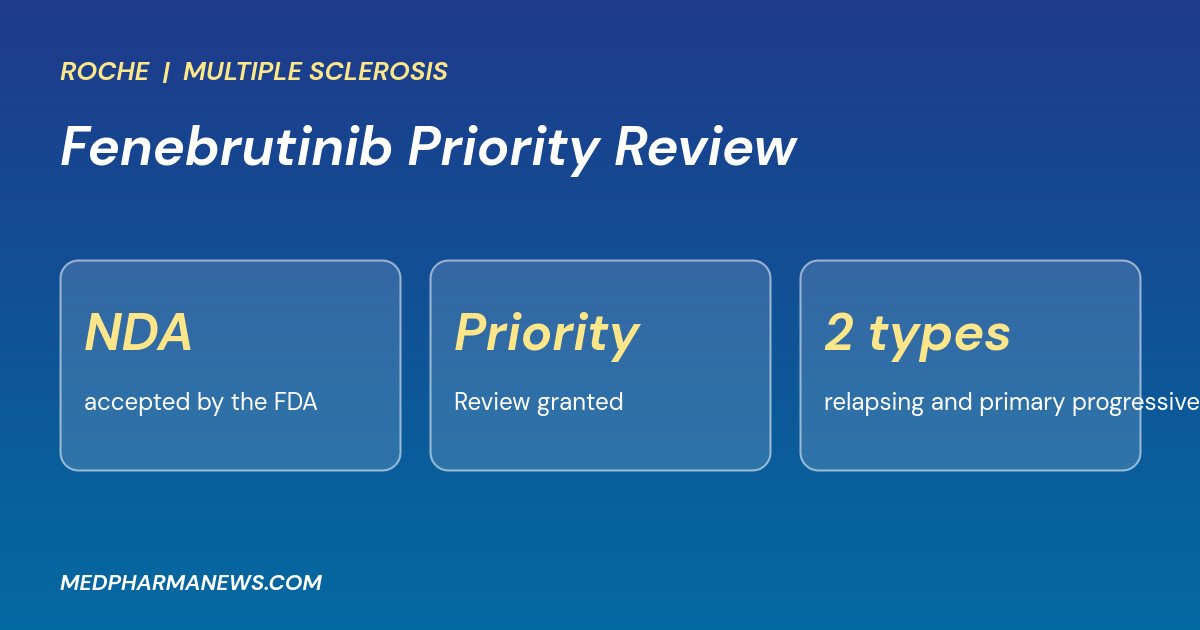
The fenebrutinib priority review means the FDA has accepted Roche’s new drug application for the non-covalent BTK inhibitor and granted Priority Review for both relapsing multiple sclerosis and primary progressive multiple sclerosis, as Roche announced on 30 September 2026. In our assessment, the fenebrutinib priority review is a regulatory milestone and not an approval, so patients cannot yet receive the drug outside of trials.
Frequently Asked Questions
What is the fenebrutinib priority review?
The FDA accepted Roche’s new drug application for fenebrutinib and granted Priority Review for both relapsing and primary progressive multiple sclerosis, as Roche announced on 30 September 2026.
Which MS types does the fenebrutinib priority review cover?
Relapsing multiple sclerosis and primary progressive multiple sclerosis.
Is fenebrutinib approved?
No. The FDA has accepted the application for review. Approval has not been granted.