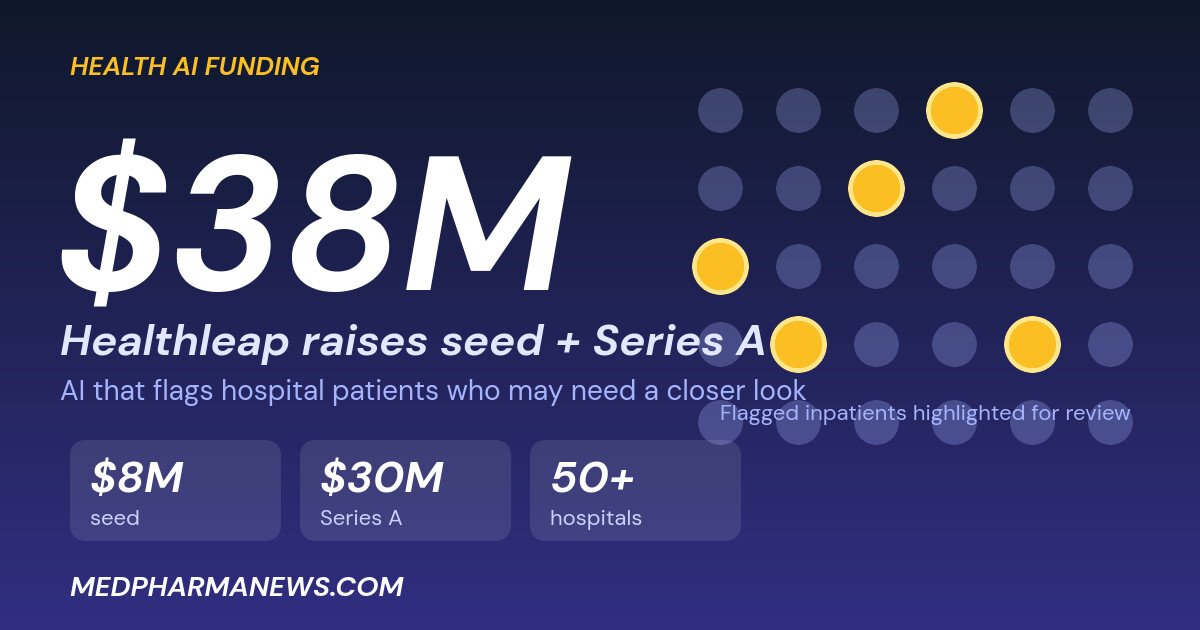
By the time the morning shift starts on a hospital ward, a piece of software has already read every adult patient’s chart overnight. That is the pitch behind Healthleap raises $38M, announced on 7 October 2026: a South African-founded start-up that uses AI to flag hospital inpatients who may have a condition nobody has yet looked for, such as malnutrition or delirium. The money comes as an $8 million seed round and a $30 million Series A.
Funding at a glance
- Total raised: $38 million across two rounds.
- Seed ($8M): co-led by Sequoia Capital and First Round Capital.
- Series A ($30M): led by Hummingbird Ventures.
- Valuation: not disclosed.
- Use of funds: engineering, product, sales and customer success.
What Healthleap actually does
Healthleap connects to a hospital’s electronic health record. Language models read clinical notes for mentions of symptoms, such as weight loss or difficulty swallowing, and those findings are combined with structured data such as lab results and vital signs in risk models. Every night the system analyses each adult inpatient’s record. Each morning it places a risk score and a trend dashboard into the care team’s existing workflow.
The company is explicit that the software does not diagnose anything. It flags patients for further review, and a clinician decides what to do next. Today it screens for malnutrition and delirium. Programmes for aspiration pneumonia, pressure ulcers and heart-failure readmission risk are in clinical validation, according to the announcement.
Why malnutrition is the starting point
Malnutrition in hospital is common and often missed. The company cites research estimating that between 20% and 50% of hospital inpatients are malnourished, and linking it to longer stays, complications and higher mortality. Public-health bodies such as the World Health Organization describe malnutrition as a broad global health problem. The practical difficulty in hospitals is that screening depends on busy staff noticing subtle signals in notes and charts, which is exactly the kind of pattern-finding the company says its models automate.
Origins and leadership
Siblings Jemima and Josiah Meyer founded Healthleap in South Africa in 2022. It began as a clinical nutrition tool built by Jemima for dietitians, then widened into a platform for spotting hospital patients who may have a range of conditions. Josiah Meyer is chief executive and co-founder.
Traction, and how to read it
The company says its platform is now deployed in more than 50 hospitals, up from three a year ago, and that revenue grew more than tenfold over the same period, though it disclosed no revenue figures. Reporting at the announcement named Penn Medicine, Cedars-Sinai, Intermountain, Houston Methodist and Emory Healthcare as customers; we have not independently confirmed each relationship.
Healthleap also reports a results claim at one site: that its malnutrition programme at the Hospital of the University of Pennsylvania produced $23.8 million in annualised financial impact, made up of $6.3 million in added reimbursement and $17.5 million from shorter hospital stays. In our check of the company’s figures, those two components add up to the total. But this is a company-reported number from a single hospital, and it has not been independently audited or published in a peer-reviewed study.
Other summaries of the round circulating online describe different pilot results and customer details. We could not corroborate those and have not used them.
The business model
Contracts run for three years and are priced by the hospital’s licensed bed count. The company also offers outcome-based pricing tied to a return on investment that hospital finance teams validate. It says every customer has seen at least a fivefold hard return, and some more than twentyfold annual total return. These are claims from the company, not independently verified results.
Why hospitals are open to this kind of tool
Hospitals sit on large volumes of unstructured text, from nursing notes to dietitian assessments, that is rarely analysed systematically. A tool that reads those notes and turns them into a ranked list for the next morning promises to make existing information usable without asking staff to enter anything new. That is a lighter lift than many clinical software projects, and it helps explain why buyers are willing to try it. In our assessment, whether it holds up depends on alert quality: too many false flags and clinicians will tune it out.
Regulatory context
Software that helps clinicians make decisions can fall under FDA oversight depending on what it does and how it presents information. The FDA’s guidance on clinical decision support software sets out how the agency distinguishes certain decision-support tools from regulated medical devices. Healthleap says it does not diagnose and only flags patients for review, but whether and how its future programmes are regulated will depend on their functions. The announcement did not discuss regulatory status.
Our assessment
In our assessment, the appeal is easy to see: hospitals have chart data in abundance and too little time to read it, and a nightly screen that surfaces overlooked patients is a modest, workflow-friendly use of AI. The open questions are the ones that matter to buyers. Do flagged patients actually receive better care, does the system generate manageable numbers of alerts, and are the financial gains repeatable outside flagship academic centres? Those are our questions, not claims by the company or its investors.
What to watch next
- Peer-reviewed or independently audited outcomes from customer hospitals.
- Results from the programmes now in clinical validation.
- Any expansion into outpatient and home care, which the company has outlined, and its long-term goal of covering more than 40 major conditions.
- Competition from electronic health record vendors and other clinical AI firms.
For wider context on AI in hospitals, see our market coverage of AI in healthcare and browse more healthcare IT news.
Frequently asked questions
How much did Healthleap raise?
$38 million in total: an $8 million seed round and a $30 million Series A.
Who invested in Healthleap?
Sequoia Capital and First Round Capital co-led the seed round, and Hummingbird Ventures led the Series A.
What does Healthleap’s AI do?
It analyses hospital inpatients’ records overnight and posts risk scores each morning to flag patients who may have conditions such as malnutrition or delirium, for clinician review.
Does Healthleap diagnose patients?
No. The company says it only flags patients for further review.
How many hospitals use it?
The company says more than 50, up from three a year ago.
How we reported this: we used the company’s funding announcement and the details disclosed alongside it on 7 October 2026. Customer, outcome and return figures are company-reported and not independently verified. Last updated: 8 October 2026. This article is news reporting and not investment or medical advice.