The World Health Organization has told doctors and governments that the foundation of obesity care for young people is not a drug and not an operation. In its first global guidelines on the subject, published on 7 October 2026, WHO says children under 10 should not be given weight-loss medicines, bariatric surgery or weight-loss devices, and that adolescents should be offered medicines only after a supervised lifestyle programme has failed to work. The new WHO childhood obesity guidelines arrive just as injectable GLP-1 drugs are reaching younger patients.
What WHO now recommends, by age
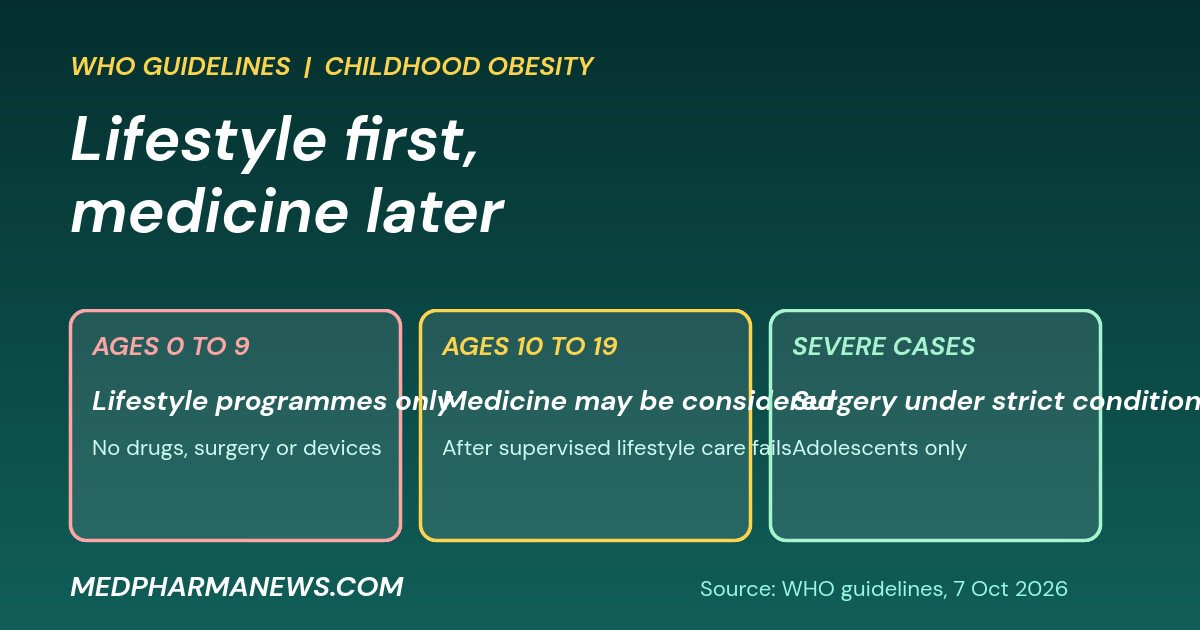
- Ages 0 to 9: WHO does not recommend pharmacological treatment, bariatric surgery or weight-loss devices. It strongly recommends structured programmes covering diet, physical activity and behaviour change, delivered individually or in a broader multimodal programme.
- Ages 10 to 19: approved weight-loss medicines may be considered if a supervised, multimodal lifestyle programme has not achieved the desired outcome.
- Severe obesity in adolescents: bariatric surgery should be considered only under strict conditions.
- Digital tools: may be used with parental or caregiver supervision.
WHO published two documents, one for children (the WHO guidelines on the integrated management of obesity in children) and one for adolescents (the guidelines for adolescents). The guidance is advisory: it does not change drug approvals or insurance rules in any country.
“The foundation is not medicine or surgery”
Dr Luz María De Regil, Director of WHO’s Department of Nutrition and Food Safety, said: “The foundation of obesity care for children and adolescents is not medicine or surgery.” WHO describes obesity as a chronic, relapsing disease that can begin early in life and raises the risk of type 2 diabetes and cardiovascular disease.
The agency also stresses that treatment should aim at overall health, functioning and well-being, not only at lowering weight. Mental health problems such as anxiety, depression, low self-esteem, stigma and bullying should be addressed alongside obesity, it says.
Why the guidance matters: the numbers
WHO estimates that in 2024 about 170 million children and adolescents aged 5 to 19 were living with obesity: roughly 70 million aged 5 to 9 and 100 million aged 10 to 19. The share of that age group with obesity has risen from 2% in 1990 to 8%, a fourfold increase.
In the United States, the Centers for Disease Control and Prevention reports that about one in five children and adolescents aged 2 to 19, roughly 14.7 million, have obesity, based on 2017 to March 2020 data. Prevalence rises with age, from 12.7% at ages 2 to 5 to 22.2% at ages 12 to 19, and is higher among Hispanic and Black children and in lower-income families.
What about GLP-1 drugs?
The headline question for many parents is whether newer injectable drugs belong in children’s care. WHO’s position is cautious. It says there is not yet enough evidence on GLP-1 drugs in young people and that it may revise the guidance as trial results emerge. For adolescents, medicines are a second step, not a starting point.
That differs in emphasis from United States paediatric advice. The American Academy of Pediatrics advised in 2023 that adolescents aged 12 and older with obesity should be offered weight-loss medication alongside lifestyle treatment, and that teens aged 13 and older with severe obesity should be referred for surgical evaluation. Some medicines, including Wegovy and Saxenda, are approved by the U.S. Food and Drug Administration for certain adolescents aged 12 and older. The two documents are not directly comparable, because WHO writes for health systems worldwide and the AAP for American clinicians.
Our reading: a sequencing message, not a ban
In our assessment, the headline “lifestyle before medication” is accurate for adolescents and an outright exclusion for children under 10. It is not a ban on medicines for teenagers. WHO’s own wording leaves room for treatment once supervised lifestyle care has been tried and has not worked. The practical difficulty is that many families struggle to access structured, supervised programmes at all, so a rule that puts them first can be hard to follow in places where they are scarce.
What families should do now
- Do not stop a prescribed medicine on your own. Teens already on a GLP-1 drug should speak to their prescriber before making any change. Severe or ongoing vomiting, intense abdominal pain or signs of dehydration need prompt medical care.
- Ask about structured programmes. Ask your child’s doctor whether a supervised diet, activity and behaviour programme is available locally, and whether insurance covers it. Coverage and waiting lists vary.
- Look at the whole child. Raise concerns about mood, bullying and self-esteem with the care team.
- Keep weight talk supportive. Stigma is itself a harm, and WHO says it needs addressing.
What it means for the pharma industry
For drug makers, the guidance narrows the near-term case for paediatric use under age 10 and frames adolescent use as second-line. Companies running paediatric trials of obesity medicines will find that WHO has said it will revisit its position as evidence arrives, which gives long-term outcome data real weight. Readers following the sector can browse our market coverage of anti-obesity drugs and our wider pharmaceutical news.
Frequently asked questions
What did WHO say about weight-loss drugs for children?
WHO does not recommend weight-loss medicines, bariatric surgery or weight-loss devices for children aged 0 to 9, and recommends structured lifestyle programmes instead.
Can teenagers be given weight-loss medication under WHO guidance?
Yes, in some cases. Approved medicines may be considered for ages 10 to 19 if a supervised lifestyle programme has not achieved the desired outcome.
Does the WHO guidance change what is approved in the US?
No. It does not alter FDA approvals or insurance rules.
How many children have obesity worldwide?
WHO estimates about 170 million children and adolescents aged 5 to 19 had obesity in 2024.
Should my child stop taking a GLP-1 drug?
Do not stop without speaking to the prescriber. This article is not medical advice.
How we reported this: we used WHO’s guideline documents and statements of 7 October 2026, plus public data from US health bodies. Our assessments are labelled. Last updated: 8 October 2026. This article is news reporting and not medical advice; consult a qualified clinician about any child’s treatment.