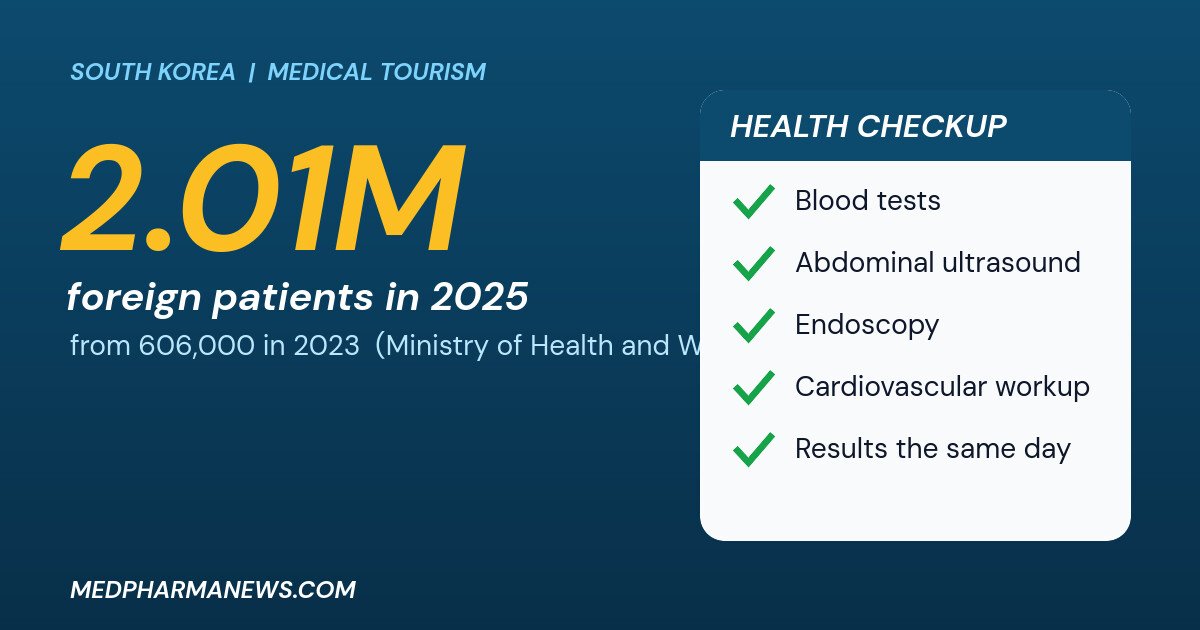
Korea medical tourism has crossed a threshold: about 2.01 million foreign patients received care in South Korea in 2025, according to figures from the Ministry of Health and Welfare, up from roughly 1.17 million in 2024 and 606,000 in 2023. The headline is that the country is turning into a global healthcare hub. The more interesting detail, though, is what travellers are buying. Alongside the well-known skin and cosmetic clinics, a fast-growing group of foreigners now flies in for something plainer: blood tests, ultrasounds and comprehensive health checkups.
This report sets out the numbers, explains what is driving the checkup boom, and looks at where the “hub” label is accurate and where it needs qualifying. Official statistics are attributed to the ministry; where costs or trends come from commentary rather than government data, we say so.
Korea medical tourism by the numbers
- Foreign patients, 2025: about 2.01 million, the highest on record.
- Foreign patients, 2024: about 1.17 million; 2023: 605,768.
- Growth: by our calculation, 2025 was roughly 72% above 2024 and about 3.3 times the 2023 level.
- Origins: patients from 201 countries or territories.
- Spending: an institute estimate puts spending by patients and companions at about 12.5 trillion won (roughly $8.4 billion) in 2025, of which only 3.3 trillion won went on treatment itself.
- Checkup-specific visitors: over 65,000 foreigners came specifically for screening in the latest year, up from about 4,400 in 2020 when the count began, according to figures cited in commentary.
Who is coming
China led all nationalities in 2025 for the first time, at 30.8% of foreign patients, just ahead of Japan at 29.8%. Taiwan accounted for 9.2%, the United States for 8.6% and Thailand for 2.9%. Patient numbers from China and Taiwan more than doubled from 2024, while US patients rose 70.4% and Canadian patients 59.1%. By our calculation, 8.6% of 2.01 million is about 173,000 US patients, which fits with commentary citing a rise from about 54,000 in 2019.
What is driving the checkup boom
- Speed: a full screening can be completed in about half a day, with urgent results returned quickly and findings relayed to patients abroad by phone.
- Breadth: a typical package can bundle blood work, endoscopy, colonoscopy, abdominal ultrasound and a cardiovascular workup in one visit.
- Price of imaging: commentary estimates a basic US checkup at $600 to $800, with a CT or MRI scan adding $2,000 to $3,000. Korean screenings are described as typically around $700, or about $300 at a specialist screening centre rather than a university hospital.
- Service for foreigners: large screening networks run global programmes with online booking and dedicated desks for international visitors, and English-language support is a selling point.
- Pairing with a trip: many visitors fold a checkup into a holiday, which is why the trend is covered as travel as well as health.
Is Korea really a checkup hub, or a skin-clinic hub?
This is where the headline needs care. The ministry data show that dermatology accounted for 62.9% of foreign patients and cosmetic surgery for another 11.2%. Clinic-level institutions handled 87.7% of visits, and Seoul treated about 87.2% of foreign patients. On those numbers, the typical foreign patient in Korea is a clinic visitor in Seoul for a skin or aesthetic treatment, not a screening customer.
By our calculation, the 65,000 screening visitors equal only about 3% of the 2.01 million total. Their growth rate is striking, rising roughly fifteen-fold in five years, but in absolute terms the segment is small. In our assessment, “global healthcare hub” is fair for the volume and breadth of Korea’s service, while “screening hub” describes an emerging niche rather than the main business. The spending split points the same way: only about 26% of the estimated 12.5 trillion won went on treatment, with the rest going on travel, accommodation and related costs.
The cost comparison, read carefully
The price comparison in the commentary deserves a second look. A basic US checkup at $600 to $800 is not dramatically more expensive than a typical Korean screening at about $700. The saving is clearest at the specialist-centre price of around $300 and for imaging, where a CT or MRI in the US can add thousands of dollars. Travellers should also add flights and accommodation. For Americans without good insurance, or those who face long waits for a primary care appointment, the maths can still work, but it is not a universal bargain.
What travellers should check first
- Follow-up: who will act on an abnormal result once you are home, and how records will be shared with your own doctor.
- Scope: a screening package is not a diagnosis; some findings need further tests that may be covered differently.
- Insurance and complications: check what your policy covers abroad and what happens if a procedure goes wrong.
- Credentials: confirm the facility is licensed and the clinicians are registered.
- Over-testing: more scans are not always better; discuss with your own doctor which screenings suit your age and risk.
This is general information and not medical advice.
Why it matters for the industry
For hospitals, the trend is a growth market worth building dedicated international desks and translation services around. For policymakers, it raises questions about balancing foreign demand against domestic capacity, given that Seoul holds 62.5% of the country’s registered medical establishments but treats about 87% of foreign patients. For other countries, it shows how a mix of speed, price, technology and service can shift patient flows. The Korea Health Industry Development Institute promotes the sector abroad. For another story at the intersection of health data and hospital operations, see how Healthleap’s AI flags hospital patients who may need a closer look, or browse more industry insights.
What to watch next
- Whether 2026 growth continues at this pace, and whether screening overtakes cosmetic care in share.
- Any rules aimed at managing foreign patient flows or protecting consumers.
- Whether overseas screening centres modelled on Korean programmes open elsewhere, as one commentary reports is planned in California.
- Data on follow-up outcomes, which are largely missing from the statistics.
Frequently asked questions
How many foreign patients visited Korea in 2025?
About 2.01 million, according to the Ministry of Health and Welfare, up from about 1.17 million in 2024.
Why are people going to Korea for health checkups?
Reported reasons include speed, a broad bundle of tests in one visit, lower imaging prices than in the US, and services for international patients.
What is the most common specialty for foreign patients?
Dermatology, at 62.9% of foreign patients, followed by cosmetic surgery at 11.2%.
Which nationalities lead?
China (30.8%), Japan (29.8%), Taiwan (9.2%), the United States (8.6%) and Thailand (2.9%).
Are medical checkups abroad safe?
They can be, at licensed facilities, but travellers should plan for follow-up care and records. This is not medical advice.
How we reported this: we used ministry statistics for 2023 to 2025 as published in 2026 and commentary for checkup costs and screening-visitor numbers. We did not independently verify the data. Our calculations are labelled. Last updated: 9 October 2026. This article is news reporting and not medical advice.