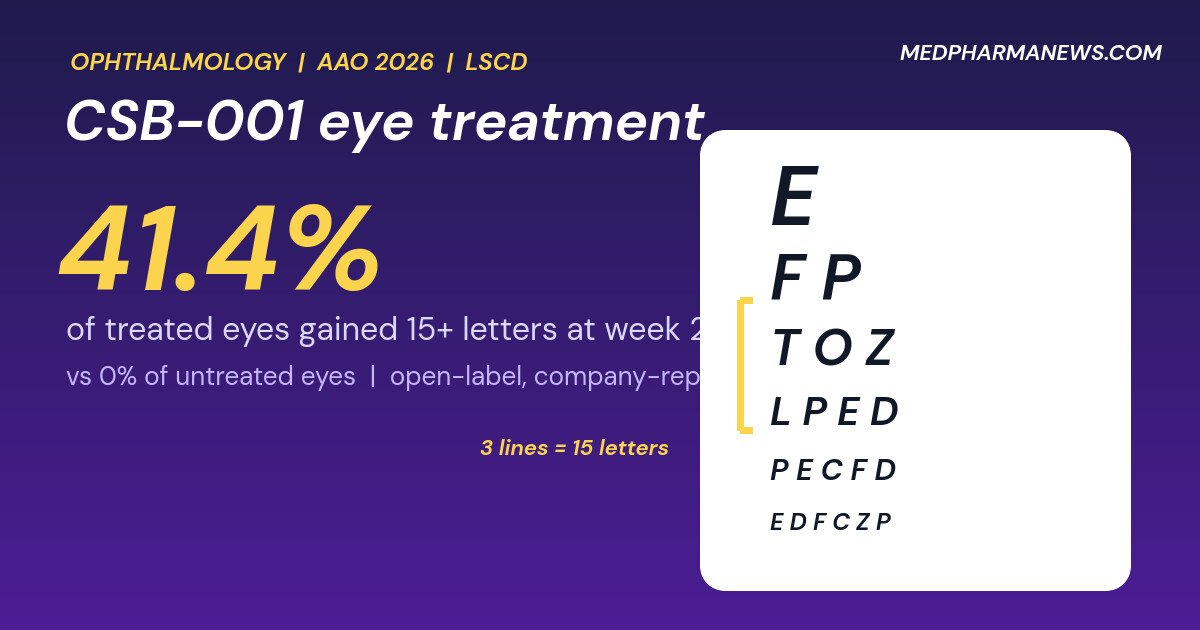
The CSB-001 eye treatment produced clear vision gains in an early study of limbal stem cell deficiency, according to data Claris Biotherapeutics released on 11 October 2026. In the open-label study, 41.4% of treated eyes gained at least 15 letters of best-corrected visual acuity by week 20, against none of the untreated eyes. The results were presented by investigator John Affeldt of Loma Linda University Medical Center at the American Academy of Ophthalmology (AAO) 2026 annual meeting in New Orleans.
The result is encouraging, but it comes from a small, unblinded study, and the company has not yet released safety detail. This report explains what was tested, what the numbers do and do not show, and what the company plans next.
CSB-001 eye treatment: the results at a glance
- Drug: CSB-001 (oremepermin alfa ophthalmic solution), an investigational eye drop.
- Condition: limbal stem cell deficiency (LSCD).
- Gain of 15 or more letters: 41.4% of treated eyes, against 0% of untreated eyes, at week 20.
- Gain of 10 or more letters: 55.2% of treated eyes, against 5% of untreated eyes.
- Any improvement: 76% of treated eyes. No control figure was given.
- Durability: 50% of treated eyes kept a 15-letter gain, and 81% kept a 10-letter gain, for 16 weeks after treatment, per the company.
- Safety: described as generally safe and well tolerated, with no adverse-event rates reported.
What limbal stem cell deficiency is
The limbus is the ring at the edge of the cornea that holds stem cells which keep the clear front surface of the eye renewed. When those cells are lost, the surface can become cloudy and scarred, as the conjunctiva grows over the cornea. Patients can have pain, light sensitivity and falling vision. The National Eye Institute provides general background on corneal conditions.
The company says there is no approved drug for LSCD, that at least 30,000 people in the United States are actively managed by an eye care professional, and that at least 40% of them have disease in both eyes. It adds that true numbers are probably higher because the condition is under-diagnosed. These are company estimates, not figures we have verified.
How the CSB-001 eye treatment study was run
- Design: an open-label proof-of-concept study, listed as ClinicalTrials.gov entry NCT06452316.
- Population: 49 eyes from 39 people with central corneal conjunctivalisation and reduced vision.
- Treated group: 29 eyes from 23 people.
- Untreated control group: 20 eyes from 16 people.
- Dosing: drops four times daily for eight weeks, a one-month break, then eight more weeks.
- Main measure: change in best-corrected visual acuity at week 20.
The company has described the study differently over time. A July 2026 announcement referred to 63 subjects, while the October analysis covers 39. It may be that the analysis set is a subset of those enrolled, but the reports do not say. The durability claim is also unclear: results are given at week 20, yet gains are described as lasting 16 weeks after treatment ended, and the reports do not explain how those time points fit together.
What the CSB-001 eye treatment numbers really show
By our calculation, the percentages correspond to about 12 treated eyes gaining 15 or more letters, 16 gaining 10 or more, and 22 improving at all, out of 29. On a standard eye chart, 15 letters is roughly three lines. In the control group, 5% means a single eye out of 20, so one eye changes that figure by five points.
Several features limit how far the results can be pushed. The study was not blinded, so patients and doctors knew who was treated. Controls were untreated, not given an inactive drop. The way eyes were allocated to each group was not described. Results are counted by eye, and two eyes from one person are not independent. No statistical tests or confidence intervals were released, and the data were presented in a talk, not a peer-reviewed paper. All of this is company-reported.
How the CSB-001 eye treatment is meant to work
The active ingredient is a recombinant form of human deleted hepatocyte growth factor, a protein involved in tissue repair. The company proposes that it helps the corneal surface regenerate, calms inflammation, limits scarring and helps cells survive. That mechanism is a company description and has not been proven in the data released.
Our assessment of the CSB-001 eye treatment
In our assessment, the CSB-001 eye treatment has produced a genuine early signal in a condition with few drug options, and a three-line gain would matter to a patient. At the same time, the evidence is the sort that often shrinks in larger, masked trials. The key questions are whether the effect holds against a vehicle drop, whether safety is clean, and whether gains last once dosing stops. For another recent example of early company-reported data, see our report on opamtistomig’s FDA Fast Track or on Alumis’s 48-week envudeucitinib results, or browse more pharmaceutical news.
What happens next for the CSB-001 eye treatment
The company plans two pivotal studies comparing the drop with a vehicle in about 400 people with LSCD in total, starting in the first half of 2027. The main endpoint will be visual acuity, supported by anatomical measures, and dosing will be continuous, without the break used in this study. In July 2026, the company announced a $118 million Series B financing, co-led by Samsara Biocapital and Catalio Capital Management, to support that plan. The sources we reviewed did not mention any special FDA designations.
What to watch after the CSB-001 eye treatment data
- Safety and adverse-event data from the proof-of-concept study.
- A peer-reviewed publication of the results.
- Final design and start of the pivotal studies in 2027.
- Any regulatory designation or FDA feedback on the development path.
Frequently asked questions
What is the CSB-001 eye treatment?
An investigational eye drop containing recombinant human deleted hepatocyte growth factor, being developed by Claris Biotherapeutics for limbal stem cell deficiency.
Did the CSB-001 eye treatment improve vision?
In an open-label study, 41.4% of treated eyes gained at least 15 letters at week 20, against none of the untreated eyes. The study was small and unblinded.
Is CSB-001 approved?
No. It is in development, and pivotal studies are planned for 2027.
Is the CSB-001 eye treatment safe?
The company calls it generally safe and well tolerated, but it has not released adverse-event data.
How many people were studied?
The October analysis covers 49 eyes from 39 people, with 29 treated eyes and 20 untreated eyes.
How we reported this: we relied on the company’s release of 11 October 2026, its July 2026 financing announcement and the ClinicalTrials.gov listing. Results are company-reported and not peer reviewed. Figures labelled as ours are our own calculations. Last updated: 12 October 2026. This article is news reporting and not medical advice.