Alumis has reported 48-week Phase 3 results for envudeucitinib plaque psoriasis treatment, saying 54% of patients reached complete skin clearance (PASI 100) after up to a year of continuous dosing. The data come from the ONWARD3 long-term extension study and were presented on 9 October 2026 at the Fall Clinical Dermatology Conference.
The envudeucitinib plaque psoriasis figures add to the 24-week ONWARD1 and ONWARD2 trials and support the company’s plan to file a new drug application in the fourth quarter of 2026. This article explains what the data show, how to read them, and what the company has not yet disclosed.
Envudeucitinib plaque psoriasis data: the essentials
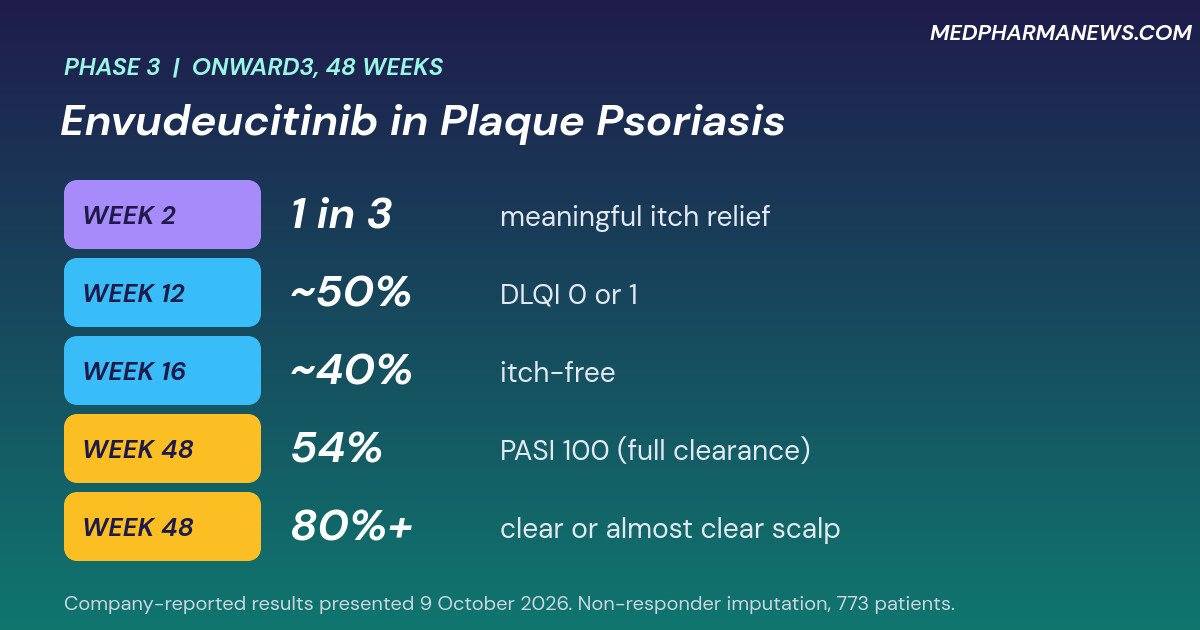
- Skin clearance: 54% reached PASI 100 at week 48, per the company.
- Scalp: over 80% maintained clear or almost clear scalp skin at 48 weeks.
- Itch: nearly 80% sustained a clinically meaningful itch reduction through week 48.
- Quality of life: more than 70% kept a DLQI score of 0 or 1 at week 48, meaning little or no effect on daily life.
- Next step: new drug application planned for the fourth quarter of 2026.
What is envudeucitinib for plaque psoriasis?
Envudeucitinib is an investigational oral drug that blocks tyrosine kinase 2 (TYK2), an enzyme that helps relay signals from immune messengers including interleukin-23, interleukin-17 and type I interferon. These signals drive the skin inflammation seen in psoriasis. Alumis describes the drug as a highly selective allosteric inhibitor designed for maximal 24-hour blocking of TYK2.
The company claims it is the only TYK2 inhibitor shown to achieve maximal target inhibition over 24 hours in humans. That is a company claim that we have not been able to verify. In the Phase 3 trials the dose was 40 mg twice daily, and the drug can be taken with or without food.
How the envudeucitinib plaque psoriasis programme was designed
Two parallel Phase 3 trials, ONWARD1 and ONWARD2, enrolled adults with moderate-to-severe plaque psoriasis. Patients were randomised 2 to 1 to 1 to envudeucitinib, placebo or apremilast, an established oral treatment, over 24 weeks. The analysed population was 1,771 patients.
By our calculation from the company’s arm sizes, 892 patients received envudeucitinib, 441 placebo and 438 apremilast across the two trials, which matches the 2 to 1 to 1 design.
- ONWARD3: an extension for people who completed week 24, with 1,509 patients enrolled.
- Open-label start: all patients received envudeucitinib for the first 24 weeks of the extension, whatever they took before.
- Withdrawal test: the first 200 patients with a 75% improvement (PASI 75) at week 24 could enter a randomised 24-week period on either blinded envudeucitinib or placebo.
- Length: designed to provide up to 96 weeks of safety and efficacy data.
Week 48 results for envudeucitinib plaque psoriasis
The 54% PASI 100 figure comes from a non-responder imputation analysis of 773 patients who received up to 48 weeks of continuous envudeucitinib. In that method, anyone who stopped treatment or lacked data counts as a non-responder, which is a conservative way to report results. By our calculation, 773 patients is about half of the 1,509 enrolled in the extension, so the figure applies to a subset.
The company describes 54% as the highest publicly reported PASI 100 rate among existing and investigational oral psoriasis therapies. Trials are not run head to head, populations and designs differ, and the release does not give the comparison data, so readers should treat that as a marketing claim and not a proven advantage.
Envudeucitinib plaque psoriasis: itch, scalp and quality of life
Psoriasis is more than a skin-deep problem, and the company emphasised symptoms that patients often rate as most troubling.
- Itch, early: about one-third of patients had a clinically meaningful drop in itch (at least 4 points on a numeric scale) as early as week 2.
- Itch, week 16: about 40% reported no itch at all and about 60% reported little or none.
- Quality of life, week 12: about half had a DLQI of 0 or 1.
- Scalp, week 48: over 80% kept a clear or almost clear scalp.
Scalp psoriasis is hard to treat and visible, so the scalp result will interest dermatologists. The National Psoriasis Foundation and the National Institute of Arthritis and Musculoskeletal and Skin Diseases provide patient-focused information on the condition.
Envudeucitinib plaque psoriasis safety: what has and has not been said
Alumis says envudeucitinib was generally well tolerated across the ONWARD programme, with no new safety signals seen with long-term exposure in ONWARD3. The release does not give rates of adverse events, treatment discontinuations, acne, herpes infections or laboratory changes, which are the details regulators and doctors will examine. Without them, the safety picture is incomplete.
The same applies to the week-48 PASI 75 and PASI 90 rates and the overall physician rating (sPGA), which the release does not report. Those figures are likely to come in a full presentation or publication.
Why envudeucitinib plaque psoriasis data matter for the oral market
Patients with moderate-to-severe psoriasis often use injectable biologics, which are effective but require injections. Oral drugs offer convenience, but until recently few matched biologic-level clearance. TYK2 inhibition is one route to closing that gap, and a first approved drug in the class already exists, so envudeucitinib would enter a competitive area.
For related drug-approval and trial news, see our reports on a monthly schizophrenia injection winning FDA approval, a Phase 3 trial for a rare neuromuscular disease and a Phase 3 hidradenitis suppurativa trial meeting its endpoint.
Our assessment of envudeucitinib plaque psoriasis data
In our assessment, the envudeucitinib plaque psoriasis data are encouraging mainly for their durability, since high clearance and symptom control held up to a year. The caveats are real: the company, not an independent group, chose what to report; the headline figure uses a subset; the extension was partly open-label; and safety details are missing. The Alumis announcement is a good starting point, but the full dataset will decide how strong the case is.
For more drug-development news, browse our pharmaceuticals section.
What to watch next for envudeucitinib plaque psoriasis
- The NDA submission planned for the fourth quarter of 2026, which by our count is at most about eleven weeks away.
- Full safety data, including discontinuation and adverse-event rates.
- Week-48 PASI 75, PASI 90 and sPGA results.
- Results of the randomised withdrawal period.
Frequently asked questions
What did the envudeucitinib plaque psoriasis study show at 48 weeks?
54% of patients reached complete skin clearance (PASI 100), and over 80% kept a clear or almost clear scalp, per Alumis.
What is envudeucitinib for plaque psoriasis?
An investigational oral TYK2 inhibitor taken at 40 mg twice daily in the Phase 3 trials.
Is envudeucitinib plaque psoriasis treatment approved?
No. Alumis plans to submit a new drug application in the fourth quarter of 2026.
How was it compared in the trials?
ONWARD1 and ONWARD2 compared it with placebo and apremilast over 24 weeks.
Is it safe?
The company says it was generally well tolerated with no new safety signals, but detailed rates have not been published.
How we reported this: we based this article on Alumis’s announcement of 9 October 2026. Efficacy and safety statements are the company’s and have not been independently verified. Figures labelled as ours are our own calculations. Last updated: 12 October 2026. This article is news reporting and not medical advice.