The Opamtistomig FDA Fast Track designation, announced on 12 October 2026, gives a Chinese-developed cancer immunotherapy a faster regulatory path in the United States for a hard-to-treat disease. Nanjing Leads Biolabs says the US Food and Drug Administration granted Fast Track status to opamtistomig (LBL-024), a PD-L1/4-1BB bispecific antibody, as a first-line treatment for advanced or metastatic biliary tract cancer, nine days after the company submitted its request.
Fast Track is a status that speeds the way a drug is reviewed, not a verdict on whether it works. This report explains what the designation does, what the company has and has not disclosed about the drug, and why biliary tract cancer is a difficult place to prove a new treatment.
Opamtistomig FDA Fast Track: what was granted
- Drug: opamtistomig, also called LBL-024, a bispecific antibody that targets PD-L1 and 4-1BB.
- Indication: first-line advanced or metastatic biliary tract cancer (BTC).
- Announced: 12 October 2026 by Nanjing Leads Biolabs (HKEX: 9887).
- Speed: the company says the designation came nine days after submission.
- Development stage: a Phase II expansion of opamtistomig plus chemotherapy in first-line BTC began in April 2026.
- Efficacy data: none disclosed in the announcement.
What the Opamtistomig FDA Fast Track status does
According to FDA’s Fast Track programme, Fast Track is meant to speed the development and review of drugs for serious conditions that address an unmet medical need. In practice, it allows more frequent meetings with the agency and, if the FDA agrees, a rolling submission in which sections of an application are reviewed as they are ready. Drugs with Fast Track may also qualify later for accelerated approval and priority review.
It does not change the evidence the FDA requires, and it does not make approval more likely in itself. The company says the FDA has recommended early discussions on a US registration plan for opamtistomig plus chemotherapy in BTC, and that it intends to talk to the agency about the clinical evidence and development strategy. That conversation will decide how much more data are needed.
How the drug behind the Opamtistomig FDA Fast Track is meant to work
Opamtistomig is built to block PD-L1, a protein tumours use to switch off immune cells, while also switching on 4-1BB, a receptor that helps activate T cells and natural killer cells. The company says it activates 4-1BB conditionally in the tumour environment, using what it calls its X-body platform. The idea is to keep the immune boost where the tumour is. This matters because earlier antibodies that stimulated 4-1BB broadly were limited by liver toxicity, which is our background context and not a claim made in the announcement.
Why the Opamtistomig FDA Fast Track matters in biliary tract cancer
Biliary tract cancer is a group of cancers of the bile ducts and gallbladder. The company cites about 419,100 new cases worldwide in 2024 and a five-year survival rate below 5%. It also says that adding a PD-1 or PD-L1 antibody to chemotherapy lifts median overall survival only from about 11.5 to 12.8 months, with a response rate under 30%. These are the company’s own summary figures, and readers can find general background from the National Cancer Institute.
By our calculation, the gain it describes is about 1.3 months. That gap is why developers keep looking for drugs that work beyond current immunotherapy, and why a first-line combination that could add survival would draw regulatory interest. Whether opamtistomig can do that is not yet shown.
The Opamtistomig FDA Fast Track and the drug’s record so far
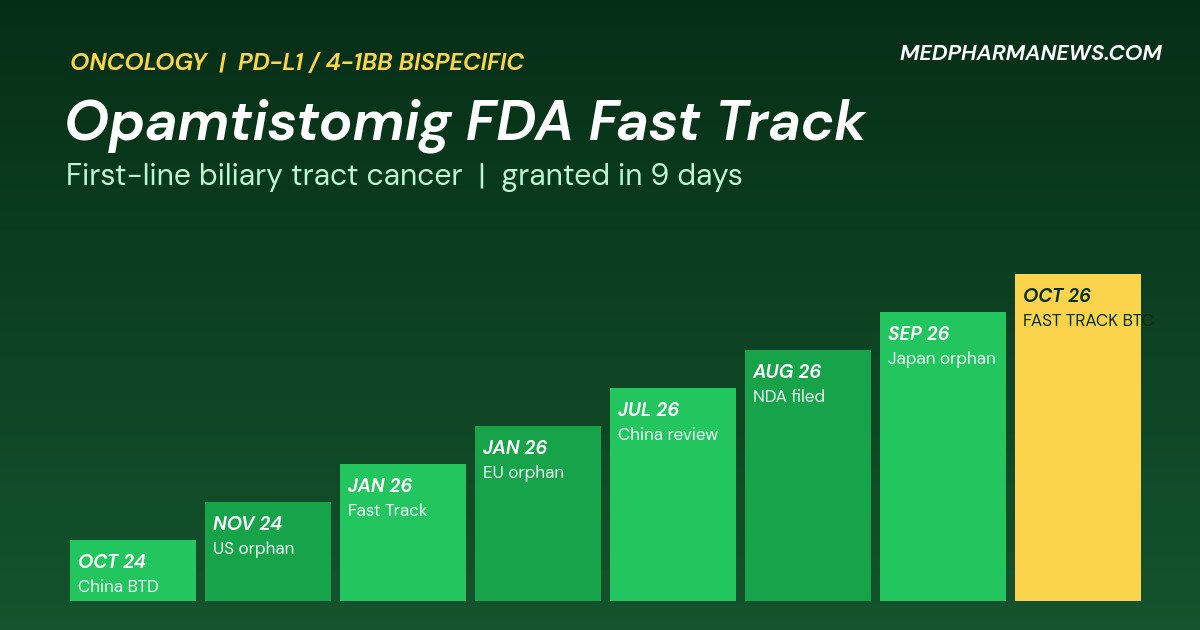
Opamtistomig has collected a series of regulatory milestones, according to the company.
- October 2024: China Breakthrough Therapy Designation.
- November 2024: US FDA Orphan Drug Designation.
- January 2026: an earlier US FDA Fast Track designation and a European Commission Orphan Drug Designation.
- July and August 2026: priority review and then acceptance of a new drug application in China.
- September 2026: Japan orphan designation for extrapulmonary neuroendocrine carcinoma.
- October 2026: the new Fast Track for first-line BTC.
By our count, that is eight regulatory milestones in 24 months. The reports we reviewed do not agree on which indication the earlier January Fast Track covers, although one links it to extrapulmonary neuroendocrine carcinoma, and they do not say which indication the Chinese application covers. Those are separate diseases from BTC, so the milestones show regulatory interest in the drug, not proof in biliary tract cancer.
What the clinical data show behind the Opamtistomig FDA Fast Track
The only human data described are from a Phase I/IIa basket study that began in 2022 and enrolled 175 patients across several tumour types, including BTC, platinum-resistant ovarian cancer, late-line liver cancer after prior PD-1 therapy and late-line extrapulmonary neuroendocrine carcinoma. A report on the study mentions a “trend toward prolonged survival compared with historical data,” but no response rates, survival figures or doses were released, and the results are unpublished. Comparison with historical data is a weak form of evidence, because patients in separate studies are rarely alike.
Our assessment of the Opamtistomig FDA Fast Track
In our assessment, the news is a genuine but modest step. A nine-day turnaround and a designation in a field with little progress are positive signs of regulatory interest. At the same time, the announcement contains no efficacy numbers for BTC, and the key test, the first-line Phase II combination, has not reported. Investors and clinicians should treat the Fast Track as a route to faster talks, not as evidence of benefit. For another recent example of late-stage data being scrutinised, see our report on Alumis’s 48-week envudeucitinib data, or browse more pharmaceutical news.
What to watch after the Opamtistomig FDA Fast Track
- Efficacy and safety data from the Phase II first-line BTC study.
- The outcome of the company’s talks with the FDA on a registration plan, including any pivotal or confirmatory trial.
- Publication of the 175-patient basket study.
- Trial listings on ClinicalTrials.gov for new opamtistomig studies.
Frequently asked questions
What is the Opamtistomig FDA Fast Track designation?
It is an FDA status granted to opamtistomig for first-line advanced or metastatic biliary tract cancer, announced on 12 October 2026, intended to speed development and review.
Does the Opamtistomig FDA Fast Track mean approval?
No. Fast Track does not mean a drug is approved or proven to work. It only enables closer contact with the FDA and faster review options.
What is opamtistomig?
A PD-L1/4-1BB bispecific antibody, also called LBL-024, developed by Nanjing Leads Biolabs.
Has opamtistomig shown efficacy in biliary tract cancer?
The announcement did not give efficacy results for the first-line combination. Early basket-study data are unpublished.
How we reported this: we relied on the company’s announcement of 12 October 2026 and its earlier designation announcements, as published through its press releases. Company claims are flagged as such and have not been independently verified. Figures labelled as ours are our own calculations. Last updated: 12 October 2026. This article is news reporting and not medical or investment advice.