Stryker has taken a $400 million step toward the operating theatre’s most contested machine. The Stryker CMR Surgical investment, announced on 12 October 2026, buys the Michigan company a stake in Britain’s CMR Surgical, the exclusive right to sell the Versius robot in the United States, and the chance to purchase all of CMR later. What it does not buy is the company itself: this is an investment and sales alliance, and no acquisition has taken place.
Below, we answer the questions a hospital executive, investor or surgeon is likely to ask, and mark clearly which answers come from the companies and which are our own reading.
What exactly does the Stryker CMR Surgical investment include?
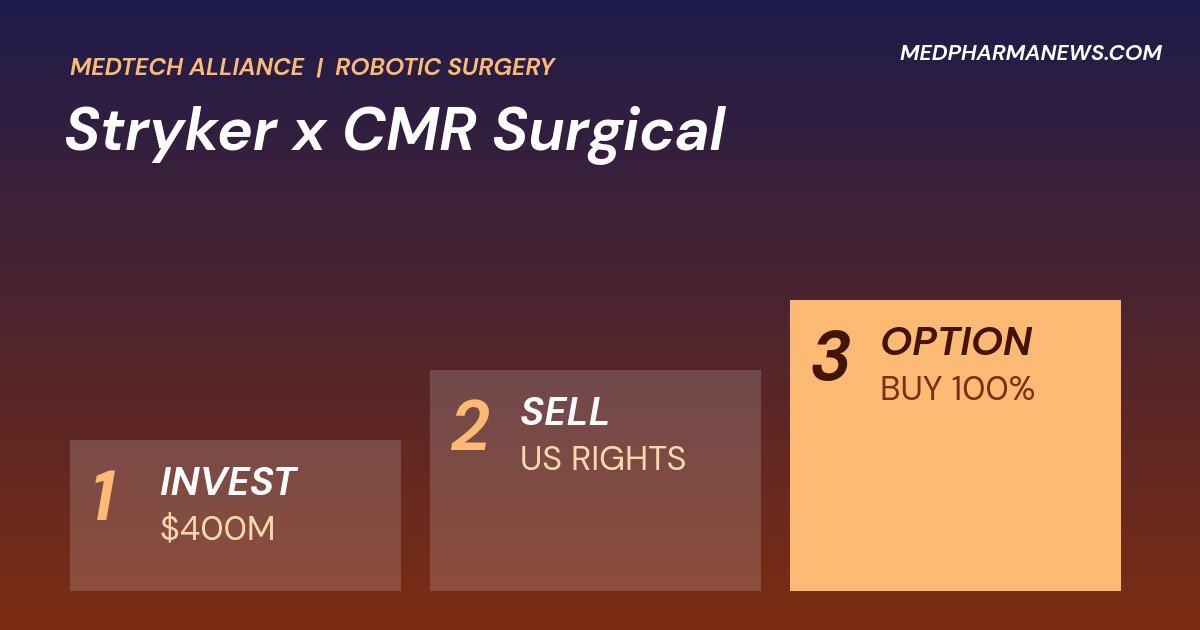
Three pieces make up the Stryker CMR Surgical investment and alliance, according to the companies’ announcement, which is also reflected on Stryker’s newsroom and CMR Surgical’s website:
- A cheque: roughly $400 million, or about £300 million, invested as preferred equity to fund product innovation and worldwide commercialisation of the Versius portfolio.
- A sales mandate: Stryker is named exclusive US sales agent under a commercial agency agreement.
- A purchase right: an exclusive option to acquire 100% of CMR’s outstanding equity in the future.
CMR keeps responsibility for development and for selling outside the United States, and Stryker executive Andy Pierce, who runs the MedSurg and Neurotechnology group, is set to join CMR’s board. Closing of the investment is subject to customary conditions, while any eventual purchase needs regulatory approvals.
Why is the Stryker CMR Surgical investment not a full acquisition?
The companies have not said, so this part is our interpretation. A staged Stryker CMR Surgical investment lowers risk. Stryker can watch how Versius performs in American hospitals, how surgeons respond and how quickly the product line develops, then decide whether to pay for the whole business. CMR, a private company founded in 2014 in Cambridge, gets capital and a large US sales channel without handing over control on day one.
There is also a practical point. Surgical robots are sold on trust, training and service, and a seller that is already in the building with endoscopes, imaging towers and implants can make that case more easily. An agency arrangement lets Stryker start selling before any ownership change is settled.
How big is the Stryker CMR Surgical investment by industry standards?
Large for an investment in a robot maker, but small next to Stryker’s overall size. News reports put Stryker’s market value at roughly $107 billion on the day of the announcement, with the shares up about 1% in morning trading. That context comes from market reporting rather than the companies, and the share move says little about the deal’s long-term value.
Crucially, we do not know what share of CMR the money buys. Neither the valuation nor the option price has been published. Without them, nobody outside the two companies can say whether $400 million is a bargain, a fair price or a premium.
What is Versius, and is it available in the US?
Versius is a modular, second-generation soft-tissue surgical robot whose separate arm carts can be fitted into existing theatres. CMR’s own boilerplate names the current product as Versius Plus. The announcement stresses established clinical experience worldwide but, notably, says nothing about US regulatory status.
Industry reporting fills in part of the picture: European approval in 2019, authorisation in several Asia-Pacific and Americas markets, and an FDA clearance for Versius Plus in December 2025 covering gallbladder removal. We have not seen the clearance document, so please check FDA’s 510(k) clearance listings for the exact indication before assuming broader use. In practice, a single clearance means Stryker’s early US pitch is likely to centre on that procedure while more indications are sought.
What does the Stryker CMR Surgical investment give Stryker strategically?
Stryker is already a major robotics seller through Mako, which dominates knee and hip replacement according to GlobalData’s 2025 figures (75.5% of US orthopaedic robotic systems). The same data put Intuitive at 80.6% of general surgery robots, a field where Stryker has been largely absent. The company calls soft-tissue robotics a high-growth adjacency to its endoscopy and visualisation business.
From our perspective, the more interesting point is account strategy. Hospital systems increasingly negotiate large multi-product contracts, and a supplier able to include a soft-tissue robot alongside orthopaedic robots and operating-room equipment has a broader conversation to offer. The same logic of scale and bundling drove another recent deal we covered, the Becton Dickinson $3 billion manufacturing investment, although that deal involved production capacity, not sales rights.
Who is affected by the Stryker CMR Surgical investment?
- Competing robot makers: Intuitive remains the market leader; Medtronic and Johnson & Johnson are also pursuing soft-tissue robotics. All face a better-funded rival to Versius in the US.
- Hospitals: more choice, but also more uncertainty about long-term ownership while the option remains open.
- Surgeons: a new platform to train on, with the usual learning curve.
- CMR staff and investors: new capital and a strategic partner, plus the possibility of a later sale.
What are the risks in the Stryker CMR Surgical investment?
The list of open questions is long. Neither company disclosed the equity share, valuation, option price or window, preferred-equity features, required approvals, closing date or installed base. Stryker also did not give any effect on financial guidance. An option can also lapse unused, so the eventual outcome may be a continuing partnership rather than a merger. Readers who follow regulated medical technology will recognise the pattern of gradual disclosure; for a parallel on regulatory consequences, see our Terumo neurovascular device coverage and our wider medical devices reporting.
What should readers watch after the Stryker CMR Surgical investment?
- Completion of the $400 million investment.
- Any filing that discloses option terms; check the SEC’s EDGAR database.
- New FDA clearances that broaden Versius Plus beyond its first indication.
- The first US hospital placements under Stryker’s sales effort.
Frequently asked questions
Has Stryker bought CMR Surgical?
No. It is investing about $400 million and holds an option to buy the remaining equity in future.
Is the Stryker CMR Surgical investment complete?
Not yet. It is subject to customary closing conditions, and no closing date was given.
What will Stryker do with Versius?
Sell it in the United States as the exclusive agent.
Where is CMR Surgical based?
Cambridge, England. The company was founded in 2014 and is privately held.
How we reported this: we relied on the companies’ joint announcement of 12 October 2026 and on public reporting on Versius clearances and market share. Interpretations are labelled as ours. Last updated: 13 October 2026. This article is news reporting and not investment or medical advice.