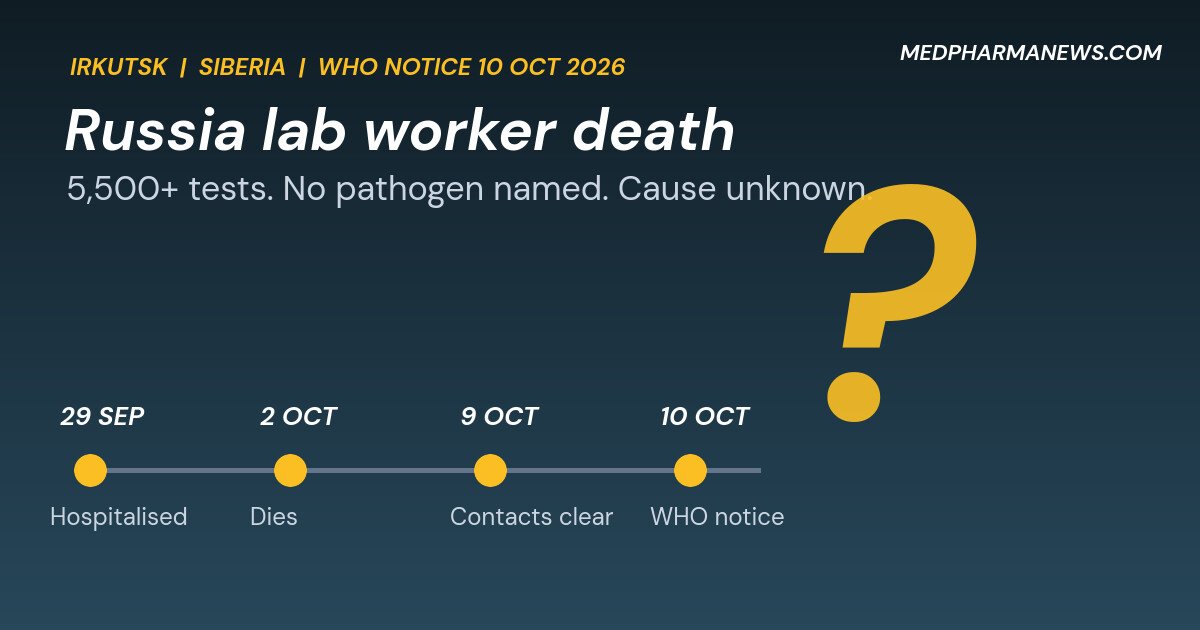
The Russia lab worker death remains unexplained more than a week after it happened. A young employee of the Irkutsk Antiplague Research Institute in Siberia, a centre that works on plague and other dangerous pathogens, was admitted to hospital with severe pneumonia on 29 September 2026 and died on 2 October. The World Health Organization (WHO) says it has seen no evidence of ongoing transmission, yet neither WHO nor Russian authorities have named what killed the patient.
That gap is why the case keeps drawing attention. This report separates what is confirmed from what is only reported, sets out where the accounts disagree, and explains what the Russia lab worker death does and does not tell us about laboratory safety. It draws on the WHO Disease Outbreak News notice of 10 October 2026 and on public statements from WHO officials.
Russia lab worker death: what is confirmed
- The patient: an employee of an institute that handles high-consequence pathogens, hospitalised on 29 September and dead on 2 October 2026.
- Plague: Russian authorities say tests were negative and that no plague case has recently been registered in Irkutsk Oblast.
- Testing: more than 5,500 laboratory tests, run by five organisations of the consumer protection agency Rospotrebnadzor, found no high-consequence or dangerous pathogen.
- Cause of death: pneumonia of undetermined cause. No agent has been named.
- Contacts: all stayed free of symptoms, and observation ended on 9 October.
- WHO position: no evidence of ongoing transmission, no travel or trade restrictions advised, and a laboratory-associated exposure that “cannot be fully excluded at this stage.”
Timeline of the Russia lab worker death
- 29 September: the patient is admitted with severe pneumonia, after first showing symptoms of an acute viral respiratory infection.
- 2 October: the patient dies. WHO learns of the death from media reports that day, when plague is said to be suspected, and Russia then confirms it through its International Health Regulations contact point.
- 7 October: a WHO official tells a briefing that the agency does not know the causative agent or how the patient was infected, and asks Russia for more information.
- 9 October: observation of contacts ends with no illness among them.
- 10 October: WHO publishes its notice, citing no evidence of ongoing transmission.
Why the Russia lab worker death is still a mystery
A negative result for plague rules plague out, but it does not say what the patient did die of. The panel covered influenza, SARS-CoV-2, other respiratory viruses and bacteria, including streptococcus, and the results were reportedly negative for high-threat pathogens. Severe pneumonia has many causes, and in some cases no agent is ever found, which may be what has happened here. We cannot tell from the information released.
The patient had not travelled outside Irkutsk Oblast in the two weeks before symptoms began and had been vaccinated against the high-threat pathogens handled at work, according to the notice. Those two facts narrow the options without settling them. If the cause was an ordinary respiratory infection in a person who fell severely ill, the case is tragic but not unusual. If it was something else, the evidence has not yet been made public.
Where the accounts disagree
Several details differ between sources, and readers should treat the less official ones with care.
- Nature of the illness: a regional governor was reported as describing a “particularly dangerous infection,” while the national health watchdog described pneumonia of unknown cause. WHO’s notice follows the second description.
- Contact infections: an early Russian statement reported two COVID-19 and two rhinovirus cases among contacts. The WHO notice lists two COVID-19, three rhinovirus and one Haemophilus infection, along with other opportunistic infections. In our reading, the later list is simply fuller, but the documents do not say so.
- A second sick employee: WHO asked about media reports of a second employee with pneumonia. Authorities told WHO that reports of a second case, and of several quarantined facilities, were inaccurate and that only the treating hospital was quarantined.
- Patient details: WHO gives no age or sex. Media reports have described a woman of 28, which we have not been able to confirm from an official source, so we do not repeat further personal details.
Could the Russia lab worker death be a laboratory infection?
Laboratory-acquired infections are a recognised risk wherever dangerous pathogens are handled, which is why institutes of this kind work under strict biosafety rules. WHO has been careful here. It says two independent investigations by Russian authorities found no biosafety or biosecurity incident, but it also says a laboratory-associated exposure cannot be fully excluded and that it cannot independently judge whether the seven-day monitoring period was long enough.
That caution is not an accusation. WHO states that its advice on laboratory safety is precautionary and does not mean a laboratory infection has been confirmed. Plague itself is caused by the bacterium Yersinia pestis, and the Centers for Disease Control and Prevention (CDC) explains that the pneumonic form, which affects the lungs, is the most serious and can spread between people through respiratory droplets, although antibiotics work if given early. The WHO plague fact sheet adds that pneumonic plague can progress very quickly, which explains the speed of the response.
What the Russia lab worker death means for laboratory safety
In our assessment, the Russia lab worker death is reassuring about spread and unsatisfying about cause. Thousands of negative tests, healthy contacts and two investigations without a finding all point away from an outbreak. What is missing is the one fact that would end the speculation: a confirmed diagnosis. Until Russian authorities share it, the case will remain a reminder that transparency matters as much as containment when a worker dies in a high-containment setting.
WHO advises continued testing of clinical samples with confirmatory testing at reference laboratories, stronger respiratory surveillance, seasonal vaccination against influenza, COVID-19 and pneumococcal disease, and strict biosafety, biosecurity and infection prevention and control in laboratories that handle hazardous agents. It also asks countries to use the notification and consultation tools of the International Health Regulations (IHR) when such events occur, and it has offered Russia support on high-threat pathogens and laboratory safety. Claims from Russian authorities in this article are as relayed by WHO and have not been independently verified by us.
For other global health coverage, see our report on Egypt being certified malaria-free after a 100-year effort, or browse more industry insights.
What to watch after the Russia lab worker death
- Whether Russian authorities publish a confirmed cause of death.
- Any update to the WHO notice on laboratory exposure.
- Any new cases among laboratory staff or in the region.
- Changes to biosafety guidance at the institute after the review.
Frequently asked questions
What caused the Russia lab worker death?
Not known. Authorities classify it as pneumonia of undetermined cause, and tests for plague and other high-threat pathogens were negative.
Was the Russia lab worker death caused by plague?
Russian authorities say it was not, and no plague case has been registered recently in the region. WHO has relayed that position without independently confirming the cause.
Is there a public risk from the Russia lab worker death?
WHO reports no evidence of ongoing transmission and advises no travel or trade restrictions.
Was the Russia lab worker death a laboratory leak?
Two investigations found no biosafety incident, but WHO says a laboratory-associated exposure cannot be fully excluded yet.
How many tests followed the Russia lab worker death?
More than 5,500 laboratory tests were reported, plus daily tests of contacts for seven days.
How we reported this: we based this article on the WHO Disease Outbreak News notice of 10 October 2026 and on public statements by WHO officials. Claims from Russian authorities are as relayed by WHO and are not independently verified. Last updated: 12 October 2026. This article is news reporting and not medical advice.