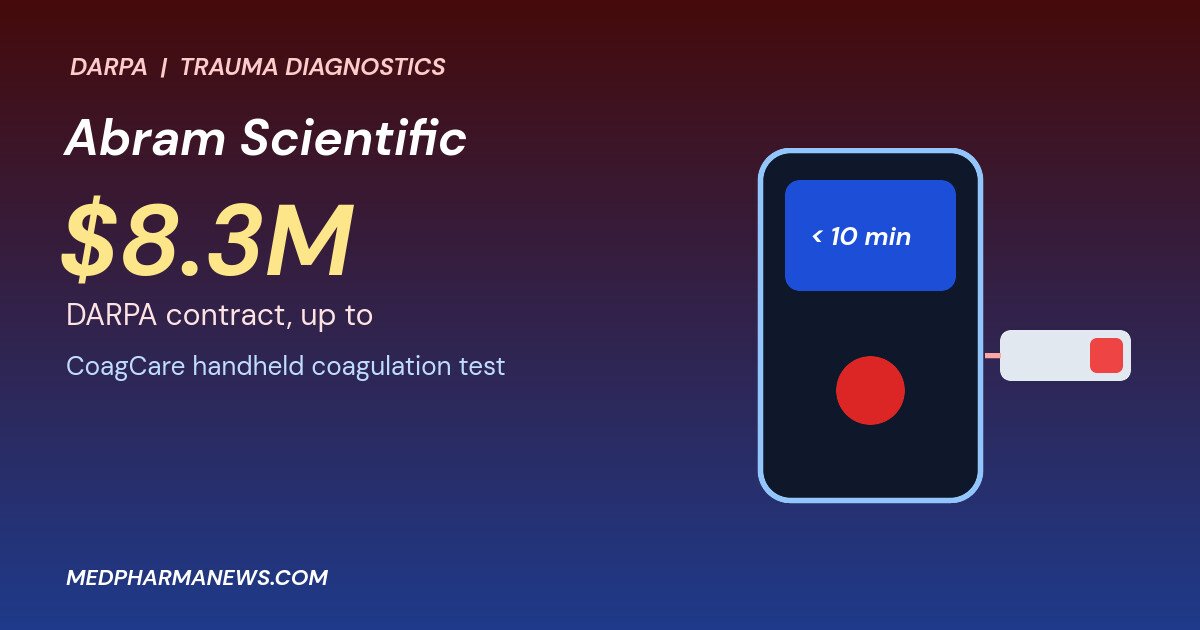
The Abram Scientific DARPA contract puts defence money behind a handheld blood-clotting test meant for ambulances, helicopters and other places where a laboratory is hours away. Abram Scientific, a medical device company in Menlo Park, California, announced on 13 October 2026 that it has been awarded up to 8.3 million dollars by the US Defense Advanced Research Projects Agency (DARPA) to advance CoagCare, a portable coagulation diagnostic aimed at trauma care.
The headline number deserves care. The award is “up to” 8.3 million dollars, the company has not said how much is guaranteed, and CoagCare is not yet cleared by the US Food and Drug Administration (FDA). The performance claims are the company’s own. Here is what is known, what is not and why a fast clotting test matters.
Key takeaways
- DARPA awarded Abram Scientific up to 8.3 million dollars under its RAPIID programme; the split between base funding and options was not disclosed.
- CoagCare is a handheld meter with a single-use test card that the company says assesses clotting from a single drop of blood in under 10 minutes.
- The device is not FDA-cleared; the company plans a 510(k) submission for civilian use.
- The speed and comparison claims are the company’s and have not been independently verified in the announcement.
What the Abram Scientific DARPA contract covers
The money comes from DARPA’s Resuscitation and Prevention of Ischemia-Induced Dysfunction (RAPIID) programme. DARPA’s program page says RAPIID seeks a shelf-stable blood analogue system that can be manufactured at scale, with rapid point-of-care diagnostics among its planned deliverables, over three years. It builds on an earlier DARPA effort showing that synthetic blood components can perform resuscitative functions.
Abram says the award will fund three things: manufacturing capability for the CoagCare meter and its disposable test card; a military-focused system design for use close to the front line; and work to optimise CoagCare so it can guide the use of the programme’s blood analogue components. Military and civilian versions are to use the same test card. The announcement gives no phases, timeline or milestone payments.
This is not the company’s first DARPA money. It received a 2 million dollar DARPA contract in October 2025 to miniaturise CoagCare. In February 2026 it closed a Series A led by Octapharma AG; the company’s headline put it at 11.75 million dollars, though another report gave 10.75 million, so we do not rely on a single figure.
How CoagCare is meant to work
According to the company, CoagCare uses proprietary technology to measure the viscoelastic properties and density of whole blood, and characterises clotting from formation through breakdown in under 10 minutes. It contrasts that with thromboelastography (TEG) and rotational thromboelastometry (ROTEM), which it says can take 30 to 60 minutes. The 10-minute figure rests on a 2024 conference abstract cited by the company, not on a full peer-reviewed validation we could review.
Viscoelastic tests show how quickly a clot forms, how firm it becomes and how fast it dissolves, which helps clinicians decide which blood products a bleeding patient needs. Abram says its design goals include use in ambulances, helicopters and austere settings. Those are intended uses, not demonstrated results.
Why the Abram Scientific DARPA contract targets rapid trauma testing
Severe bleeding is a leading cause of preventable death after injury, and an NCBI Bookshelf evidence review on NCBI Bookshelf estimates that clotting abnormalities affect roughly a quarter to a third of trauma patients arriving at emergency departments. Viscoelastic tests give a broad picture of clot formation and may help target transfusion instead of giving blood products without guidance.
The same review is a reminder to stay measured. It reflects older literature and rated the clinical evidence as low quality, found that benefit for guiding transfusion in trauma was unclear and noted that no randomised trials had compared viscoelastic-guided care with standard care. A faster device does not by itself settle that question.
Regulatory status after the Abram Scientific DARPA contract
The announcement says CoagCare is not FDA-cleared. The company intends to seek clearance through the 510(k) pathway for civilian transfusion management during trauma and surgery, using part of its Series A funding. A 510(k) shows that a device is substantially equivalent to an existing one; it is not an approval and does not guarantee clearance. No filing date has been given. For another device regulatory story, see our report on the FDA early alert on Philips Lumify ultrasound.
Our assessment of the Abram Scientific DARPA contract
In our assessment, the Abram Scientific DARPA contract is meaningful validation of the idea that fast clotting data belong close to the patient, and DARPA’s interest in pairing diagnostics with synthetic blood is a notable signal. But it funds development, not proof. Clinicians will want head-to-head accuracy data against TEG and ROTEM, results from real trauma patients and evidence that decisions guided by the device improve outcomes. Until then, CoagCare is a promising prototype-to-product story, not a proven tool. For wider context on miniaturised testing, see our overview of the lab-on-chip market, or browse more in our medical devices section.
Risks and caveats of the Abram Scientific DARPA contract
- The contract value is a ceiling, not a guaranteed payment.
- Speed and comparison claims are the company’s own.
- No FDA clearance, filing date or clinical accuracy data were reported.
- Military and civilian versions are still in development.
What to watch after the Abram Scientific DARPA contract
- Publication of accuracy data against TEG and ROTEM.
- An FDA 510(k) submission and its timing.
- DARPA programme milestones for the blood analogue system.
- Field testing in ambulances or helicopters.
Frequently asked questions about the Abram Scientific DARPA contract
How much is the Abram Scientific DARPA contract worth?
Up to 8.3 million dollars. The announcement does not say how much is guaranteed.
What is CoagCare?
A handheld point-of-care system with a meter and single-use test card that the company says assesses blood clotting from a drop of blood in under 10 minutes.
Is CoagCare FDA-cleared?
No. The company plans to seek 510(k) clearance for civilian use.
What is RAPIID?
A DARPA programme developing shelf-stable blood analogue components, with rapid point-of-care diagnostics among its deliverables.
Is the 10-minute claim proven?
It is a company claim based on a 2024 abstract; the announcement offers no independent validation.
How we reported this: we relied on Abram Scientific’s 13 October 2026 announcement, DARPA’s programme page and an NCBI evidence review. Company claims are labelled as such. Last updated: 14 October 2026. This article is news reporting and not medical advice.