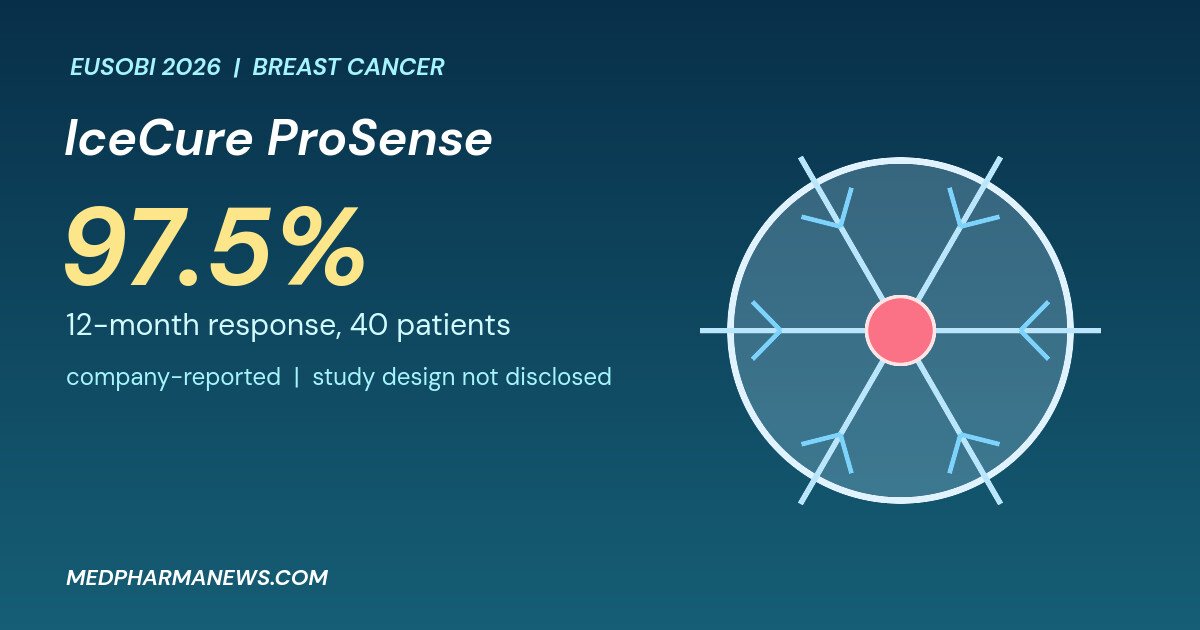
The IceCure ProSense breast cancer cryoablation system is back in the spotlight after the company reported 12-month response rates of 97.5 percent and 91.7 percent in two patient groups. In a release dated 13 October 2026, IceCure Medical reported the figures while covering the European Society of Breast Imaging’s annual meeting, EUSOBI 2026, held in Maastricht, the Netherlands, from 1 to 3 October. The company called the results encouraging.
The numbers are small, company-reported and thinly described. The release does not name the study, say how “response” was defined or report safety results, so they are best read as an early signal and not as proof that freezing a breast tumour is as effective as surgery.
Key takeaways
- IceCure reports a 97.5 percent objective response rate at 12 months in 40 patients treated with cryoablation plus endocrine therapy.
- It reports 91.7 percent in 24 patients treated with cryoablation alone.
- The release does not give the study design, patient characteristics, response definition or safety data.
- In the United States, ProSense is authorised for a narrow group: low-risk breast cancer, tumours of 1.5 cm or smaller, patients aged 70 or older, alongside endocrine therapy.
What the IceCure ProSense breast cancer cryoablation results show
Cryoablation destroys tumour tissue by freezing it. IceCure’s systems use liquid nitrogen and are presented as a minimally invasive alternative to surgical removal. The 12-month data cover two groups: 40 patients who received cryoablation plus endocrine (hormone) therapy and 24 who received cryoablation alone. By our own arithmetic, the percentages correspond to 39 of 40 and 22 of 24 patients.
The release uses the term objective response rate but does not define it. In oncology, that usually refers to a measured shrinkage or disappearance of a lesion on imaging. It is not the same as long-term local control, freedom from recurrence or survival. The release also does not say whether the data are prospective or retrospective, which centres contributed or whether the two groups were comparable.
The 5.8-point gap between the groups should not be read as evidence that adding hormone therapy works better. With groups this small, different sizes and no statistical comparison, the difference could easily reflect who was treated.
What else was presented around EUSOBI 2026
The release lists several activities: a talk by Dr Lucia Grana-Lopez on image-guided therapy, a poster by Dr Francesca Pugliese on local tumour control in elderly patients ineligible for surgery that compares cryoablation alone with cryoablation plus hormonal therapy, a poster from Romania on single-centre one-year efficacy and safety, and two workshops of nearly 70 attendees each. Results from these items are not summarised in the release, and it does not say which of them produced the 12-month figures. We therefore do not attribute the numbers to any specific presentation.
Regulatory status of IceCure ProSense breast cancer cryoablation
The company describes ProSense as the first and only device cleared by the FDA for local treatment of breast cancer in this setting. FDA records show something slightly different in kind: ProSense was reviewed through the De Novo pathway, which classifies new low-to-moderate risk devices, not the 510(k) route. The FDA letter dated 20 March 2026 corrects an earlier classification order dated 3 October 2025 and sets out the authorised use in the FDA De Novo database entry.
- Patients aged 70 or older with biologically low-risk tumours of 1.5 cm or smaller.
- Treatment alongside adjuvant endocrine therapy, including for patients not suited to surgery.
- Tumour criteria include unifocal, hormone-receptor positive, HER2-negative invasive ductal cancer with node-negative status and low proliferation or low-risk genomic results.
FDA also set conditions. The special controls call for postmarket surveillance, including a study of about 400 patients at 30 sites, and a performance standard tied to five-year local recurrence or another justified endpoint. In other words, longer-term evidence is still being built. The release does not say whether the 12-month cohorts match this narrow US indication, and the company says the device is marketed in Europe and Asia for its cleared or approved indications without naming them.
Our assessment of the IceCure ProSense breast cancer cryoablation data
In our assessment, the IceCure ProSense breast cancer cryoablation news is encouraging in tone but light on evidence. High short-term response rates are what one would hope to see, yet the key questions for freezing treatment are whether tumours stay controlled over years, how often residual disease is found on follow-up and what the complications are. None of that is in the release. Cryoablation is an option for older, low-risk patients, often alongside hormone therapy, and any decision belongs with the treating team. For wider coverage of cancer-ablation technology, see our market report on ablation technologies and our report on the CrossFAST 6F FDA clearance, or browse our medical devices section.
Risks and caveats of the IceCure ProSense breast cancer cryoablation data
- The figures come from a company release, not a peer-reviewed paper.
- Study design, definitions and safety results were not disclosed.
- Samples are small and the groups are not directly comparable.
- Short-term response does not show long-term cancer control.
What to watch after the IceCure ProSense breast cancer cryoablation results
- Publication of the 12-month data with methods and safety.
- Longer follow-up on recurrence.
- Progress of the FDA-required postmarket study.
- Any new regulatory decisions outside the United States.
Frequently asked questions about IceCure ProSense breast cancer cryoablation
What did IceCure report at EUSOBI 2026?
A 97.5 percent objective response rate in 40 patients at 12 months with cryoablation plus endocrine therapy, and 91.7 percent in 24 patients with cryoablation alone.
Is IceCure ProSense breast cancer cryoablation a replacement for breast cancer surgery?
Not on this evidence. In the United States, ProSense is authorised for a narrow group of older patients with low-risk tumours, alongside endocrine therapy.
Were safety results reported for IceCure ProSense breast cancer cryoablation?
No safety data for the 12-month cohorts appear in the release.
Who can currently receive ProSense in the US?
Patients aged 70 or older with biologically low-risk tumours of 1.5 cm or smaller, treated with adjuvant endocrine therapy, per FDA records.
How we reported this: we relied on IceCure Medical’s 13 October 2026 release, FDA’s published De Novo letter and database entry, and the EUSOBI event page. The clinical figures are company statements. Last updated: 14 October 2026. This article is news reporting and not medical advice.