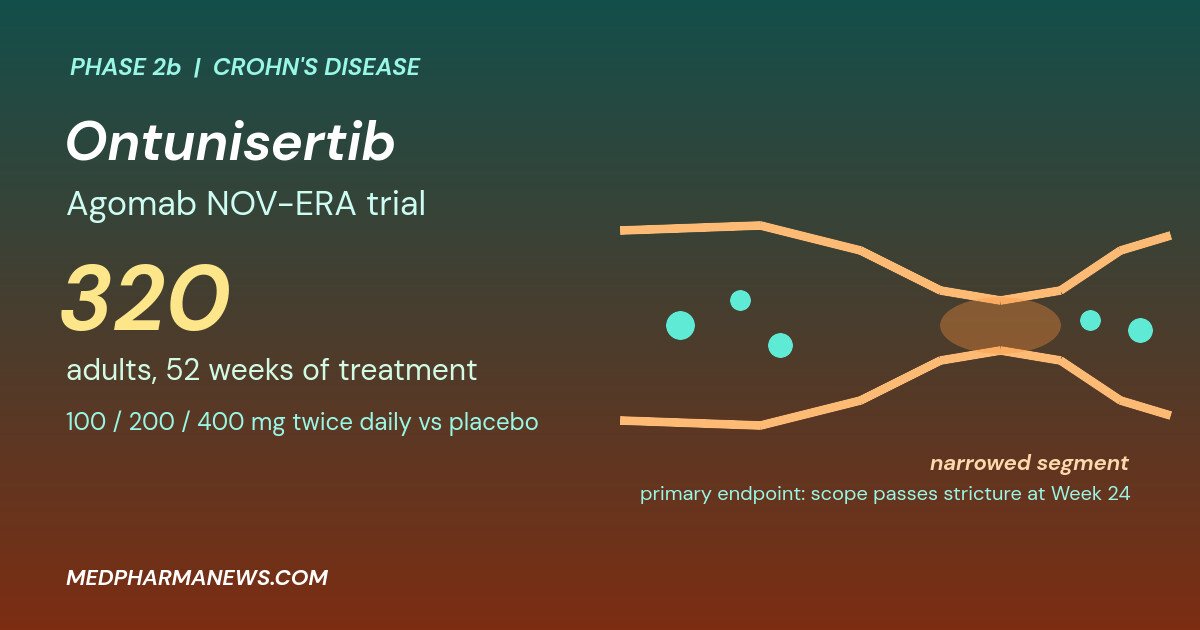
The ontunisertib Crohn’s disease Phase 2b trial is now under way. On 13 October 2026, Agomab Therapeutics said the first patient has been dosed in NOV-ERA, a global randomised, placebo-controlled study of ontunisertib (AGMB-129), an oral experimental drug for fibrostenosing Crohn’s disease, in which scarring narrows part of the intestine. The trial plans to enrol about 320 adults.
The drug is investigational and not approved anywhere. No efficacy data exist for the question this trial is built to answer, which is whether ontunisertib can open narrowed bowel segments. Here is the design, what earlier studies showed and where the evidence is thin.
Key takeaways
- Agomab dosed the first patient in NOV-ERA on or before 13 October 2026; the site, country and dosing date were not named.
- Up to about 320 adults with symptomatic fibrostenosing Crohn’s disease will receive ontunisertib 100, 200 or 400 mg twice daily, or placebo, for 52 weeks.
- The primary endpoint is endoscopic passability of the narrowed ileal segment at Week 24.
- Earlier Phase 2a work focused on safety; efficacy on passability has not been tested.
- Ontunisertib has US FDA Fast Track Designation.
How the ontunisertib Crohn’s disease Phase 2b trial is designed
According to the company’s design of the study, NOV-ERA is a randomised, double-blind, placebo-controlled, dose-ranging, multicentre trial in adults with symptomatic fibrostenosing Crohn’s disease. Eligible patients need at least one new or surgically related (anastomotic) stricture in the ileum, the last part of the small intestine, that an endoscope cannot pass, confirmed by central reading.
- Arms: ontunisertib 400 mg, 200 mg or 100 mg twice daily, or matching placebo, randomised 1:1:1:1. If enrolment reaches 320, that is 80 per arm, by our arithmetic.
- Duration: a 6-week screening period, 52 weeks of treatment and 2 weeks of follow-up, or about 60 weeks per participant by our count.
- Primary endpoint: the share of patients whose index ileal stricture becomes endoscopically passable at Week 24.
- Key secondary endpoints: passability at Week 52, MRI-based changes in the stricture, changes in the endoscopic score, endoscopic response and remission, patient-reported stricture symptoms and time to a stricture-related event such as surgery or balloon dilation.
The company says it has aligned with the FDA on key design elements, including the passability endpoint, and that the endpoints are intended to inform choices for later registration studies. The first-dosing announcement did not name sites or countries, and gave no date for results.
What ontunisertib is meant to do in the Crohn’s disease Phase 2b trial
Ontunisertib is an oral small molecule that blocks ALK5, a receptor for TGF-beta, a signal that drives tissue scarring. Agomab describes the drug as restricted to the gut: rapid metabolism in the liver is said to keep blood levels low, which the company believes may give a better safety profile than similar drugs that reach the whole body. That is a design claim, not a proven result.
The company says about 46 percent of people with Crohn’s disease have fibrostenosing disease, and that no approved medicine specifically targets the fibrotic part. Both are company statements. The US National Institute of Diabetes and Digestive and Kidney Diseases describes Crohn’s disease as a chronic immune-driven inflammation of the digestive tract, and its NIDDK treatment guidance says medicines do not cure it and that 30 to 55 percent of people need surgery within 10 years of diagnosis.
What earlier studies showed before the ontunisertib Crohn’s disease Phase 2b trial
The Phase 2a STENOVA study first randomised 103 participants for 12 weeks to ontunisertib or placebo on top of standard care, with safety and tolerability as the primary endpoint. In the open-label extension results on 1 October 2026, the company reported that 49 patients entered a 48-week open-label extension at 200 mg twice daily and 37 completed it, for up to 60 weeks of exposure.
The company reported five serious adverse events in four patients, all judged unrelated or unlikely to be related to treatment, and low blood levels of the drug. It reported one stricture-related event, a balloon dilation, and no surgeries. It said imaging suggested stabilisation of strictures and that 97 percent of evaluable patients were in clinical remission by a standard activity index at Week 48. Endoscopy was optional and the company called those data too limited to interpret.
These results come with obvious limits. The extension was open-label, had no placebo group and included a self-selected group of patients who completed the first part. The company itself cautions against comparing event rates with other studies. For these reasons the data justify the Phase 2b but do not show that ontunisertib works.
Our assessment of the ontunisertib Crohn’s disease Phase 2b trial
In our assessment, the ontunisertib Crohn’s disease Phase 2b trial matters because it tests a hard endpoint, whether a stricture can be passed by a scope, in a disease where treatments largely target inflammation and where narrowing often ends in surgery. Success would be notable. The risks are familiar: a placebo response in endoscopic measures, a mismatch between scope findings and symptoms, and safety questions at the 400 mg dose, which was not part of the Phase 2a design.
For another Crohn’s disease development story, see our report on FDA backing for a proposed stem cell trial in treatment-resistant Crohn’s disease. For another fibrosis programme, see Oorja Bio’s ORJ-001 pulmonary fibrosis trial. More news is in our pharmaceuticals section, and Agomab’s investor site carries company updates.
Risks and caveats of the ontunisertib Crohn’s disease Phase 2b trial
- The drug is investigational; efficacy and safety have not been established.
- The Phase 2a data were mainly safety data and an uncontrolled extension.
- Sites, countries, enrolment pace and result dates were not disclosed.
- Safety claims about gut-restricted action are design intentions.
What to watch after the ontunisertib Crohn’s disease Phase 2b trial begins
- Enrolment updates and the list of trial sites.
- Presentation of full STENOVA extension data.
- Any safety review at the higher 400 mg dose.
- Timing of Week 24 data.
Frequently asked questions about the ontunisertib Crohn’s disease Phase 2b trial
What is the NOV-ERA ontunisertib Crohn’s disease Phase 2b trial?
A global Phase 2b trial testing ontunisertib in about 320 adults with symptomatic fibrostenosing Crohn’s disease.
What is fibrostenosing Crohn’s disease?
A form of Crohn’s disease in which scarring narrows part of the intestine, which can cause blockage and may lead to surgery.
What is ontunisertib?
An experimental oral drug, also called AGMB-129, designed to block a scarring signal in the gut. It has FDA Fast Track Designation but is not approved.
When will ontunisertib Crohn’s disease Phase 2b trial results be available?
The company has not given a date.
How we reported this: we relied on Agomab Therapeutics’ 13 October 2026 announcement, its earlier company releases and US government health information. These are company statements and the drug is unproven. Last updated: 14 October 2026. This article is news reporting and not medical advice.