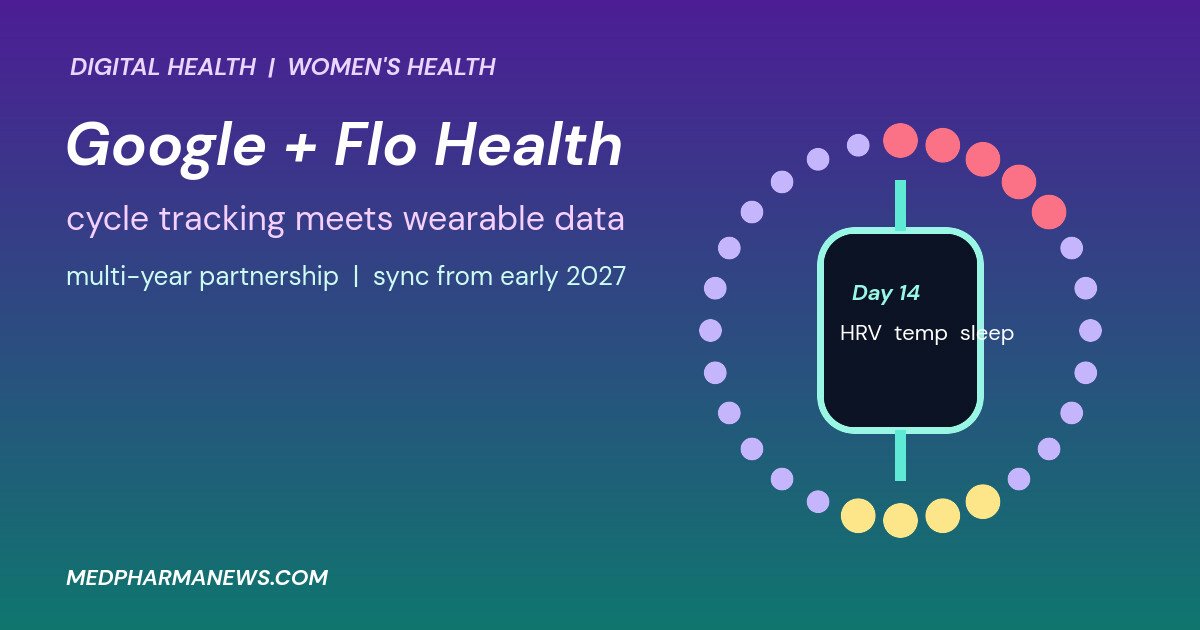
The Google Flo Health partnership links two things that have mostly lived apart: a menstrual cycle tracker with more than 80 million monthly users and the sleep, heart-rate and temperature readings from Google’s wearables. In a multi-year deal announced on 12 October 2026, Google Health and Flo Health said they will let users connect cycle data with wearable metrics, build cycle-aware coaching and run joint research. Flo also said Google made a strategic investment in the company, with no amount given.
Most of what was announced is a plan. The first data syncing is due in early 2027, and the companies gave no names, prices or dates for new devices. The features are described as general wellness tools, not medical ones, and Flo’s privacy history makes the data-handling promises worth reading closely.
Key takeaways
- Google Health and Flo Health announced a multi-year strategic partnership on 12 October 2026.
- Users will be able to sync Flo with the Google Health app from early 2027, combining cycle data with sleep stages, resting heart rate, heart rate variability and skin temperature.
- Flo says Google Health made a strategic investment; the amount was not disclosed.
- Cycle-aware coaching requires a Google Health Premium subscription, sold separately.
- Google describes the features as wellness estimates that should not be used for contraception, conception or other medical purposes.
What the Google Flo Health partnership includes
Google’s announcement, written by Dr Nichole Young-Lin, a clinician lead for women’s health at Google Health, sets out four parts.
- Consent-based syncing: from early 2027, the Flo app can be linked with Google Health. Cycle data can sit alongside resting heart rate, heart rate variability, skin temperature and sleep stages, and Google Health data can also flow to Flo.
- Coaching: Flo data will feed Google Health Coach, which ties cycle, sleep and recovery together. It requires Google Health Premium.
- Research: joint work on under-studied topics that may include perimenopause, polycystic ovary syndrome (the Google post uses the name polyendocrine metabolic ovarian syndrome), pregnancy and postpartum recovery.
- New products: women-focused devices that pair Flo’s insights and algorithms with Google’s wearable hardware and sensors. No specifics were given.
Google lists cycle logging, period predictions and cycle-phase views in the Google Health app, and says the Fitbit Edge will show predictions and phases on the wrist. It names Fitbit Air and Pixel Watch 5 as devices that capture continuous biometric data. It does not say which devices will support every feature, and regional availability is not stated.
Why the Google Flo Health partnership matters for wearable women’s health
Cycle length and symptoms are only part of the picture. Wearables record signals such as skin temperature and heart-rate variability that change across the menstrual cycle, so combining them could give apps richer context. That is the logic behind the Google Flo Health partnership, and it fits a broader move by consumer technology companies toward women’s health. For market context, see our overview of the femtech market and the wearable health sensors market.
There is a limit to what it can promise. Estimates drawn from wearable sensors are not diagnoses. Spotting a pattern linked with a condition does not mean a person has it, and the usefulness of the AI coaching will depend on data quality and on whether independent studies test it. We found no announced clinical validation programme.
The investment and what was not disclosed
Flo said in a statement, as quoted in trade reports, that Google Health made a strategic investment in the company alongside the partnership. Google’s own blog post does not mention it, and neither company disclosed the amount, the stake or Flo’s valuation. We therefore treat the investment as Flo’s statement rather than a verified deal term. At the time we checked, Flo’s press centre had not yet listed an announcement.
Rishi Chandra, general manager of Google Health, said Google is making a significant investment in its commitment to women’s health. Dmitry Gurski, Flo’s co-founder and chief executive, said women have waited too long for technology that understands their bodies as well as it understands their steps. Both are company statements.
Privacy: the part to read closely
Google says the integration is built on a strict, transparent opt-in model. Data moves between apps only with explicit permission, granted separately for each data type and purpose, and users can withdraw it at any time. Flo data shared with Google Health will not be used for advertising or sold, and will not be made available to other apps or developers through Google’s health platforms.
Those are strong commitments, and they are company promises. Flo is also a company with a past on this subject: in 2021 the US Federal Trade Commission order in 2021 finalised a settlement in which the agency said Flo had shared sensitive health data with Facebook, Google and others despite telling users it would not. That history does not mean the new arrangement is unsafe, but it is a reason for users to check permission screens carefully and for regulators to watch how the commitments work in practice.
Our assessment of the Google Flo Health partnership
In our assessment, the Google Flo Health partnership is more important as a data and distribution deal than as a clinical advance. Google gets cycle data and a large audience; Flo gets deeper wearable signals and a platform. The test will be execution: whether syncing works smoothly, whether the coaching is useful enough to justify a subscription, and whether the privacy wall holds. Anyone relying on a cycle app for contraception or conception should keep in mind Google’s own statement that these estimates are not for that purpose. For another example of consumer technology moving into health, see our report on Healthleap’s $38 million raise for hospital AI, or browse our healthcare IT coverage.
Risks and caveats of the Google Flo Health partnership
- Most features are future plans, with syncing due in early 2027.
- The investment amount and terms are undisclosed.
- Coaching needs a paid Premium subscription, and device support is not fully specified.
- Wellness estimates are not medical advice or diagnoses.
- Privacy protections are company commitments that outsiders cannot yet test.
What to watch after the Google Flo Health partnership
- The early 2027 launch of syncing and the devices that support it.
- Details of any independent validation of the AI coaching.
- Disclosure of the investment terms.
- Announcements of joint research topics and study designs.
Frequently asked questions about the Google Flo Health partnership
What is the Google Flo Health partnership?
A multi-year strategic partnership, announced on 12 October 2026, to connect Flo’s cycle tracking with Google Health and Google’s wearables, build coaching, run research and develop new products.
When will Flo sync with Google Health?
Google says syncing begins in early 2027.
Did Google invest in Flo?
Flo says Google Health made a strategic investment. The amount has not been disclosed, and Google’s blog post does not mention it.
Is my data used for advertising?
Google says Flo data shared with Google Health will not be used for advertising or sold, and will not be made available to other apps or developers through its health platforms.
Can the features be used for contraception?
No. Google says the women’s health feature uses estimates and is a general wellness feature, not for contraception, conception or other medical purposes.
How we reported this: we relied on Google Health’s 12 October 2026 announcement, the FTC’s published order and reports quoting Flo’s statement. Company claims are labelled as such. Last updated: 14 October 2026. This article is news reporting and not medical or privacy advice.