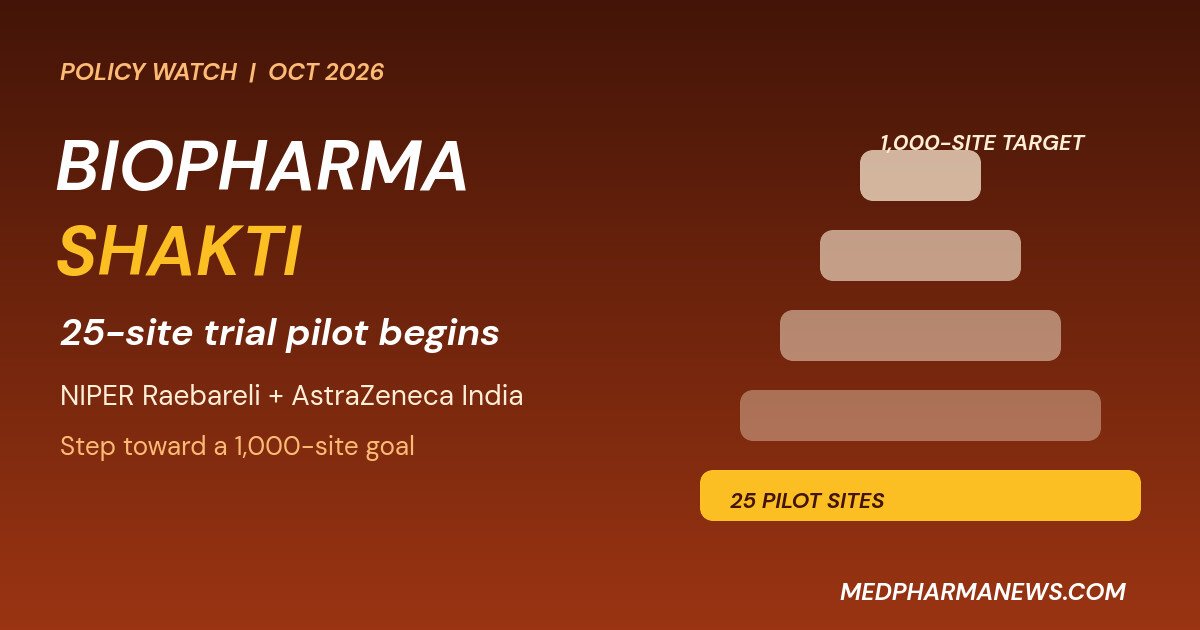
The first concrete test of Biopharma SHAKTI on clinical trials may be a 25-site pilot. According to a Press Information Bureau release dated 14 October 2026, NIPER Raebareli and AstraZeneca India signed a memorandum of understanding in New Delhi to strengthen clinical research capability in 25 emerging geographies beyond the major metropolitan areas. The release describes Biopharma SHAKTI as the government’s flagship initiative to build a stronger biopharma ecosystem, with a target of 1,000 clinical trial sites, and says the partnership advances those objectives.
This report reads the announcement as policy: what the pilot is meant to prove, how large it is against the national target, and what the industry will want to see next.
Biopharma SHAKTI: key takeaways
- The pilot adopts 25 trial sites in emerging geographies, assesses them, trains staff and strengthens ethics, safety and feasibility processes.
- NIPER Raebareli will host a Centre of Excellence for training and certification in clinical research.
- Biopharma SHAKTI includes a target of 1,000 clinical trial sites. Our calculation: 25 sites is 2.5% of that.
- The release gives no duration, funding, enrolment targets or site names.
What the Biopharma SHAKTI pilot is meant to prove
The release says the model is designed to be scalable and that, after a proof-of-concept phase, it may expand to more geographies and therapeutic areas beyond oncology. A proof of concept typically tests whether an approach works at small scale before it is repeated. Here, the open question is whether a structured programme of assessment, mentoring and training can turn ordinary hospitals into sites that pass regulatory inspection.
The release does not say how success will be measured. Plausible indicators would be the number of sites that reach inspection readiness, the number of trials they go on to host and the quality of the data they produce, but these are our suggestions, not announced metrics.
The phrase beyond oncology suggests that cancer research is the starting focus, although the release does not say so outright. Cancer trials are often complex, with strict requirements for testing, imaging and safety monitoring, so they are a demanding first proving ground. If sites can meet that standard, expanding to other conditions could be easier. That is our reading, and the partners have not confirmed it.
Who does what in the Biopharma SHAKTI pilot
- Department of Pharmaceuticals: provides direction and endorsement, aligning the work with national clinical research priorities. Secretary Manoj Joshi witnessed the signing.
- NIPER Raebareli: hosts the Centre of Excellence. Director Dr. Shubhini Saraf said it would provide a dedicated platform for structured training and certification.
- AstraZeneca India: contributes clinical development expertise, designs and delivers the programme, engages Indian and global faculty, and supports sites. Praveen Rao Akkinepally, country president and managing director, said clinical research is central to bringing innovative medicines to patients.
Why the industry cares about Biopharma SHAKTI
Sponsors choose trial locations on practical grounds: patient availability, trained staff, speed of ethics approval and the likelihood of passing audits. Sites in emerging geographies can offer access to patients who are rarely recruited, but only if the other conditions are met. A government-backed programme that raises readiness at many sites could widen the pool of locations available to any sponsor, which is why the question of whether trained sites will be open to other companies matters. The release does not address it.
For India, the stated aim is to raise its share of global clinical trials. Whether the pilot moves that share depends on factors beyond training, including regulatory timelines and sponsor decisions, and the release makes no forecast.
The Biopharma SHAKTI pilot against the 1,000-site target
Scale is the obvious challenge. A pilot of 25 sites is small against a national goal of 1,000, and the release gives no date for reaching that goal. To get from one to the other, the programme would have to be repeated roughly forty times over, or other companies and institutions would have to run similar efforts in parallel. That second route is why a shared, certified training standard at a public institute could matter more than any single company’s role.
There is also a quality question. Counting sites is easy; counting sites that can actually run a modern trial is harder. A target of 1,000 sites will mean little unless each one can recruit patients, follow protocols and withstand inspection, so the published definition of a ready site will be important.
How the pilot fits the regulatory system
Trials in India run under national rules overseen by CDSCO, and studies are registered in the Clinical Trials Registry of India. Training sites does not change those rules. It prepares the people who must follow them. For an example of how a global trial is structured and reported, see our report on the ontunisertib Phase 2b trial. More coverage is in industry insights.
Risks and caveats on Biopharma SHAKTI
- An MoU records intent and not outcomes.
- No budget, timeline or site list has been published.
- The programme is company-designed and company-delivered, so its openness to other sponsors is unclear.
- Sites may be trained and still not win studies.
In our assessment, the pilot is useful mainly as a template. If NIPER Raebareli’s certification becomes a recognised standard and other companies adopt it, Biopharma SHAKTI would have a practical way toward its 1,000-site target. If each company builds its own separate programme, progress could be slower and more uneven.
What to watch next for Biopharma SHAKTI
- Naming of the 25 sites and selection criteria.
- Opening and curriculum of the Centre of Excellence.
- Additional company partners under Biopharma SHAKTI.
- Trial registrations from newly trained sites.
Frequently asked questions
What is Biopharma SHAKTI?
The government’s flagship initiative to build a stronger biopharma ecosystem, including a target of 1,000 clinical trial sites, according to the release.
What does the AstraZeneca and NIPER Raebareli pilot do?
It adopts 25 trial sites, assesses them and provides training, mentoring and process support.
Are the sites named?
No. The release says only that they are in emerging geographies beyond the major metropolitan areas.
When will results be known?
No timeline has been announced.
How we reported this: we relied on the Press Information Bureau release of 14 October 2026 and the websites of the bodies named. Figures labelled as ours are our own calculations. Last updated: 15 October 2026. This article is news reporting and not medical or investment advice.