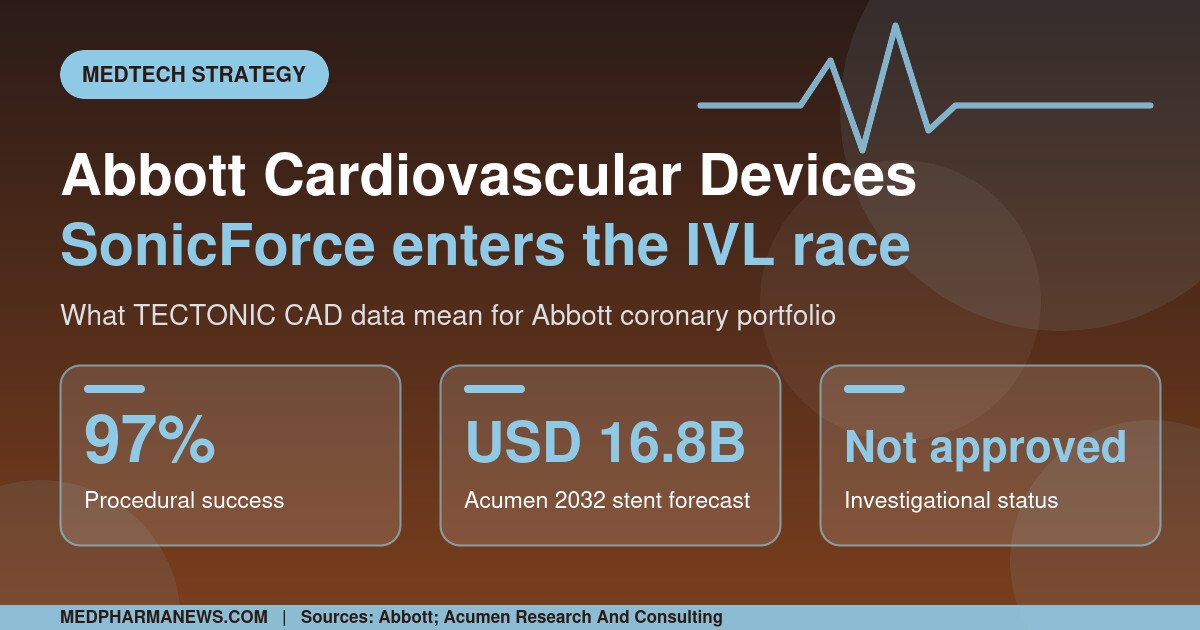
Abbott cardiovascular devices form one of the company’s major medtech franchises, and the TECTONIC CAD results put a new product in front of that business. On 1 November 2026 Abbott reported that its investigational SonicForce coronary intravascular lithotripsy (IVL) system met its 30-day primary safety and effectiveness endpoints in 335 patients, with procedural success of 97%. The system is not approved by the US FDA.
Key takeaways on Abbott cardiovascular devices and SonicForce
- TECTONIC CAD enrolled 335 patients at 40 US sites; procedural success was 97% and 30-day target lesion failure was 0.3%.
- SonicForce is investigational and limited by federal law to investigational use.
- Abbott says approval would strengthen its coronary portfolio, which spans imaging, lesion preparation and stents.
- Abbott’s Julie Tyler, senior vice president of the vascular business, said the system could strengthen its leadership in treating severely calcified coronary arteries.
- The release gives no regulatory submission date, pricing or sales forecast.
Why SonicForce matters to Abbott’s coronary portfolio
Treating a severely calcified artery is usually a multi-step job: image the vessel, prepare the lesion so the stent can expand, then place the stent. Abbott already sells imaging and stent technology in the coronary space, according to its own description. A lesion-preparation device such as IVL fills the middle step, and Abbott says it supports its integrated care offerings. Owning each stage lets a company present a single workflow to hospitals, though the announcement does not say how it would price or bundle products.
How coronary IVL works, in short
IVL uses a balloon-mounted catheter to send acoustic pressure waves into the vessel wall, fracturing calcium so a stent can expand. SonicForce delivers up to 160 pulses at two pulses per second and is designed with longer treatment lengths, more pulses and improved catheter deliverability, per Abbott. Those design points are the product claims investors and hospitals will test against competing systems.
The TECTONIC CAD numbers at a glance
| Metric | Result |
|---|---|
| Patients enrolled | 335 at 40 US sites |
| Procedural success (primary effectiveness) | 97% |
| 30-day target lesion failure (primary safety) | 0.3% |
| Residual stenosis after IVL, core lab | Below 50% in all patients assessed |
| OCT sub-study | 106 patients; calcium fractures and improved stent expansion |
Procedural success is a short-term technical measure. It does not show long-term patient outcomes, which the release does not report.
Timeline
- 1 November 2026: TECTONIC CAD 30-day data presented at TCT 2026 and published in JACC: Cardiovascular Interventions.
- Next: Abbott has not announced when it will seek regulatory approval.
Competitive and regulatory implications
Competition matters because an IVL system from another manufacturer is already in clinical use, so a new entrant must show either parity or an advantage. Abbott’s case rests on safety and effectiveness in a US pivotal-style study and on device design features such as longer treatment lengths. Whether those translate into market share depends on regulatory timing, pricing and physician preference, none of which the announcement addresses.
From a regulatory perspective, the study was run under an Investigational Device Exemption in the United States, which is the pathway typically used to generate data for an FDA submission. We do not know whether Abbott has filed or when it plans to. For the company’s wider news, see our analysis of Abbott’s planned split and visit Abbott.
What hospitals weigh when adopting a new lesion-preparation device
These are general adoption factors, not statements by Abbott or hospitals. Clinical evidence comes first: do the safety and effectiveness data match or beat what physicians already see? Workflow follows: does the catheter cross difficult lesions easily, and does it shorten or lengthen procedure time? Cost and reimbursement matter next, because a new device must fit within procedure payments. Finally, familiarity counts: interventionalists who already use an IVL system need a reason to switch or to add a second one. The announcement addresses only the first factor and, indirectly, deliverability.
Three scenarios for SonicForce
These are our own illustrations, not forecasts.
- Smooth path: longer follow-up confirms the 30-day safety signal, Abbott files, and the system is cleared in due course, allowing it to join Abbott’s coronary workflow.
- Slower path: regulators ask for additional data or longer follow-up, delaying any launch and giving the existing competitor more time.
- Differentiation path: if physicians value the longer treatment length and deliverability features, Abbott could win share even as a later entrant.
Market context: coronary stents
IVL is used alongside stenting. According to Acumen Research And Consulting, the global coronary stents market was valued at USD 7.8 billion in 2022 and is projected to reach USD 16.8 billion by 2032, a compound annual growth rate of above 8.2%. North America held 34% share in 2022, Asia-Pacific is expected to grow at about 9% and drug-eluting stents held 66% of the type segment.
Flags: the report’s own endpoints imply about 8.0% growth, the headline lacks a clear CAGR period and it contains a wording error (agent-eluting). It covers stents, not IVL, so it indicates the size of the adjacent market and not the size of the IVL opportunity.
Our analysis
In our assessment, TECTONIC CAD gives Abbott credible evidence to carry into regulatory discussions, and the low 30-day event rate removes an obvious obstacle. The strategic question is less about the data than about timing: a late entrant into a category with an established product needs a clear differentiator. We make no forecast on sales or share price, and Abbott has not provided any.
What is not disclosed
- The regulatory submission plan and timeline.
- Pricing, reimbursement or commercial launch plans.
- Whether the study had a comparison arm.
- Long-term clinical follow-up.
Risks and caveats
- SonicForce is not approved; approval is not guaranteed.
- Results are 30-day, manufacturer-reported data.
- Market figures are for stents and are third-party estimates.
- This article is not investment or medical advice.
What to watch next
- Abbott regulatory filings and any FDA decision.
- Longer follow-up from TECTONIC CAD.
- Competitor data in coronary IVL.
- Abbott’s commentary in future results calls.
General background
More coverage of device makers is in our medical devices section.
Questions readers are asking about Abbott cardiovascular devices and SonicForce
Is SonicForce approved for sale?
No, it is investigational.
How many patients were studied?
335 at 40 US sites.
Will it boost Abbott’s revenue?
Abbott has not provided any sales estimate, and approval has not been granted.
FAQ
What did Abbott say about the results?
That they are strong and that approval would strengthen its coronary portfolio.
Where were results presented?
At TCT 2026 in San Diego.
What is the main caveat?
The data are 30-day procedural results, not long-term outcomes.
How we reported this: details come from Abbott’s announcement and the associated publication; market figures are attributed to Acumen Research And Consulting. Last updated 4 November 2026. This is news reporting and not investment or medical advice.