Bag-valve-mask device safety is a procurement issue as much as a clinical one. On 3 November 2026 the FDA published an Early Alert on Compact Medical’s ButterflyBVM resuscitators, asking users to remove nine lots and apply a pre-use test to 22 more. For hospitals, ambulance services and distributors, the alert triggers inventory work and raises questions about supplier quality systems. The FDA has not assigned a recall classification.
Key takeaways on bag-valve-mask device safety and the ButterflyBVM alert
- The FDA alert concerns a possible hole in the bellows that can leak tidal volume and cause inadequate ventilation and hypoxia.
- Removal applies to lots 000109 to 000117; correction applies to lots 000081 to 000108.
- Distributors should stop distributing the removal lots; users should keep backup BVMs available.
- As of 2 November 2026 the company reported no serious injuries or deaths.
- No financial impact, unit count or distribution dates are disclosed.
What the alert means for buyers and distributors
For purchasing teams, the immediate tasks are operational. Removal lots must be located across carts, vehicles, stations and storage, labelled Do Not Use, quarantined and replaced, with backup units confirmed in place before anything is pulled. For correction lots, each unit must pass the pre-use test before every patient. Distributors have a separate duty: the FDA says they should stop distributing the removal lots.
Because manual resuscitators are cheap, widely stocked and often scattered across many sites, the main cost of an alert like this is time: finding units, checking lot numbers and training staff on the pre-use check. The FDA page does not estimate costs, and we do not either.
Timeline of the ButterflyBVM alert
- 26 September 2026: Compact Medical sends its first customer letter.
- 7 October 2026: follow-up letter.
- 3 November 2026: FDA Early Alert published, per the FDA page.
Removal versus correction: why the distinction matters commercially
A removal means the product leaves service, so replacement supply is needed. A correction keeps the product in service under an added control, so the cost is checking and, potentially, failures that must be replaced. The two lot groups therefore carry different commercial consequences for the manufacturer and its customers. The manufacturer’s own notice calls the removal an urgent medical device recall; the FDA states it has not classified the event, so we avoid describing it as a classified recall.
Three scenarios for the ButterflyBVM alert
These are our own illustrations of how the situation could develop, not predictions, and they rely only on the public FDA notice.
- Contained action: the removal lots are replaced quickly, correction-lot users adopt the pre-use test, and no further lots are added. The alert then closes out as a limited, lot-specific event.
- Scope widens: further lots or products are added after investigation, which would extend replacement work and raise customer concern about the supplier.
- Formal classification: the FDA later assigns a recall class. That would change how the event is recorded and followed, though the practical instructions to users might remain similar.
Lessons for quality systems in high-volume, low-cost devices
Alerts on simple, inexpensive devices can be harder to manage than those on capital equipment, because there are so many units in so many places. Three practical themes stand out. Traceability: can a hospital say which lots it holds and where? Incoming inspection: is there a routine functional check before a unit enters a cart or vehicle? Backup planning: is a second device always within reach? The FDA’s own instructions touch all three, which is why they are useful beyond this single product.
Market context: bag-valve-mask ventilation
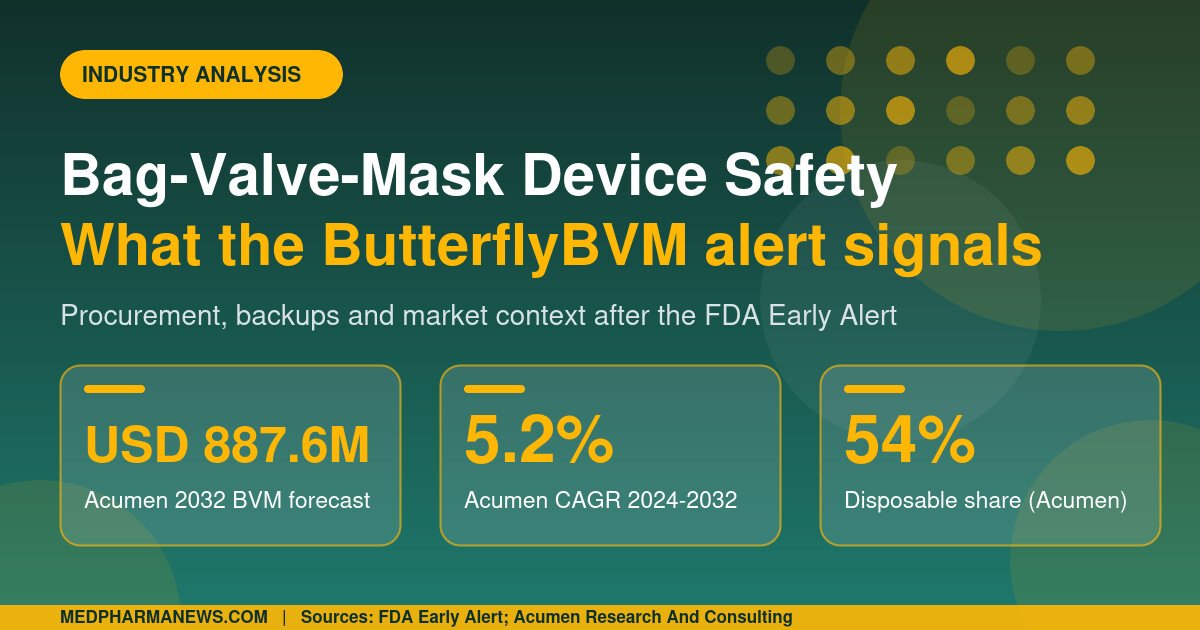
According to Acumen Research And Consulting, the global bag-valve-mask ventilation market was valued at USD 563.2 million in 2023 and is projected to reach USD 887.6 million by 2032, a compound annual growth rate of 5.2% for 2024 to 2032. North America was the largest region at about USD 214.1 million in 2023, and Asia-Pacific is expected to grow fastest at above 5.9%. Disposable BVMs held 54% share and hospitals and clinics 60% of end use.
From a business viewpoint, a small, mature category with a high share of disposable units means many buyers and frequent replenishment, so quality events can spread quickly across suppliers’ customer bases. The report page was last updated in February 2025 and has inconsistencies, including a statement about reusable textiles that conflicts with disposable leadership; the growth maths is consistent. The figures say nothing about ButterflyBVM’s own sales.
Questions buyers may want answered
The following are questions procurement and risk teams commonly ask after a device alert; they are our framing, not the FDA’s. How many affected units are in stock and on vehicles? Is a backup BVM from another lot or brand at every location? Who owns the pre-use check, and is it logged? How will the supplier replace removed lots and on what timeline? None of these answers is in the public record, so we do not speculate.
Our analysis
In our assessment, the commercial risk to Compact Medical depends on facts not yet public: how many units are affected, how quickly replacements ship and whether the FDA classifies the event. The lot-based scope suggests a contained action, but customers will judge the supplier on responsiveness. For the wider industry, the alert is a prompt to review incoming-inspection and complaint-handling practices for low-cost, high-volume devices.
What is not disclosed
- The number of units in affected lots.
- Distribution dates and customers.
- Costs of replacement or any financial impact.
- The FDA classification, if any.
Risks and caveats
- This is analysis of a regulator notice and not investment advice.
- The alert may be updated by the FDA.
- Market figures are third-party estimates for the whole category.
- Lot lists must be checked against the FDA table.
What to watch next
- Any FDA classification or update.
- Replacement-supply announcements by the manufacturer.
- Hospital and EMS procurement changes.
- Further device alerts across respiratory care.
General background
Compact Medical’s product information is on the ButterflyBVM website. For more industry coverage, see our medical devices section.
Questions readers are asking about bag-valve-mask device safety
Is the ButterflyBVM alert a recall?
The FDA published an Early Alert and has not assigned a recall class; the company calls the removal an urgent recall in its own notice.
What should distributors do?
Stop distributing the removal lots, per the FDA.
Are patients at risk?
The FDA says a hole could cause inadequate ventilation and hypoxia, but no serious injuries or deaths were reported as of 2 November 2026.
FAQ
Which lots are removed?
000109 to 000117.
Which lots are corrected?
000081 to 000108.
Where can I report a problem?
To Compact Medical and through FDA MedWatch.
How we reported this: details come from the FDA Early Alert dated 3 November 2026; market figures are attributed to Acumen Research And Consulting. Last updated 4 November 2026. This is news reporting and not investment or medical advice.