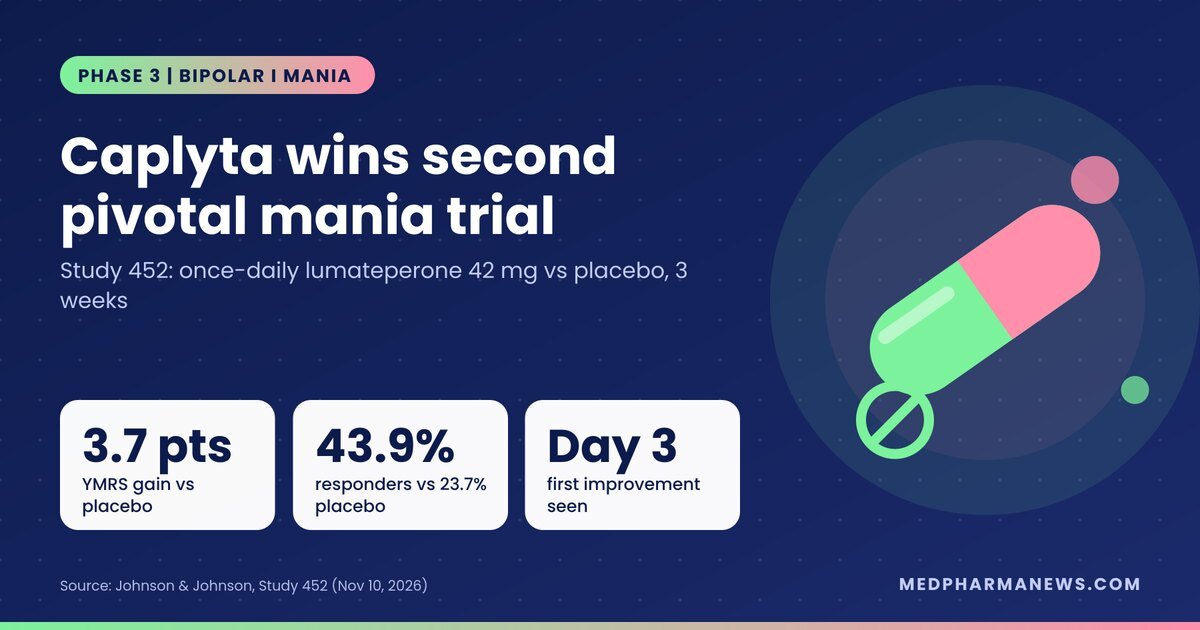
The case for Caplyta bipolar mania approval just got its second leg: Johnson & Johnson said on November 10, 2026, that once-daily Caplyta (lumateperone) 42 mg beat placebo in Study 452, its second pivotal Phase 3 trial in adults with manic episodes of bipolar I disorder. Caplyta cut Young Mania Rating Scale (YMRS) scores by 3.7 points more than placebo at Week 3 (P<.0001), and J&J now plans to file with the FDA using both Study 451 and Study 452.
Key takeaways on Caplyta bipolar mania results
- Study 452 met its primary endpoint (YMRS change at Week 3) and its key secondary endpoint (CGI-S severity).
- 43.9% of Caplyta patients were responders, versus 23.7% on placebo.
- Improvement showed up by Day 3 in both pivotal studies.
- The effect in Study 452 was smaller than in Study 451 (effect size -0.43 vs -0.69).
- A US filing is planned; J&J has not given a date. Caplyta is not yet approved for mania.
Two pivotal studies, side by side
The FDA generally wants two adequate, well-controlled trials for a new indication, and J&J now has them. Both studies were three-week, randomized, double-blind, placebo-controlled trials of the same 42 mg dose in adults with manic episodes, with or without mixed features. Comparing them shows a consistent direction but a noticeably different size of effect.
| Measure (Week 3) | Study 451 (Sept 2026) | Study 452 (Nov 2026) |
|---|---|---|
| YMRS gap vs placebo | 4.8 points | 3.7 points |
| Effect size | -0.69 | -0.43 |
| Responders, Caplyta vs placebo | 45.8% vs 20.9% | 43.9% vs 23.7% |
| Responder gap | 24.9 points (by our calculation) | 20.2 points (by our calculation) |
| CGI-S gap vs placebo | -0.5 (P<.0001) | -0.41 (P=.0003) |
| Registry ID | NCT06462586 | NCT06462612 |
Neither release disclosed how many patients were enrolled, which limits how far outsiders can judge the precision of these estimates. A difference in effect size between replicate trials is common in psychiatry, where placebo response varies by site and region; the higher placebo responder rate in Study 452 (23.7% versus 20.9%) is one likely contributor.
Tolerability is the selling point
Mania is already treatable with lithium, valproate and several atypical antipsychotics, so a new entrant has to win on something other than raw efficacy. Caplyta’s pitch has long been tolerability: in its approved indications it has been associated with low rates of weight gain, metabolic change and movement side effects compared with many older antipsychotics. In Study 452, the side effects seen in at least 5% of patients and at least twice as often as placebo were dizziness, dry mouth and somnolence or sedation. In Study 451 they were dry mouth (7.9% vs 3.4%) and nausea (7.9% vs 2.3%). J&J describes discontinuation rates as low in both.
What the releases do not include is the weight, glucose, lipid and movement-disorder data from these mania studies. Those numbers, typically reported in full presentations or the FDA label, will decide whether the tolerability argument carries over to a population that often needs higher-intensity treatment.
The commercial logic for J&J
Caplyta came to J&J through its roughly $14.6 billion acquisition of Intra-Cellular Therapies, completed in 2025. The drug is already approved for schizophrenia, bipolar depression (bipolar I or II, alone or with lithium or valproate) and, more recently, as an add-on treatment for major depressive disorder. Adding mania would give it coverage of both poles of bipolar I disorder with a single once-daily capsule and no titration at the 42 mg dose, a simple message for psychiatrists who currently switch or combine drugs as patients move between episodes.
It also gives J&J a lifecycle story for a product that sits at the centre of its neuroscience franchise. Competitors are not standing still: smaller developers are running their own mania programs, as we covered in Rapport’s Phase 3 bipolar mania plans, and long-acting injectables continue to expand in schizophrenia, such as Teva’s monthly Weltruza.
Caveats before reading too much into it
- Both readouts come from company releases and conference posters, not peer-reviewed papers.
- Three weeks is the standard acute mania design, but it says nothing about relapse prevention or maintenance.
- No head-to-head data against lithium or other antipsychotics exist in these studies.
- Effect sizes in the -0.4 to -0.7 range are in line with established mania drugs, not clearly superior.
What to watch next
The next milestones are the supplemental filing itself and FDA acceptance, which would set a decision date roughly ten months later under a standard review. Fuller metabolic and movement data, and any peer-reviewed publication of the two studies, will shape how quickly psychiatrists adopt the drug for mania if approved. Study 452 was presented as a late-breaking poster at the NEI Fall Congress in Colorado Springs, held November 5-8.
FAQ
Is Caplyta approved for bipolar mania?
Not yet. It is approved for bipolar depression, schizophrenia and as an add-on for major depressive disorder. J&J plans to seek FDA approval for manic episodes of bipolar I disorder.
How well did Caplyta work for mania?
In two Phase 3 trials, Caplyta reduced YMRS scores by 4.8 and 3.7 points more than placebo at three weeks, with improvement seen from Day 3.
What are the common side effects of Caplyta in mania trials?
Dizziness, dry mouth, sleepiness or sedation, and nausea were reported more often than with placebo across the two studies.
When will the FDA decide on Caplyta for bipolar mania?
No date is set. A decision timeline will follow once the FDA accepts J&J’s submission, which has not yet been announced.
More drug development news in our Pharmaceuticals section.
Sources: Johnson & Johnson Study 452 release (November 10, 2026); Study 451 release (September 2026). Not medical or investment advice; do not change any medication without talking to your doctor. Last updated: November 11, 2026.